
Food couriers were hailed as “unsung heroes” during the lockdown. Did we see them more as a symbolised function than humans before?
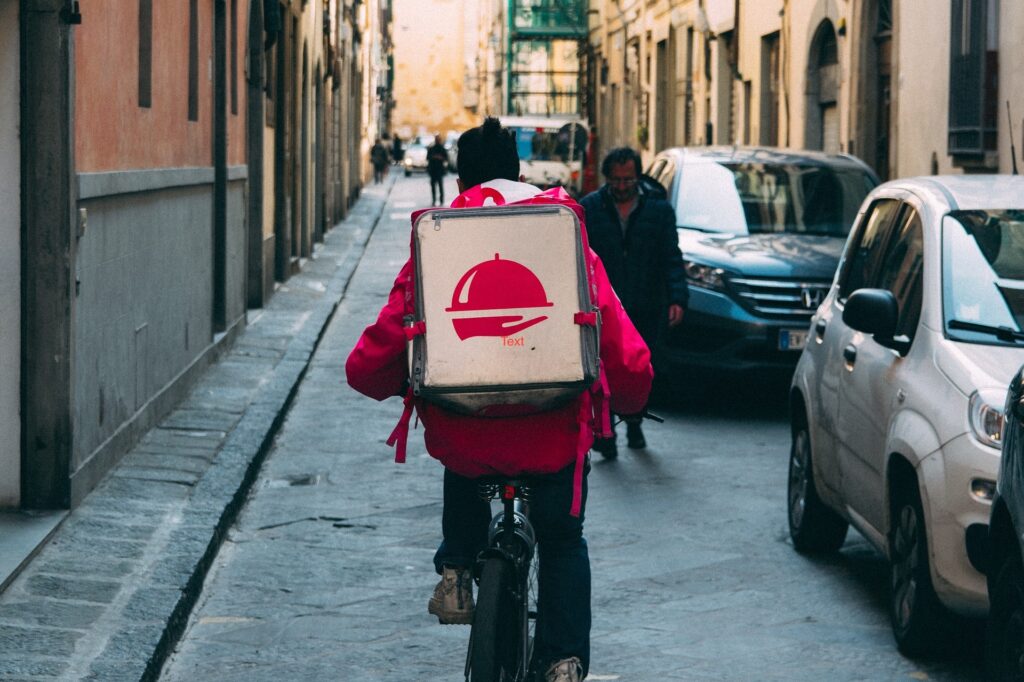
COVID seems to be an opportunity for us to see the world for how it really runs: us being able to stay in isolation and live with unchanged fundamental qualities relies on countless people working to keep the system going — supermarket workers, NHS workers, postmen, care workers, binmen and food couriers. The dialectical and cynical interpretation is: in normal circumstances, they are others that we fail to see as human, for they have been, in a greater sense, symbolised as a service, a function, a cog in the machine.
Are we becoming more indifferent? The dilemma is: we do feel and express our fury and pity for food couriers being exploited online (see the Twitter result for ‘Deliveroo/Uber Eats/Just Eat exploit’], but at the end of the day, our direct interest in when our food will arrive and why stuff is missing will still override any interest in the life-stories of the person making it happen.
It seems like our imaginations of others are dissolved in “paying for a service”. Jonathon Nunn, the editor of the food newsletter, Vittle, and a former Uber Eats courier says by taking out, “anything extraneous to making quick profits — decor, location, front of house staff, anything that cultivates hospitality in a restaurant” — delivery apps streamline the restaurant to a faceless entity solely about delivering a service: the selling of food. And when a courier arrives at your front door, there’s no need for interaction other than just taking the food and a formulaic thank you.
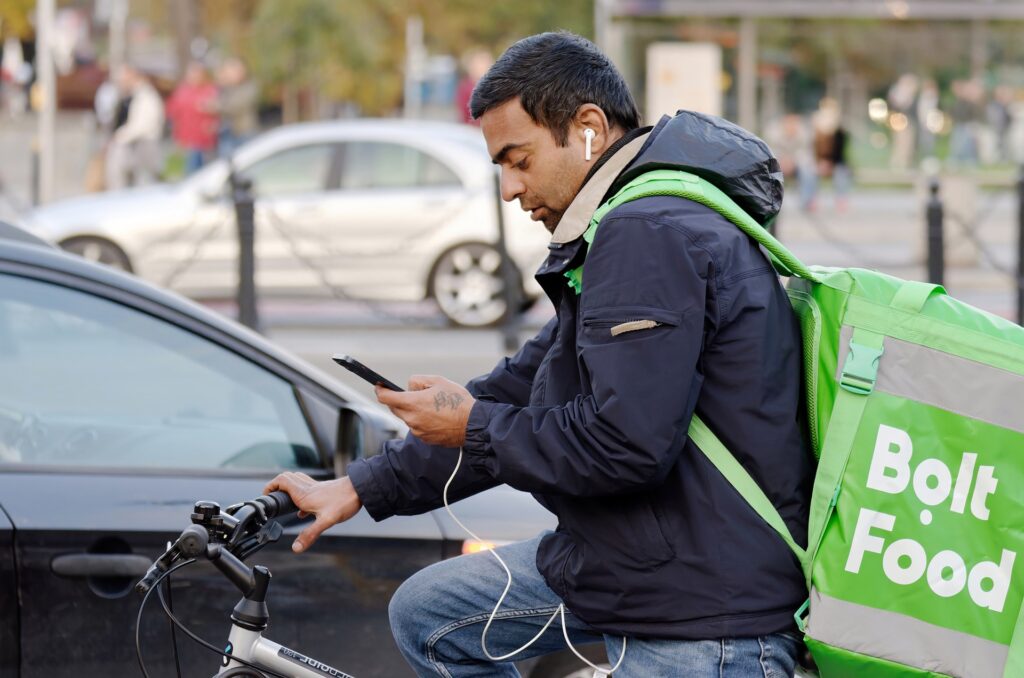
Our unquenchable thirst for the easiest life possible, and the aim of the delivery apps to fulfil it, “come at the expense of all these relationships [between the customers, the restaurants and the couriers] which have been reduced entirely to their transactional nature”, says Jonathon.
The reason he never uses delivery apps, he told me, is that he thinks: “The restaurant is really one of the last spaces where people come face to face with the people who are providing them with labour. Slowly, every social interaction has been chiselled away — booking apps so you don’t have to ring up and speak to someone, delivery services so you don’t need to speak with front of house, dark kitchens so back of house is even spatially hidden away.”
A theory about the uniforms of a company is proposed in Ken Loach’s film, Bread and Roses(2000): they “make us invisible”. Twenty years after, our modern world has taken one step further, making the labour truly invisible but under surveillance — “the working people just become a little tracker on your screen”, says Jonathan.
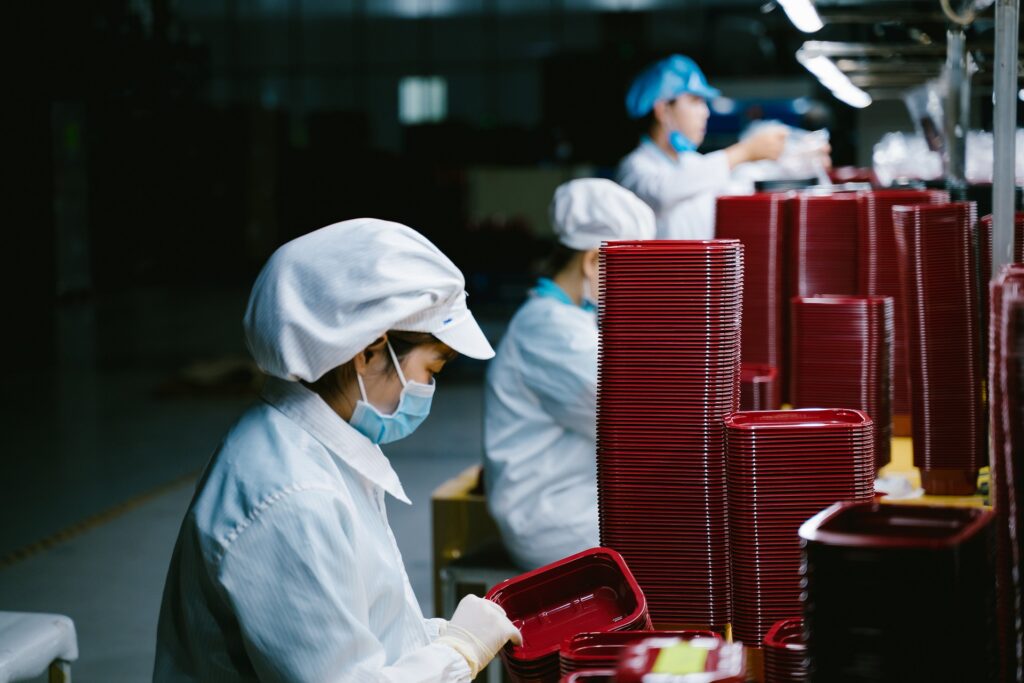
The writer, Barclay Bram uses “frictionless” to describe this form of digital ease and points out: alongside the convenience, “we have this massive loneliness pandemic”. “As much as we gain, we also have to understand what we lose,” says Barclay, “The more these platforms take over, the less you feel a part of it, you’re just an atom in that system.
“By creating these kinds of platforms, and turning workers into their own kind of mini brand, working individually for the algorithm, you stratify that work so much.” And somehow in the name of the division of labour, absolute inequality gets naturalised.
“It all comes down to this…” says Barclay, at the end of our interview pointing at one guy with his bright blue Deliveroo bag. He is hunching over on the edge of a flower bed, waiting to pick up an order from the restaurant across. “He’s not being paid right now, but he’s at work, right? And I’m at work right now. I stepped out for coffee, but I have a salary and that’s really powerful. It means that there’s some sense of protection about what I do, and value and respect. But everyone should have that. All jobs should look like that on some level.”
By binding the self-employed status of the courier to notions like “voluntariness” and “reciprocity”, Deliveroo has managed to erase holiday pay, sick pay, fuel and vehicle costs, and payment for any time the courier isn’t spending on delivering. The company is famous for providing flexibility and not paying its couriers minimum wage. One-third of its couriers made on average less than £8.72 according to a 2021 survey of over 300 couriers by the Bureau of Investigative Journalism. Deliveroo insists on this sample to be “not a meaningful or representative proportion” for couriers are not required to work in an hourly pattern so the average pay should be calculated “from the moment a rider accepts a Deliveroo order until they complete the order”. Having no rights to employee benefits articulates the choice left for couriers fairly clearly during the pandemic — “go to the streets to work anyway” says Tiago Contieri, who gets a living by juggling between Deliveroo, Uber Eats, Stuart Delivery and Ryde for “you can’t make enough money” using one app in London.

Tiago, from Brazil, started working as a Deliveroo courier soon after he came to the UK in 2019 “because apparently it was a good option to start working for someone from abroad” and he says that what he makes from Deliveroo, nowadays, is around £80-90 for 10 hours working with no breaks. “It’s basically slavery working for delivery apps if you work by bicycle,” he says.
If you live in London, you wouldn’t need to order many times to notice that couriers are predominantly migrants — “this is quite different to the image that Deliveroo tried to push for a long time that young, white students would deliver your food on a bicycle” says Dr Jamie Woodcock, the author of The Fight Against Platform Capitalism, “Many of these workers are excluded from other kinds of employment. And their migration status is often one of the sources of their exploitation.”
Food couriers have finally been recognised as essential workers in the pandemic, but despite the verbal elevation, there hasn’t been any rise in their working conditions. JustEat’s subcontractor, Stuart Delivery, cut the minimum delivery pay in Sheffield by 24%, from £4.50 to £3.40 on 6 December 2021. This triggered the longest gig-economy strike by local couriers which is still ongoing to this day.
Deliveroo got its Initial Public Offering (IPO) in London in March 2021 with an investment from Amazon in the anticipation that it will stay till the end-game and become the gatekeeper of the industry. It has indeed robustly expanded its UK market share to 77% at the end of 2021 from 53% at the end of 2020. But Tiago says: “They’re paying less than they actually used to pay before, which is funny as all prices are rising in the UK. It was really rare to have a delivery fee of £2.90 in the past on Deliveroo but now it’s something normal. It used to be always more than £3.”
But there are also couriers very satisfied with the job. Shajon Hussain, worked at the Soho Sandwich factory when he first moved to the UK from Bangladesh about half a year ago before he took up the delivery work. It could take him three hours on the train and bus to work. Despite leaving home at 4 am., he was often late due to unpredictable traffic problems, which angered his boss. The job was paid approximately £1100 per month, but now he keeps a weekly income of £450-600 with Deliveroo and Uber Eats. “If it’s busy, I work. If not, I come back. It’s flexible. It’s self-employment, you know?” he says.

Either precarious flexible self-employment or stable inflexible employment, this is our common default assumption. But Dr Woodcock says, “there’s no reason why employment can’t be flexible. Apart from employers not wanting it to be flexible.”
The Independent Workers’ Union of Great Britain (IWGB) has been fighting through courts to reclassify couriers as limb (b), an existing non-binary employment status in the UK, which subjects independent workers to basic employment rights. But last year’s Court of Appeal rejected IWGB’s appeal for the fourth time, for one term in Deliveroo’s contract: it is allowed to have a different person using the same courier account, which contradicts the personal performance obligation in the definition of employees under Article 11 of the European Convention on Human Rights.
Throughout history, every tech advancement brings in a labour market reform with jobs catering to the new way of production, i.e. the interest of the factories and companies, and decades later, the workers rise up with demonstrations to articulate their interests and rights. This process sometimes needs generations to fuel up. What’s perhaps cheeringly surprising in this cycle of platform work is how it has happened incredibly quickly.
The IWGB has done incredible work winning gig workers health and safety protections, and worker status for CitySprint couriers and foster care workers, but there is little more that can be done to safeguard the rights of couriers under current domestic laws that fully allow Deliveroo to escape liability and do not take into account the nuances of gig work.

“It’s about how as a society, we can think through the bargain of work”, says Dr Woodcock, “It’s about having a political debate about whether employment law works in the way it does now, whether the tax system works for supporting people, whether labour market enforcement is working in the right way, and seeing that that kind of collective discussion and voice is what drives forward work.”
The on-demand delivery industry is aggressively expanding, copying the model to other services like grocery, laundry, manicurists, salons, parking and so on. Uberisation is happening.
As Dr Woodcock says: “If we don’t do something about it now, that model will spread out to the rest of the economy. And it’s very difficult to change things after that’s happened.”