Comedian Sam See on culture, crowd work, and why British audiences keep him coming back
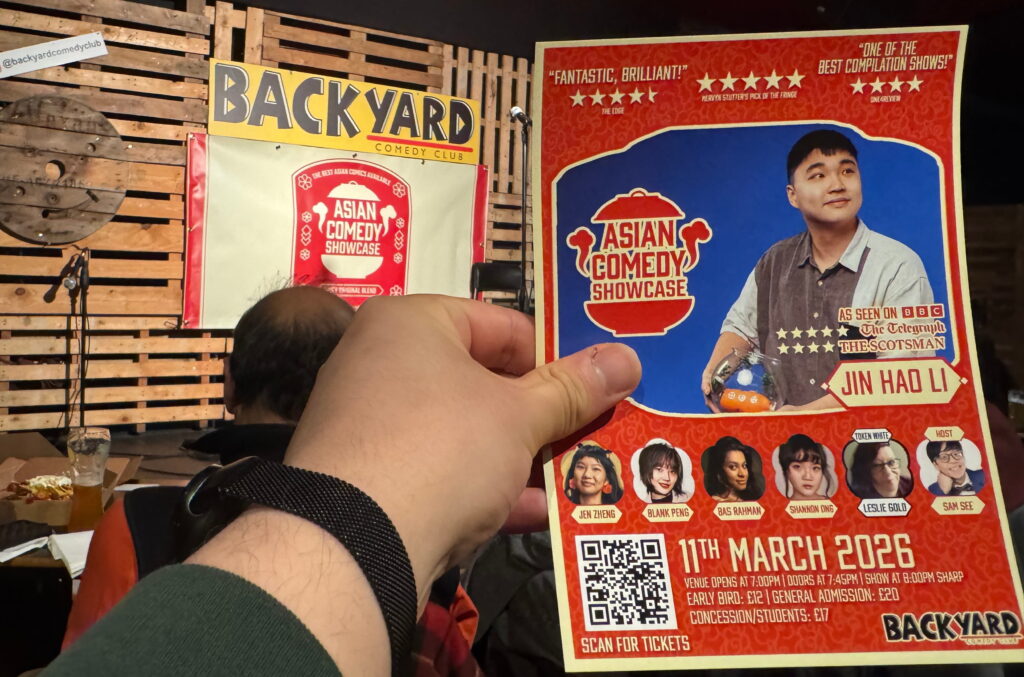
Singaporean stand-up comedian Sam See has recently made the move to the UK, bringing with him a style shaped by performing across multiple countries and cultures. As the founder and company director of Bowtie Productions, Sam created the Asian Comedy Showcase, a platform aimed at spotlighting Asian comedians within the UK scene.
Starting out in Singapore before travelling around the world and now being based in London, the COVID-19 pandemic convinces Sam that the UK is where he ought to be. “When we were all locked down, I did what most comics would do and created online shows to keep sane and financially afloat.”
Sam says that every time he booked them, “British comics would always be the most keen, most excited and most creative with their approaches to the challenges”, making “fast friends with a lot of acts”. When Sam started to return to the UK for shows, he says it felt more and more like he “fit in here better than anywhere else”.
His love of the UK, he says, “comes from the people”. “Even if a crowd is with me or against me just based on what I look like, they’ll still give me a chance.” While he admits it “won’t always be easy”, he points to a kind of openness he did not expect. “It sounds hard to believe,” he says, “but British people are much more complex and warm than they give themselves credit for”.
When asked to compare Singaporean and British comedy, Sam says “Where do I even begin?” “This is kind of like asking ‘describe the difference between a satsuma and a Kia’, there’d be too much to get through.”
What stands out most to him is how differently humour travels. As someone who has performed internationally, he supposes that “one thing I’ve realized a lot of comedians take for granted when travelling is how pop culture truly translates” when moving between countries. “It’s a staple in the US and UK, but head to Europe and Australia and your pop culture references won’t work as well, and in Asia not at all,” Sam says, suggesting this may be due to “a mix of state controlled media and an aversion to the West for reasons involving ‘Where’s my national treasures’”.
As a result, “the audience worldwide is not always set in stone, and that’s the thrill of stand-up”. Starting out in Singapore, he says, shaped his approach early on. “Most Singaporeans are not world savvy, pop culture savvy or history savvy, so unless your joke in our multiracial society is ‘that ethnicity sucks because…’, every premise needs explaining.” Because of that, Sam learns to assume nothing.
He is “slowly trained to assume the audience has not a clue about what I’m about to mention”, which means his writing becomes naturally more inclusive. As he puts it, it is “all a nice way of saying ‘I played for a lot of dumb dumbs, but it took me a while to learn how to perform for said dumb dumbs, for I was also a dumb dumb’.”
Another key part of his process is constant testing. “Unlike a lot of other live performance arts, you can’t ‘practise’ stand-up comedy. It’s reliant on an audience reaction, and without it, the whole thing can be shambolic”, citing the majority of stand-up shows on platforms such as zoom as reference for his opinion.
As such, every performance is a practice, says Sam, who is “always balancing a performance that gives audiences a great time, but also lets me make sure that the jokes are ready for the next audience.” “So if you ever see me have a bad show, it’s not that I’m a bad comic, I’m just really good at practicing.”
For Sam, London stands out for one reason above all: diversity. “I don’t go a single day here without listening to so many different languages and accents and seeing people unashamed to be themselves.” “This diversity has, in turn, brought very diverse voices to stand up,” he says. “You have the good folks over at FOC It Up at Soho Theatre and Brown Sugar at Top Secret being excellent examples.” Through the Asian Comedy Showcase, he hopes to build something similar – a space that introduces audiences to Asian acts and encourages them to explore further.
“I want the Asian Comedy Showcase to be amongst them, the go-to to start your comedy journey into Asian acts or if you are Asian, and then to explore more after that. And once they’re seen it, to return to the ACS because we have some of the best acts on the scene, and also because the host makes a mean Old Fashioned (a type of cocktail).”
When it comes to advice for comedians thinking of moving to the UK, Sam is clear: do not rush it. “The biggest advice is don’t just move here.” “The UK comedy scene works primarily on connections, who you know and, more importantly, who knows you.”
Instead, he suggests testing the waters first. “Swing by for a week or a month first, do the major festivals like Edinburgh, make friends and contacts, and once you have a taste for the UK and the network, then make the move.”
“This network isn’t just for business,” he adds. “The industry is immensely difficult, and you’re gonna need friends here who understand what you’re going through.” “I’m lucky to have made so many dear friends here who have kept me going, and I think above everything else, you need camaraderie to survive the UK.”
And adapting to life here? That, he says, comes down to something much simpler. “You need to learn how to make a sandwich and a bag of crisp feel filling to you, and develop an unhealthy love for pasties.”