Why international students adopt English names and what those choices reveal about identity, belonging and power

When people cross borders, they often change many things about themselves; such as accents, habits, and even ways of thinking. But sometimes, the first shift is much smaller and much quieter: a name. Changing your name in a new cultural context isn’t merely a practical adjustment, it is instead a symbolic act of identity negotiation, through which individuals reposition themselves within new social and linguistic hierarchies.
For many international students from China living in the UK, adopting an English name is almost a rite of passage. It appears casual, practical, even trivial. Yet behind this seemingly simple choice lies a complex negotiation of identity, power, belonging and self-definition.
This is not just about pronunciation. It is about who gets to name whom – and who gets to decide how they are remembered. More importantly, it raises a deeper question: is a name something we own, or something that situates us within systems of language, culture, and recognition?
The name as strategy

Villoter, now 20 years old, began using her English name in middle school. Unlike many children who are assigned one by teachers, she chose it herself.
Villoter, this name was inspired by a French wine and a small town – an external cultural symbol she deliberately borrowed. “It wasn’t completely made up, and it wasn’t fully connected to my personal history either,” she explains. “It felt like a label I could actively choose – something acceptable in an English-speaking context.”
What mattered to her was that the translated meaning in Chinese was gender-neutral. Neutrality meant not being immediately classified. It preserved a certain control over how she would be perceived.
Here, the act of naming becomes a subtle form of self-curation. In a context where gender, nationality, and linguistic identity are often quickly read and fixed, a name can function as a filter – revealing some aspects while concealing others. By choosing neutrality, she is not erasing identity, but suspending immediate categorisation.
For her, the English name was not merely convenient. It was a social strategy. In middle school, everyone had one. Not having an English name meant becoming “the person who needs explanation”. So choosing one was less about communication efficiency and more about reducing social friction. It was a way to avoid repeated questions, corrections, and subtle moments of otherness.
“The English name feels like a ticket,” Villoter says. “It lets you enter the group order faster, instead of staying in the position of the outsider”.
This metaphor of a “ticket” is telling. It implies that access – to conversations, to friendships, to informal belonging – is not equally distributed. Instead, it is mediated by linguistic norms and expectations. In this sense, the English name functions as a kind of cultural currency: small, everyday, but powerful enough to ease entry into dominant social spaces.
Here, naming becomes a mechanism of integration – a way of smoothing oneself into a system where English is the default linguistic authority. But this smoothing is not neutral. It reflects an asymmetry: the burden of adaptation falls disproportionately on the non-native speaker.
Choosing an English name, besides just a personal preference, it is a response to an environment that subtly rewards familiarity and penalises difference.
The name that grew with me

For Dora, 19, the story unfolds differently. She did not choose her name. It was given by an English teacher in kindergarten during an after-school class in China. “I didn’t think too much about it back then,” she recalls. “It was just part of the class.”
At that time, the name carried little meaning. It was part of an academic routine – one of many small practices through which English education is normalised in China. Names, in this context, are often distributed rather than chosen, functioning as tools for classroom interaction rather than identity markers.
But the name stayed. Through primary school, international middle school, high school, and eventually university in the UK, Dora accompanied her. Over time, it ceased to feel assigned and began to feel owned.
Unlike many international students, she never experienced pronunciation issues. The spelling was simple, and the name was widely recognised.
With the name not being difficult to pronounce, it enabled Dora to integrate seamlessly into everyday life. Because of this, she became deeply embedded in her routines – on parcels, emails, food delivery apps, and social media accounts. Friends in China call her Dora, too.
“I don’t feel like I’m switching identities,” she says. “It’s not a Western version of me. It’s just me”. For her, identity does not split across languages; it expands. Her Chinese name connects her to family and cultural roots. Dora connects her to international education and adult independence abroad. The two coexist without contradiction.
This challenges a common assumption that adopting an English name necessarily involves loss or erasure. In Dora’s case, the name accumulates meaning over time. It becomes less about origin and more about usage – shaped by relationships, experiences, and repetition.
In this sense, her English name is not an imposed layer but an evolving archive. It documents growth. It traces movement across spaces. It marks transitions from childhood to adulthood, from local to global contexts.
Rather than dividing identity, it records becoming.
I am me, whatever you call me
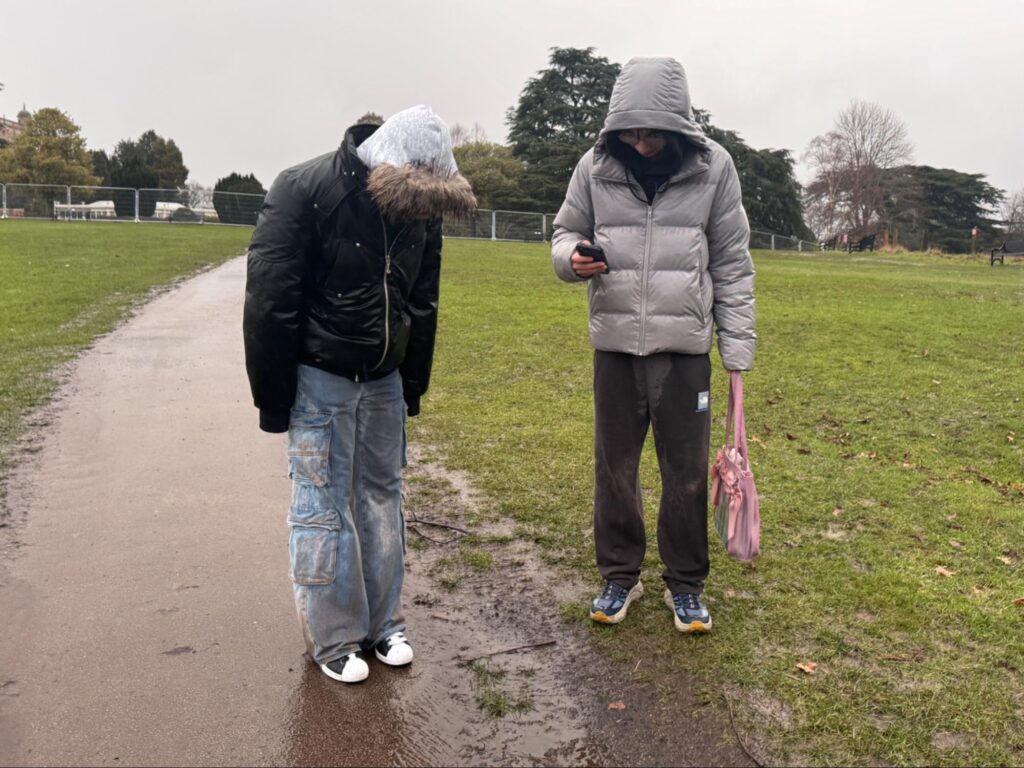
Raven’s experience shows another story of what a name means and how it affects your self-perception.
Unlike Villoter, her English name was not self-chosen. Unlike Dora, it was not given by a teacher. It was given by his parents at birth, alongside her Chinese name. The Chinese characters combine elements from both parents’ names, and its sound was transliterated into Raven.
In China, she mostly used her Chinese name. In the UK, she uses Raven for practicality. “I usually just let people call my surname or Raven,” she says, “I don’t really have the experience of being mispronounced.”
But what stands out most in her responses is a striking detachment from the politics of naming. “I don’t think many people need to know what my name is. They just need to know who I am.”
She does not experience a switch of identity. Even when speaking English requires extra cognitive effort, she sees it as a matter of language proficiency rather than identity. “No matter what people call me,” she says simply, “I’m still me”.
Her position introduces an important counterpoint. While much discussion around names emphasises power, representation, and cultural negotiation, Raven’s perspective resists over-interpretation. For Raven, a name is a fundamentally functional tool of address.
Only close friends use her full Chinese name. But that intimacy is relational, not existential. It reflects closeness, not identity fragmentation.
In her narrative, belonging is not secured by pronunciation accuracy or cultural adaptation. It is secured internally. This perspective does not negate the structural dynamics observed in other cases, and instead complicates them. It reminds us that individuals do not all experience cultural systems in the same way. Agency can also take the form of indifference.
Between Public and Intimate Spaces
Across the interviews, a subtle distinction appears between public and intimate spaces. The first interviewee describes her English name as a “tool-like outer shell”, while her Chinese name is the “real entrance” in close relationships. Being called by her Chinese name feels like being truly seen.
Here, the difference between names is not just linguistic but emotional. One facilitates interaction; the other signifies recognition. The English name enables participation in broader social systems, while the Chinese name anchors personal identity and affective connection.
Dora experiences expansion rather than division, yet her two names still map different dimensions of life. One is associated with global mobility and independence; the other with continuity and origin.
Raven sees naming as secondary – but even she notes that only close friends use her full name. This shows that names still shift depending on context, shaping how we move between spaces – classroom and home, public and private, stranger and friend.
Adopting an English name, then, is not just about convenience. It sits within wider expectations around language and culture. A name may seem small, but it carries weight – it is one of the first things we offer to others, and one of the first things used to place us.