From her Guerlain heritage to bottling the essence of London, Patricia de Nicolaï explores how fragrance shapes our identity in motion
Patricia de Nicolaï occupies a defiant position in the world of haute parfumerie. As a descendant of the Guerlain dynasty and a former president of the Osmothèque – the world’s largest scent archive dedicated to the preservation of olfactory history – her mandate is not merely to create, but to preserve and strategically interpret heritage.
Her connection to London is deeply visceral; she recently captures the city’s essence through an exclusive fragrance for Harrods. Translating the atmosphere of this emblematic British institution into a scent, de Nicolaï creates a sensory bridge between French savoir-faire and London’s historic luxury. As a woman working globally, she understands that while the physical places we inhabit may lack permanence, they maintain a profound connection to us through our olfactory identity.
Culture shapes more than arts and attitudes; it fundamentally shapes scent. For de Nicolaï, the act of perfuming oneself is a way to share a sensory dialogue with those around us, anchoring identity even in constantly transitioning environments. For the cosmopolitan London explorer seeking meaning in movement and discipline amid cultural flux, she offers a philosophical guide to navigating identity through the invisible architecture of scent.
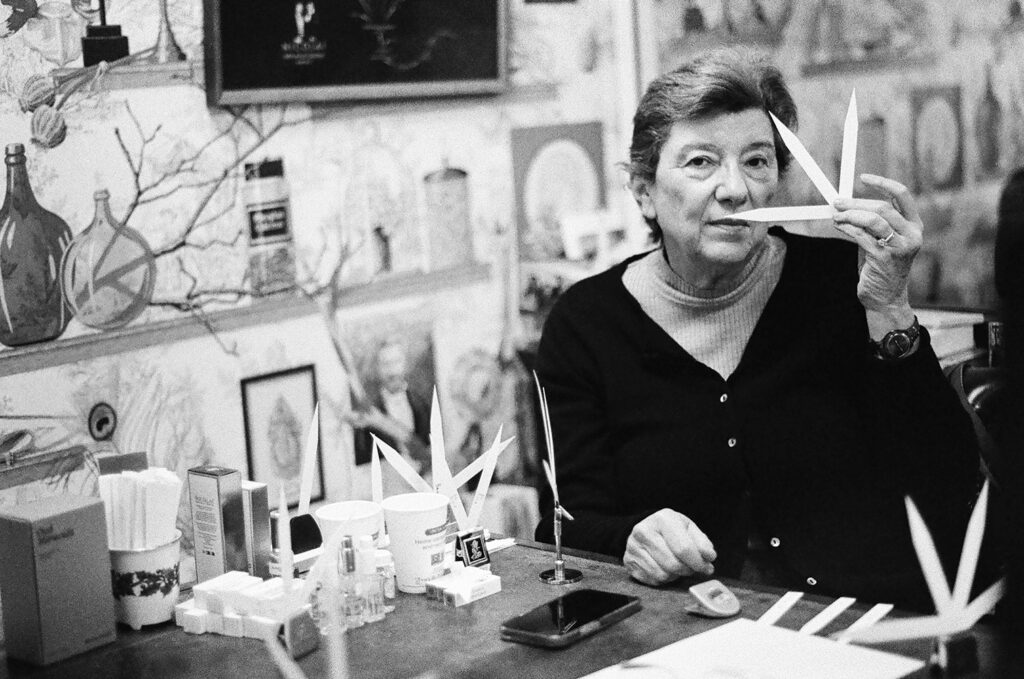
Interlude: You have captured the essence of iconic spaces, most recently with your exclusive fragrance for Harrods. What does it mean for you to translate such an emblematic British institution into a scent?
de Nicolaï: It is a gesture of cultural resonance. Harrods embodies a deeply British tradition of luxury, and inscribing an independent French signature there is almost like a conversation between two heritages. It strengthens the reach of French savoir-faire while confronting it with a highly sophisticated international market.
Patchouli carries a complex history, from 19th-century luxury to 1970s counterculture. How do you approach working with such a layered material for a contemporary London audience?
London is a city of layers, ambivalence and contrasts, exactly like patchouli. I respect its depth without turning it into a cliché. I clean it up, polish it and work on its shadows and lights. The goal is a modern patchouli that evokes both opulence and insolence without nostalgia.
If perfume is a form of non-verbal communication, what can it reveal more sincerely than words?
Perfume reveals a vulnerability that language tends to soften. It expresses gentleness, fear, strength or hope without detours. For someone in transition, in movement or in transformation, it becomes a private anchor and a silent affirmation of self, even before words take shape.
If you had to compose the ‘Scent of Arrival’ for the independent London explorer, which foundational material would you choose?
I would choose a dry, light wood, perhaps a modern cedar. It is a vertical, reassuring material that suggests determination. Around it, I would add soft, almost airy musks to offer a protective gentleness. Arrival is a moment suspended between momentum and calm; the fragrance should give shelter to that emotion.
Perfumery is often described as a form of invisible architecture. How do you transform a fleeting olfactory intuition into a stable, intentional structure?
For me, an olfactory intuition is a raw emotion that needs to be tamed. I begin by identifying its main axis: its density, colour and pace. Then I build a frame for it, a structure that will withstand the test of time. A lasting perfume is born at the meeting point between instinct and discipline: one gives it life, the other gives it a skeleton.
Total creative independence comes with strategic challenges. How do you turn those into strengths, particularly regarding raw materials or distribution?
Independence means that every decision rests on my shoulders. It is a real weight, but it allows me to avoid compromise. Trends do not constrain me; I can defend that Nicolaï’s signature is coherent and sincere, even when it diverges from dominant fashions.
Does the Guerlain heritage function for you as a burden or as a dialogue with tradition?
Never as a burden. It is a dialogue, sometimes demanding, always stimulating. My heritage taught me rigour, clarity and exacting standards. But to honour that school, I had to find my own house and follow my own path. Respecting tradition means having the freedom to interpret it.
Having formerly served as president of Osmothèque, how does the preservation of perfume history influence your current creations?
My involvement with the Osmothèque has always reminded me of the fragility of olfactory heritage. It pushes me to compose with a long-term vision in mind. A perfume that aspires to become a classic must be built with precision, honesty and humility. I always ask myself: “What memory will this fragrance leave 20 years from now?”