
Written by Lia Keeble Otero
When love refuses to make sense, oracle cards offer something it can’t: clarity. For Aleysha, every relationship begins – or ends – with their approval.
Sacha lays out three cards: Reconsider. No. Unlikely. The answer is immediate.
“No.”


There is no hesitation in the reading, no ambiguity in the outcome. The cards do not explain his behaviour, nor do they soften it. There is no condemnation of his character, just clarity. The kind Aleysha has been seeking for years. For the first time, the flame is named not as fate, but as distraction.
The room is already prepared. Candles flicker against drawn curtains, the deck placed deliberately at the centre of the bed. Ambient music plays softly in the background, instrumental and atmospheric, the kind that suggests something significant is about to be revealed.
The process unfolds with familiarity. The shuffling, the pauses, the exchange of glances. This is not a spontaneous act of belief, but a ritual sustained over time. Weekly readings have created rhythm – a shared language refined through repetition, built over years of friendship.
Aleysha Chambers, 21, is a business and finance student at Regent’s University, living in West London and working part-time alongside her degree. She has been officially single her entire life. She says this plainly, without irony or apology, as though it is simply a technical detail rather than a personal failure. The word single, however, does not account for the amount of love she has experienced.
Her first serious attachment began at fourteen – an on-and-off relationship that never quite aligned. “It was always intense,” she says. “We were never on the same page at the same time.” Since then, there have been others: emotionally intense encounters that arrive suddenly, demand attention, and disappear before anything stable can form.
Aleysha is business-minded, academically focused, and acutely aware of time. She does not believe in wasting it, especially not on men who do not align with her values.
“I date to marry, if it’s not going somewhere, I don’t see the point.”
This is where the cards come in. She does not pursue romantic connections without their approval, nor will she reply to a message, agree to a date, or emotionally invest unless the cards give her permission to proceed.
For Aleysha, they act as a filter – a way of eliminating the ones that do not meet her standards before time is wasted.
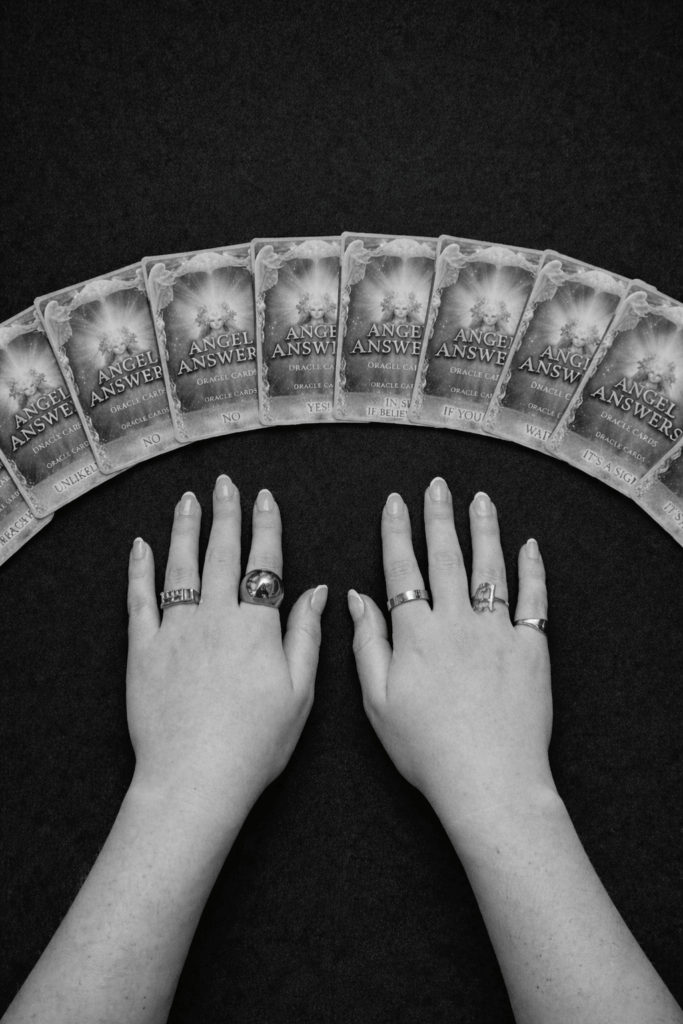
Oracle cards are less about prediction and more about approval. Unlike tarot, they follow no fixed structure or universal meaning; each deck operates according to its own internal logic, offering phrases rather than prophecies. A reading begins with an intention, followed by a small number of cards pulled intuitively and interpreted collaboratively. Rather than determining the future, they reflect emotional readiness, alignment, and timing.
In practice, the ‘Angel Answers’ oracle deck, produced by spiritual publisher Hay House, functions as a pause in moments of romantic uncertainty, suggesting when to wait, when to act,
and when to disengage. For those who trust it, like Aleysha, it does not make decisions, but legitimises the ones already forming.
Sacha Rivoire, 21, also studies at Regent’s University and has been reading oracle cards for years. She does not describe herself as mystical. Her tone is measured, almost clinical. She insists she does not tell people what to do, only interprets energy.
“People already know the answer, the cards just help them see it.”
People come to her when their emotions are louder than their logic. Most of the questions are about love. Clients, she explains, rarely want answers. They want reassurance. The cards do not reveal anything new, but instead reflect what the person already knows but is not ready to admit. In that sense, they are less predictive than permissive.
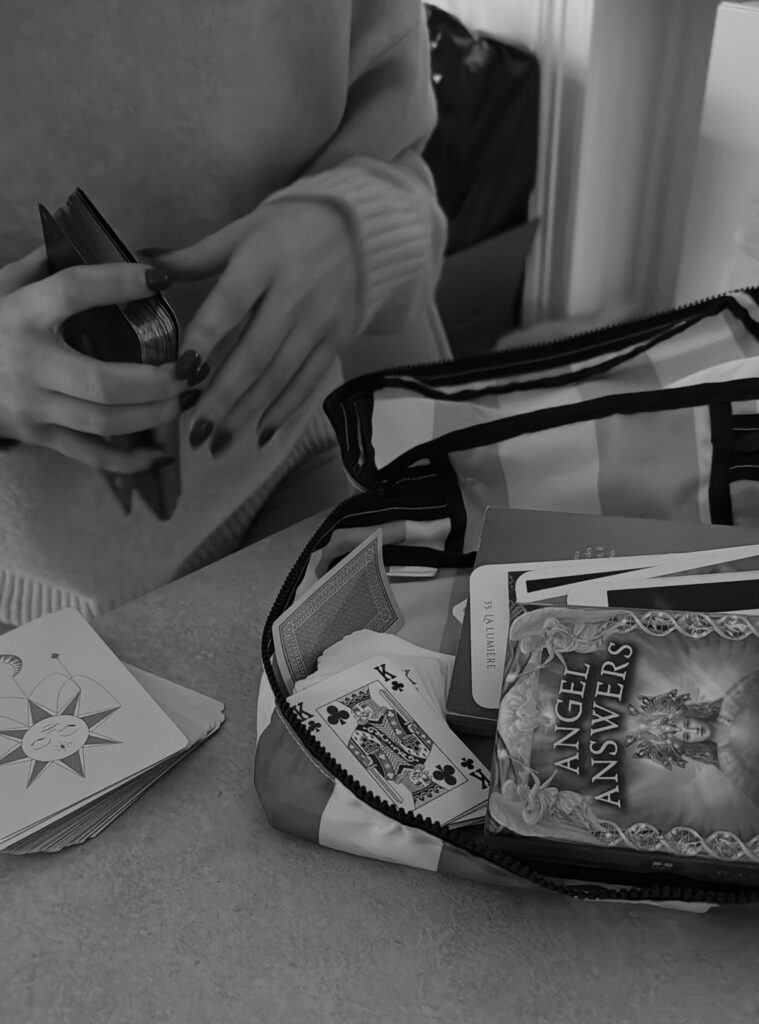
She has been reading for Aleysha for years. Best friends for nearly a decade, they have moved through school, countries, and relationships together. The readings began in their mid-teens, becoming routine as romantic complications intensified. Weekly at first, they now happen as often as needed – more frequent when emotions escalate, less when life feels steady.
The reading does not concern a new love, but an old one – the recurring presence she has known since she was fourteen, appearing just often enough to remain unresolved, each absence leaving more questions than answers.
This time, the question is simple: what are his intentions? What action, if any, should she be taking? As the cards are shuffled, Aleysha twists her hair absentmindedly around her fingers, her gaze fixed on the deck. “What do you need to know?… Is he worth my time?” It is not the first time the question has been asked. Only the first time has it been answered so definitively.
“Men have
let me down,
the cards
never do.”
The resurgence of oracle cards is not happening in isolation. Their popularity mirrors a broader Gen Z search for meaning in a dating culture defined by ambiguity, situationships, soft launches, and emotional half-commitments that rarely come with explanation or closure.
During the pandemic, tarot and oracle readings surged across TikTok, often framed with captions like “if this finds you, it’s meant for you.” For many, the messages felt uncannily specific – a reflection of both algorithm and emotion.
In a time when romantic outcomes are rarely clear, the cards provide what many relationships do not: a sense that events unfold for a reason, even when they do not last.
Aleysha wants to be married by twenty-five. This is not a vague aspiration, but a logistical plan. She has already chosen the venue, the ring, the dress, and the guest list. The only missing element is the groom. “The man is not the most important part. What matters is alignment, values, intention, and timing. The rest will arrive when it is meant to.”
The cards, in this context, are less romantic than they are strategic. They do not help her fantasise about love; they regulate access to it. She does not wait to be chosen. She consults a system that decides whether someone is worth accommodating into a life plan that is already complete. For her, marriage is inevitable. The mystery, apparently, is optional.
The reading unfolds with practised ease. The gestures are familiar, repeated over years of shared experience. Whether it is faith or simply a method of managing uncertainty remains unclear. What is visible, however, is the function it serves. The cards are never pulled alone. They sit between friends, between doubt and hope, between impulse and restraint. Less a search for answers than a shared way of navigating uncertainty. When the reading ends, the candles are blown out. The deck is put away. Life resumes. Aleysha does not text him that night.
The cards do not approve.