
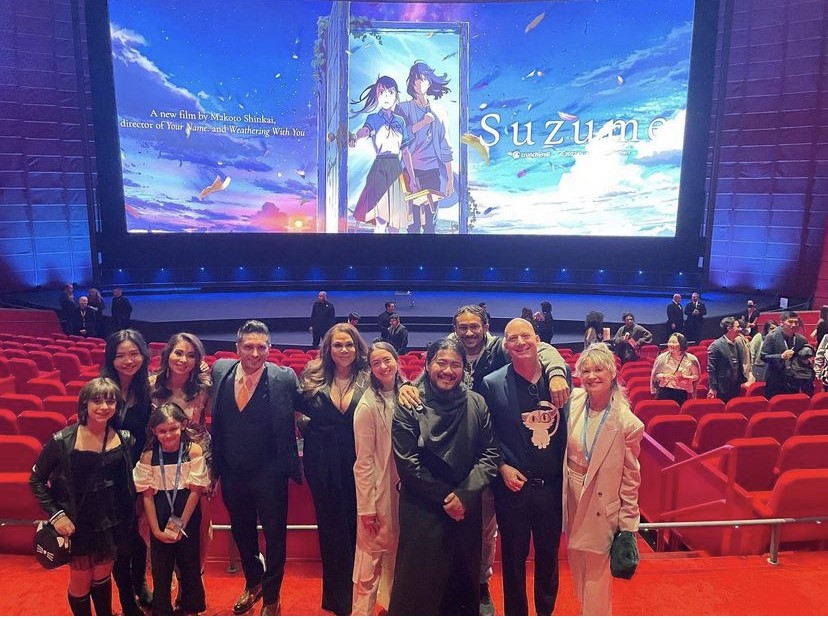
Makoto Shinkai’s latest film Suzume delves into the Japanese psyche more than his previous films, Your Name and Weathering With You. Suzume follows the eponymous teenage girl, Suzume, as she embarks on a journey to close the mysterious doors that have unleashed chaos across Japan. As Suzume travels northbound, the unclosed doors become a metaphor for the national trauma of the devastating 2011 Tohoku earthquake. The film premiered in April and has grossed $300 million worldwide. Dubbing the film to English, with a sensitivity to the language and themes of the film, has played a big part in its ability to connect with a global audience.
Dubbing anime films usually starts with an adaptor who translates the lines of every scene in the original film. The challenge comes when the dubbing team delves into the specific parts, like how to make a natural translation to express the meaning of the Japanese language and when to add layers of emotion to better portray the animated characters.
Dubbing can be controversial; some fans see it as watering down the original. But there is an art to translating the “purity of intentions” between Japanese and English, which Bill Millsap is attuned to. Because the film revolves around a profound topic tightly linked to Japanese culture, getting the matched intentions of what the characters say is of utmost importance. The film is the most emotionally challenging film Bill has worked on: “Suzume hits deepest out of all the projects I’ve worked on thus far,” he says. “It is a love letter to that moment when people learn to say goodbye to somebody they have lost. No previous project has been more emotionally tipping as Suzume.”
“I want to honour anime to a point where it’s drawing in new audiences”
Bill Millsap
Bill explains how dubbing is a way to extend these emotions to a wider audience: “One of the things I’m delighted to hear is, when people watch the projects I’ve worked on, they’re connecting to the material deeply,” says Bill. “As someone who loves anime, I want to honour it to a point where it’s drawing in new audiences.”
As anime is rooted in Japanese culture, Bill sees his dubbing as a way to make more people fall in love with the “delicacy” of Japan: “I have been blessed to direct dubs that are very personal. They have to do with love, loss, acceptance, sexuality, and each project really digs deep into human connections in their own way,” he says.
Dubbing requires great sensitivity to language. For instance, the phrase “Itadakimasu” is constantly said throughout the film as Suzume connects with people along her journey. As the phrase expresses feelings of gratitude, reverence, and delight before a meal, Bill was keen to dub “Itadakimasu” in a way that truly speaks and implies the innate meaning of the Japanese language. “Itadakimasu” is such a subtle greeting that there is no direct translation but only an earnest intention. These are small yet tender moments in the film that Bill finds mesmerising, as the words are full of meaning and emotion — something you can’t achieve through direct translation.
To honour the film, Bill argues for the importance of originality in the dubbing process: “Dubs do not need to copy the original performances, but the intention of the storyline and the intention behind what the characters are saying needs to be pure,” he says. “For people who are not familiar with the cultural differences, being able to get the purest intention for things that can’t be translated is super important to me.”
“We all have our own tragedies that stay with us due to their severity and the impact they have on us individually and collectively”
Bill Millsap


Suzume is about trauma on both a national and personal level. Suzume lost her mother in a tsunami. Bill explains: “Everything that’s tied in with Suzume surrounds that incident — that horrifying moment on March 11, 2011.” The Tohoku earthquake and the tsunamis that followed have fundamentally altered Japanese culture. However, many nations have a collective trauma of a disastrous event that reshaped society. Therefore, he sees the emphasis on disasters as a universal experience crucial for a global audience to relate to the film. “We all have our own tragedies, and these moments stay with us due to their severity and the impact they have on us individually and collectively,” Bill says.
Taking this universal principle into account, Bill is keen to show that the dubbing conveys the intentions of Shinkai’s underlying message: “It’s important to create a bridge of understanding and empathy. Because everybody can relate to loss, good, evil, and the grace in between,” he says, “I just want to make sure that we relate through the lens of Japanese culture, which is where this film was created.”
Whilst Suzume is closely tied to Japanese culture, it’s also a film with universal themes of love, loss and humanity that transcends culture and borders.

Jennifer Sun Bell is the voice actor who plays Suzume’s aunt Tamaki, and the character resonated with her deeply: “I remember watching one scene of Tamaki in the film and crying because I just connected to her… Tamaki is a mother, but she’s also complex, and that’s all of us. She’s doing her best to provide Suzume with everything she can,” she says. “A lot of the things Tamaki goes through and feels emotionally are real for me because I am a mother and an aunt. I just needed to let my emotions flow because, as a mom, you feel you’re doing your best, but sometimes you feel like it’s not enough, and you just have to persevere.”
Jennifer argues that this is what beautiful storytelling is: “If we all found a little of something to work on, to forgive and to love, then the story succeeds in its aim to bring laughter, joy and connect people.” Suzume is a film that “honours the loss and the beauty of coming to terms with loss,” says Bill – a message that transcends any cultural differences that exist.