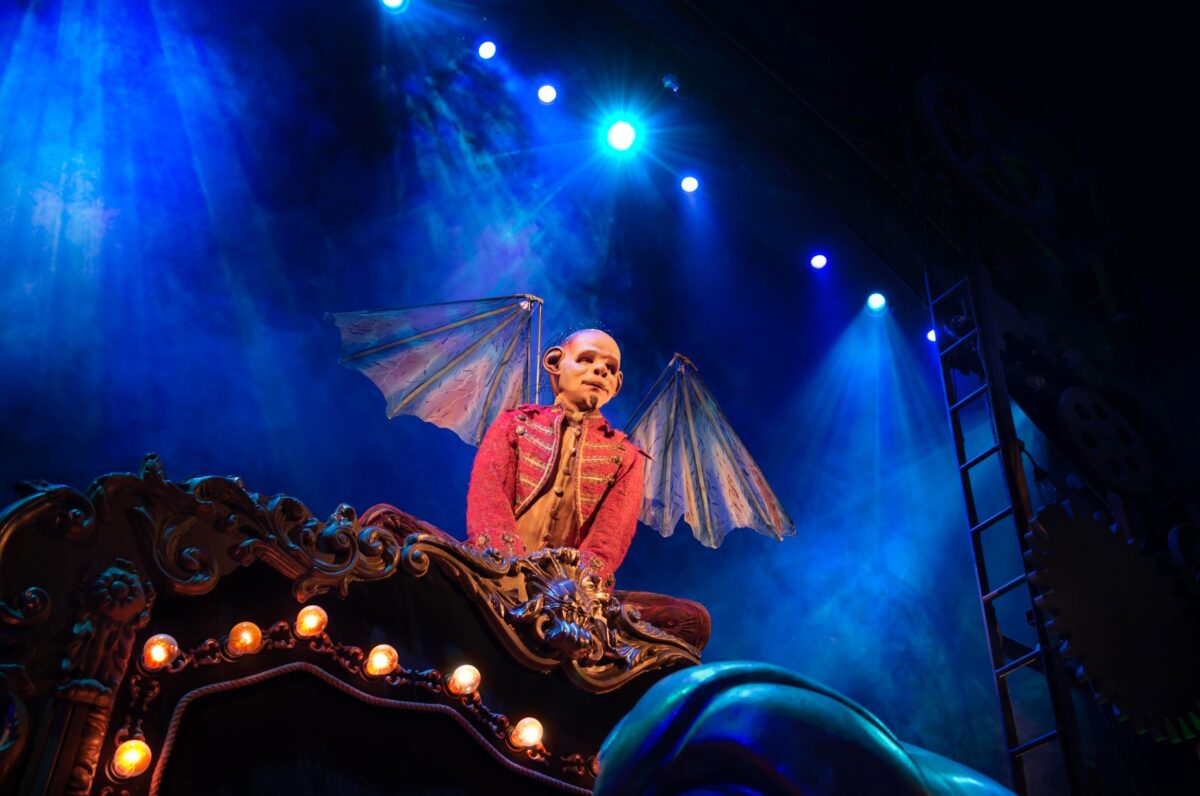
It was 17 years ago when the Wizard of Oz prequel musical, Wicked, came to The Apollo Theatre in London. The show, full of witches, wizards, munchkins and talking goats, has lived there ever since. Alongside of course, their essential team of flying monkeys. The monkeys provide some of the most interesting choreography in the show, with their elaborate costumes and primate-inspired choreography. Conor Ashman leads this team in his West End debut.
You play Chistery, the lead flying monkey. He is first seen as a servant to The Wizard until Elphaba is tricked into cursing the monkeys with wings, ultimately freeing them from their subservient role. What does your onstage action mostly consist of?
Lots of climbing! The first time you see me I’m clambering down a rope center stage. Then, I’m always up and down the towers and down some more ladders later on. As well as, of course, dancing. It’s pretty strenuous!
What was the audition process like for this role?
So, it was over three weeks in total. We did an initial dance round, and I got recalled. On that recall, I did a snippet of one of the routines. Then I got recalled again for a long day with partner work and singing rounds. At the end of that day, we learnt the monkey stuff. Then they take you onto the actual stage and that was mad! It’s raked (when a stage is at a slant) too, which made all the routines back to front. Yeah, the audition for Wicked was pretty rigorous!
What do you think made you stand out from the rest?
I had no fear of being a fool. I told myself: “You’re the one who wants to be a monkey.” So, I was just dropping my preconceptions and going for it. I remember thinking I’m just going to enjoy it, and that allowed me to approach it in a really different way.
When did you first find your love for musical theatre?
I started dancing when I was three. Both my sisters danced and they needed a little boy to carry some rings in a ballet show – apparently I just never wanted to leave. My first love of musical theatre came from watching Gene Kelly. My Nan showed me Singin’ in the Rain and I fell in love; it’s still my sick day movie. When I got older, I realized this could be a real job.
The flying monkeys are such an iconic image within Wicked. What did it feel like getting the call to say you got the part?
Before doing it, I had seen the show 10 times. The role is a dancer’s dream and finding out I got to do it was mind-blowing. I was working as a runner at ITV Studios when my agent called me. I was instantly sobbing on the phone to her. Of course, it has been a hard few years jobwise for all of us since the pandemic, and this proved to me sometimes you’ve got to let the universe do its thing.
These monkeys aren’t exactly the cutest, have you ever scared anyone with it?
Sometimes I’ll look in the mirror and go: “Wow! You are a sight to see.”
How did you and the other monkeys develop your primate physicality?
We worked on it all together, but the style definitely comes from the choreography. Like the specific thing of us always having to run hands and then feet when we are moving on all fours across the stage. The creatives on the production went to the zoo and looked at how the monkeys acted in order to inform us. A lot of it is about staying grounded and knowing I’m only going to embarrass myself more by not being a monkey enough.
What significance do you think the flying monkeys have to the story of Wicked?
They are iconic visuals that were important to carry over from the film, which is another sick-day movie for me. Obviously, the vision in The Wizard of Oz is that she’s created these things for evil and to be spies, when actually the way Wicked twists that on its head is that The Wizard has forced her to create these things to cause damage. So, there’s something there for me that ties in with how we retell history in society. I think they are a big part of the story.