
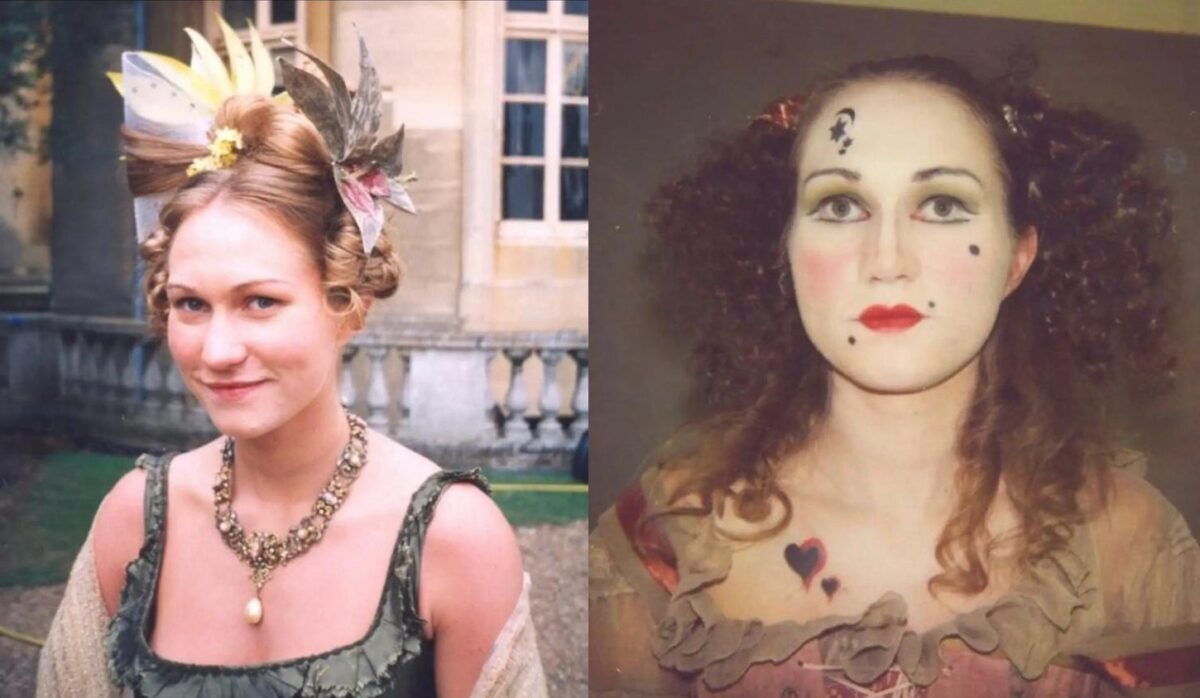
In Harry Potter and the Goblet of Fire, there is an early scene at the Quidditch World Cup where Death Eaters set fire to a campsite and chaos ensues: “Even though we’ve got health and safety checks, the fire is controlled and there’s a lot of people ready to step in if anything goes wrong,” says Joy F., who played one of the civilians being attacked. “It still feels scary as you are on the real set having real feelings.”
Joy has 22 years of experience playing an extra, or what is known in the industry as “background” or “atmosphere”. She was 18 when Ridley Scott was shooting the historical epic Gladiator in her hometown in Surrey and the production was looking for local people to play soldiers. “I thought it would be good for me to do it alongside being an art student,” says Joy. Since then she has played an extra in films like The Sense of an Ending, Bridget Jones: The Edge of Reason, Stage Beauty and Stardust, among others.
“While you’re not invisible, you do need to be okay with being part of the creation of the atmosphere”
Joy F.
If your eyes have ever wandered during a scene set in a bustling city or an opulent ballroom, you’ll know that extras are essential to creating the realism of a scene. “It takes an army of people to create one scene, which often gets overlooked when lead actors are in the limelight,” says Joy. The role of an extra is to not stand out or draw attention to themselves. For instance, if you’ve got very blonde hair and the main actress of a scene also has similar blonde hair, you will be asked to move to the back to not draw the audience’s attention away from the lead. “While you’re not invisible, you do need to be okay with being part of the creation of the atmosphere,” she says.
Nathan Elliot, a 26-year-old from London, has recently worked as an extra in the upcoming Mission: Impossible – Dead Reckoning Part One, and agrees with this sentiment: “You need to be okay with the fact that you are essentially there to fill in the background,” says Nathan, whilst he also acknowledges the “bond and the relationship you build with everyone because you’re in it together.”
During the shooting of Mission: Impossible amidst the Covid pandemic, 80 extras were accommodated in the same hotel. They were strictly instructed to maintain isolation and wear masks: “As we were confined to our quarantine rooms, we would socialize by enjoying drinks, playing cards and having a good time,” says Nathan. However, the entire production had to halt for several weeks when one of the extras got Covid which spread to the whole set.
Being an extra in a film requires patience. Lots of it. Even though your moment on camera is brief, it takes hours of waiting around. It’s important to be able to entertain yourself and be ready for the non-glamorous side of it. “As long as the money keeps rolling in, you’re looked after and getting a good meal and coffee, you don’t mind waiting,” says Joy. “If you’re there all day from 5 am, you could get up to £250 but it really varies. Sometimes the director might say the actor is going to push you and say “sorry”, or that we need to react in a specific way, in which we get a supplementary payment for that as well.”
Vicky Wilson, casting team manager of The Casting Collective, UK’s largest background casting agency of extras for films and TV, says they cast extras depending on what the brief is from the production as they have a database of artists, “but the person has to be reliable, punctual and polite to be a good extra.”
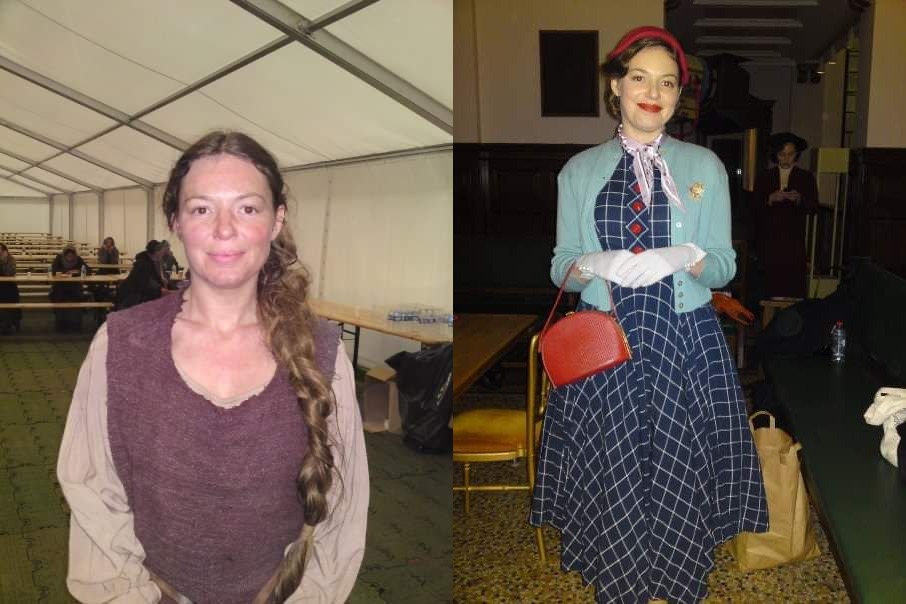
Samantha Harrington, who has been working as an extra since 2003, says that there’s a subtlety to the art of being an extra, and a lot of it is common sense. “One needs to be bang on with the timings and be a bit conscious about where people are, what you’ve picked up on, and returning props because they can’t just keep an eye on every single person every minute of the time,” she says. “So you have to take a bit of responsibility for yourself.”
“We’re at the bottom of the ladder, so we get the brunt of it if people aren’t having a good day”
Samantha Harrington
Samantha also says the job can be quite stressful if the mood and atmosphere on set aren’t right. “We’re at the bottom of the ladder, so we get the brunt of it if people aren’t having a good day.” She has heard people being shouted at in the past, but it doesn’t seem to happen so much nowadays: “Once on a TV programme, everyone was having a meal and ordered pizzas, and someone said: ‘You can give the rest to the animals,’ and she was referring to the extras. That was quite unpleasant.”
But there are of course fun parts about working as an extra. Joy says it’s a thrill not knowing what you’re walking into – what kind of scene, costume or even century. “It’s never boring. I enjoy that I can be somebody scruffy in a back alley in Victorian and Edwardian England or be a Titanic survivor, a nurse or in the far future in a science fiction film,” says Joy. “You arrive in the morning, and you’ll have a sheet with photographs from your fitting,” she says, “and then you go into makeup and wardrobe and throw yourself into it.” Joy’s favourite sets to work on are period dramas.
Being an extra gives an insight unlike any other into the inner workings of the film industry: “It’s cool to see how it all works, like how they’ll make their own snow out of mulch,” says Nathan, referring to the fake snow provided by Snow Business. You may also catch a glimpse of the megastars: “I was in Michigan and Tom Cruise showed up for the shooting, which was super cool,” he says.
Samantha talks about her starstruck moment in a Clint Eastwood film. “He was absolutely lovely and very polite. He just chatted away like a normal guy, and I found that quite amazing because he’s such a megastar,” she says. “I have also worked with Olivia Colman a few times and she is absolute heaven and has been nothing but divine. She just lifts the whole set!”
Being an extra pays a decent wage, but “it is like freelance work; you can’t rely on it. It’ll be a lot of money coming all at once and then no money for some time,” says Joy. Even people who are regular extras often have other jobs on the side. Sometimes being an extra is also a way into acting in higher-up roles: “As I started doing more extra work I got to notice directors and they started putting me forward for more featured roles,” she says. “I had worked as an extra in England and the same director was doing a TV show in New Zealand. So I managed to get myself on that TV show as a stand-in for a five-month contract,” says Joy.
Despite the long hours and sporadic work, being an extra has its own charm.“You get to experience these different magical worlds and it is experiences like this that make the role of an extra worthwhile,” says Joy.