

If you’re nervous just imagine the audience naked, the adage goes. But how do you soothe your anxieties when naked and performing a simulated sex scene? Acting out a sex scene is awkward. Intimacy coordinators help to diffuse the awkwardness and, more importantly, create a space to explore intimate scenes through open communication and choreography.
“It’s first and foremost a creative role,” says Tommy Ross-Williams, the intimacy coordinator for the current West End production of Brokeback Mountain. “I think a lot of people think of intimacy coordinators as consent officers,” says Tommy. The treatment of the intimacy coordinator in the first episode of HBO’s The Idol, released earlier this month, illustrates this sentiment. In the episode, the intimacy coordinator is locked in a bathroom after saying that the nudity rider of Lily-Rose Depp’s character does not permit showing her nipples. The role of an intimacy coordinator is much more than implementing contractual boundaries and the caricature portrayed in The Idol has left some of the intimacy coordinator community feeling “appalled”.
“Intimacy coordinators bring the intimate scenes to life with as much nuance, detail and complexity as the scene asks for whilst supporting both the cast and crew,” says Tommy. The extent to which the scene is choreographed is up to the actors. Some prefer to have every thigh touch, forehead kiss and midriff graze planned, but that is not always the case. “There are lots of ways of doing intimacy,” says director Sam Woof. “There’s a system of containers you can use which allow you to continue to improvise and be flexible.” For clarity and ease, some actors prefer an intimate scene to be heavily staged from beginning to end, like Lukas Sperber. “We all have different boundaries, and for a lot of people it is hard to communicate those boundaries,” says the Faking Hitler actor. By working with an intimacy coordinator and collaboratively choreographing the scene “it lifts a lot of weight off of me,” says Lukas.
The use of intimacy coordinators is relatively new, and awareness of the need for them on set for scenes that include nudity or simulated sex increased after the beginning of the MeToo movement in 2017. Revelations of MeToo exposed how detrimental power dynamics on set can be, particularly when filming intimate scenes, and highlighted the pressing need for clearly defined boundaries. Alicia Rodis’ work as an intimacy coordinator on HBO’s The Deuce in 2018 carved out a place for the role in the entertainment industry. Since 2019, HBO has required an intimacy coordinator on all of their productions. Ita O’Brien has been a strong advocate of intimacy coordination and founded Intimacy on Set, an intimacy coordination agency. Her work on Normal People, whose intimate scenes took over Britain’s television screens during lockdown, brought attention to the essential role.
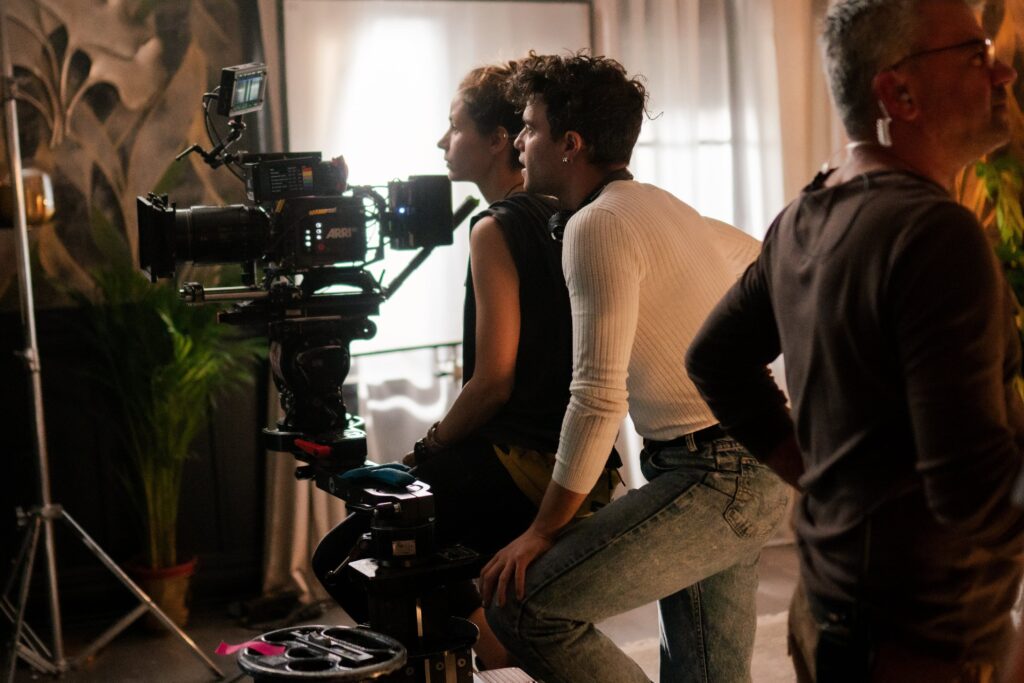
Whilst it is undeniable that intimacy coordinators provide vital security and safety for actors, they also benefit directors. “As a director, the big thing you get out of an intimacy coordinator is a sense of security,” says Sam. “We forget sometimes that directors can also be nervous and fallible around intimacy,” they say.
Last year, Game of Thrones actor Sean Bean told The Times that intimacy coordination would “spoil the spontaneity” and “I should imagine it slows down the thrust of it.” Questionable pun aside, Bean poses one of the main arguments against intimacy coordination: that it can be more restrictive than freeing. However, Tommy thinks that this is part of the reason that intimacy coordination is needed. In terms of intimacy coordination ruining the “spontaneity” of a performance, they say: “There’s a reason why it shouldn’t be just spontaneous, which is the same reason we wouldn’t want a fight to be spontaneous – it’s just not safe.”
But Tommy also sees intimacy coordination as an opportunity to create a space for a different kind of spontaneity and freedom: “What you’re doing is creating a vocabulary with your cast and director to create what is almost a score,” they say. “Once you’ve got the consent and understand what’s possible, you can play it like music.”
The choreographing of intimate scenes differs with each project because actors have different boundaries, which intimacy coordinators have to navigate. But having an intimacy coordinator in the room to help make decisions and listen to the actors makes the task easier. The power dynamic between actors and directors is “very acute” and is “felt by everyone”, says Sam. An intimacy coordinator helps bridge the divide. “It’s important to have somebody you can go to and say: ‘I’m not comfortable with this. Can you communicate this?'” says Lukas. “Or even better, if that person comes to you and says: ‘Are you comfortable with what we have just agreed on?'” he says. Lukas sees the implementation of intimacy coordination as the “right decision”, but the choreography “doesn’t leave room for the unexpected, and if you are searching for that moment of truth, it can be tricky,” he says.
“Intimacy coordination is the most rapidly changing aspect of how we make theatre”
Sam Woof
It can also be difficult to figure out what the director actually wants from the scene. “People are very scared to talk about sex,” says Tommy. “That’s why so often in scripts people say, ‘you find them in the throes of love’. We don’t even get it written down.” That is why the initial conversation is always with the director about their vision: What do they want to happen in the scene? What do they want to achieve? How does the moment develop the story? Intimate scenes are vital parts of the story and “it’s wild we never gave enough time to these climatic moments,” says Tommy.
For Brokeback Mountain, Tommy spent the first week checking in with the actors and focused on consent work with the whole company during the second. It wasn’t until the third week that they started working on the intimate scenes. For Tommy, it’s about “moving at the speed of trust,” and that speed is “often quite slow”.
The role is still relatively new and intimacy coordination is “the most rapidly changing aspect of how we make theatre,” says Sam. This year marks the launch of the world’s first intimacy practice degree, which is promising for the future of the role. Ita O’Brien has collaborated with Mountview and will be leading the two-year masters course starting in September. For the future of intimacy coordination, Tommy hopes that people understand how key it is and how it’s “wonderful to champion the cast and make them feel safer and supported”.