
Peer steps into the studios, workshops, and creative hubs of artists who bring their visions to life.
From violin makers crafting in nostalgic ateliers to filmmakers shooting on the fly in bustling markets, we look into their personal spaces—permanent and transient—where creativity thrives. Whether it’s a meticulously organized craft room, a sunlit pottery studio, or a notebook carried on the go, each space tells a story of passion, adaptation, and the unique ways these creatives make their work their own. Join us as we explore how these spaces shape the art, the process, and the people behind it.
Violin Maker, Jan van der Elst
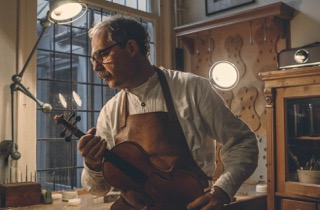
A master violin maker with 35 years of experience, Jan van der Elst has spent decades honing his craft in a studio and shop that blends tradition with practicality. Located in Germany, his workspace is divided into two distinct areas: a quiet, focused studio for creating and repairing violins, and a charming shop designed to evoke the atmosphere of a 19th-century violin atelier.“For my craft, it’s very important to be able to concentrate. I need silence and isolation to make an instrument.”
Jan’s studio is a sanctuary of precision and focus. Designed to minimise distractions, it features a high workbench—a nod to his training in England—where he crafts and repairs violins, alternating between standing and seated work. “The biggest challenge was arranging everything so I could work without being annoyed by not finding things,” he says. Tools are meticulously organised, and a separate room houses noisy machinery, ensuring the main workspace remains a quiet haven for craftsmanship.
The studio is also a repository of personal history. A handmade wooden violin sign from his first workshop and an old leather apron hang proudly, untouched by time. “I can’t throw them away,” Jan admits. These items are more than sentimental—they’re reminders of his journey, from a small first-floor workspace overlooking a garden to the expansive studio he now calls home.
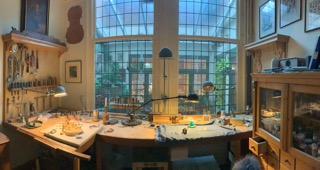
Adjacent to the studio is Jan’s shop, a space designed to transport customers to the golden age of violin playing. Adorned with paintings and drawings of violin players, it captures the ambiance of the late 19th century, a time when the craft flourished. “I wanted the shop to look like it would have around the turn of the century,” he explains. “It’s important for customers to feel they’re stepping into a world that honours the craft.”
For Jan, the studio is more than just a workspace – it’s a place of deep connection. “The silence and isolation are essential for the kind of work I do,” he says. “It’s where I can truly concentrate, where the world falls away, and the instrument comes to life.”
Musician & Potter, Karin Dolman
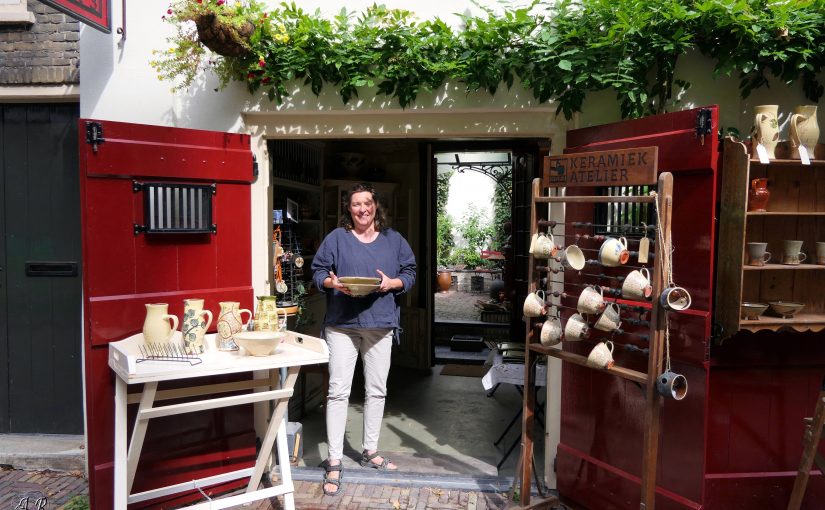
Karin Dolman, a musician and potter based in Germany, has cultivated two distinct creative spaces: a music room for practicing, teaching, and composing, and a pottery studio where she crafts and sells her ceramic works. Both spaces reflect her lifelong passion for creativity, nurtured since childhood. Her music studio sits opposite to her partner, Jan’s violin workshop, separated by a courtyard and two huge windows, creating a cosy space for the two.“When I’m restless because I want to create something that’s in my mind, I go to my music room. It’s not just about the things we make; it’s about the process and the joy of being there.”
Karin’s music room, located in the same building as Jan’s workshop been her creative haven since 1985. Designed for functionality, it houses her viola, sheet music, and a computer for composing and managing her website. “The light is very important,” she says. “It’s not the bright light of a factory but a concentrated, warm glow that helps me focus.” The room’s deep red walls and vintage cupboards, repurposed from an old printer’s drawer system, add warmth and practicality, ensuring her music is always within easy reach.
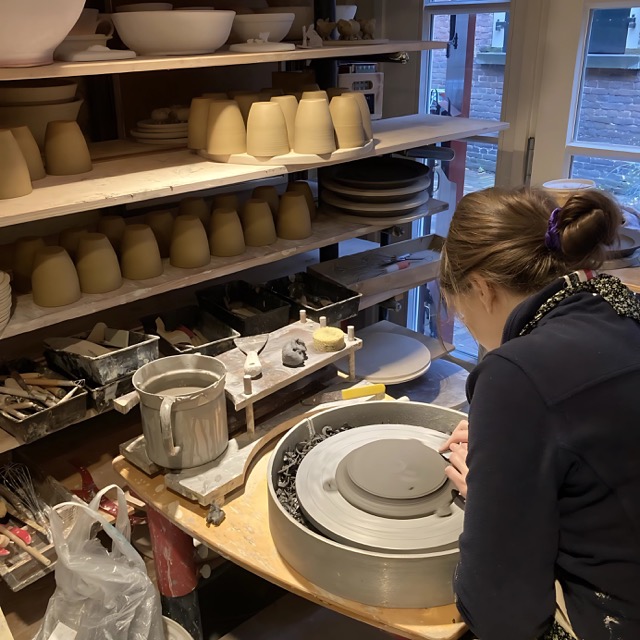
Her pottery studio, a 10-minute walk from home, is a nostalgic space that transports visitors to another era. Once a small fire brigade building, it now houses her kiln, pottery wheel, and a charming shop. “I wanted it to feel like stepping back 100 years,” Karin explains. The studio’s floor heating saves space, while its wisteria-covered garden creates a welcoming atmosphere. “Seeing the wisteria in full bloom makes me happy, and customers love it too,” she adds.
Karin’s connection to her spaces is deeply emotional. The music room is her sanctuary for creativity and focus, while the pottery studio is a place of shared joy, where visitors can watch her work. “Throwing clay feels magical, and showing that process to people is part of being a potter,” she says.
Both spaces are integral to her life, reflecting her belief that creativity is as much about the process as the final product. “It’s not just about making things,” she says. “It’s about being in the space, letting the world fall away, and creating something that feels alive.”
Mixed Media Artist, Alison Bomber
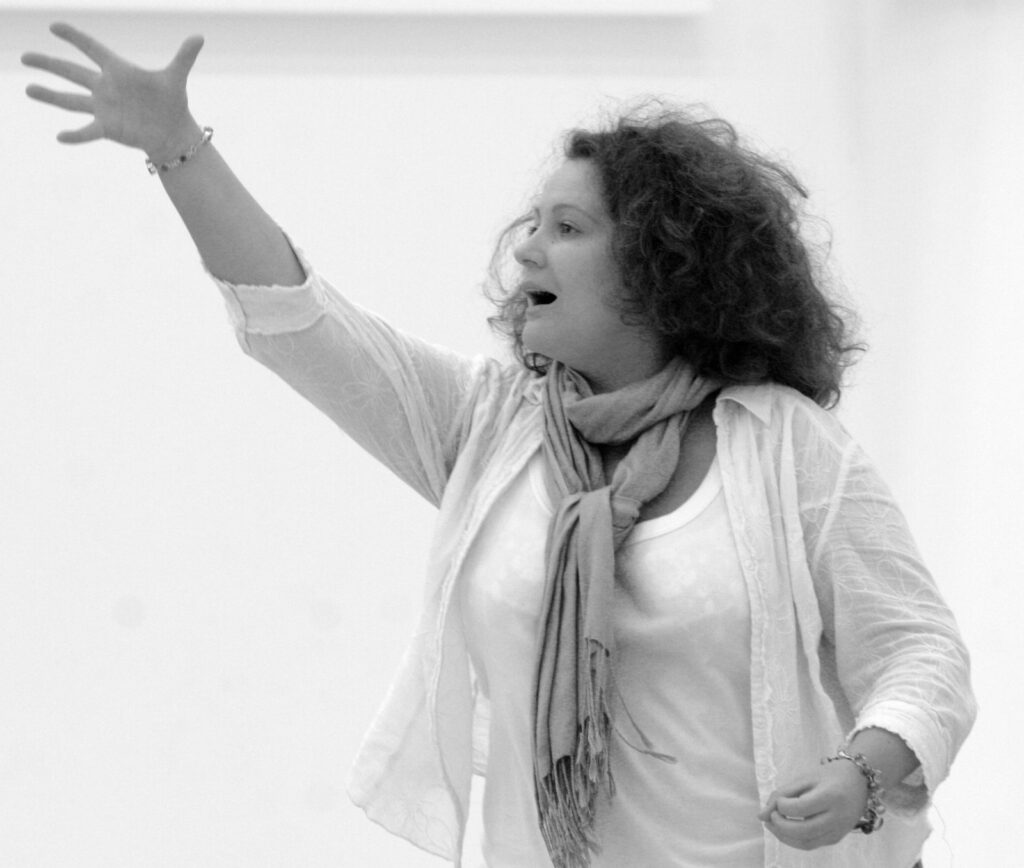
A visual creator with over a decade of experience in mixed media art, watercolour painting, and sketching. Alison Bomber has spent the last four and a half years crafting a studio that reflects her creative evolution. Located in the Czech Republic, the space is a vibrant hub of artistic exploration, blending functionality with a Scandinavian-inspired aesthetic.“My first crafting space compared to this one is like a mouse to elephant.”
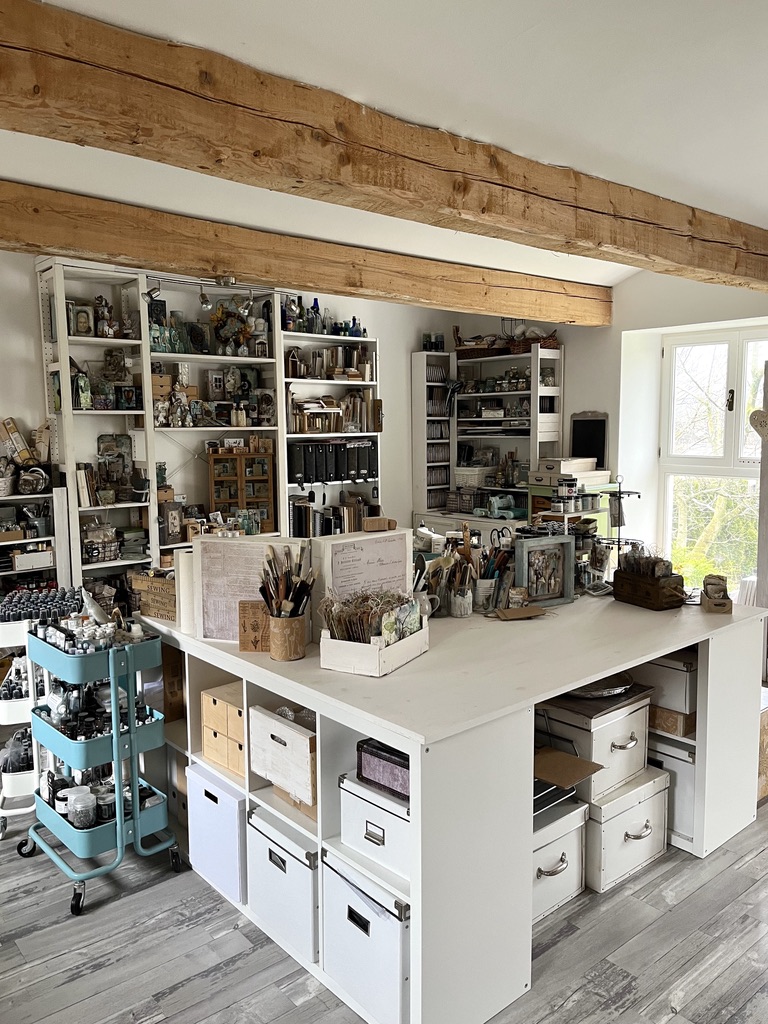
Alison’s studio is more than just a workspace—it’s a living record of her creative journey. What began as a modest crafting area on a kitchen table in England has grown into a sprawling, light-filled sanctuary filled with watercolours, inks, and an array of tools that fuel her artistic process. “When I first started, I had no idea it would lead to this,” she admits. “I bought my first rubber stamps and inks without a clue that I’d end up with a studio packed with supplies. My first crafting space compared to this one is like a mouse to an elephant.”
Moving hundreds of art supplies across Europe required meticulous planning, including taping every pot of paint and ink to prevent spills. “It was a lot of Sellotape,” she says with a laugh. “I still find pots with tape on them because I haven’t used them all since I got here four years ago.”
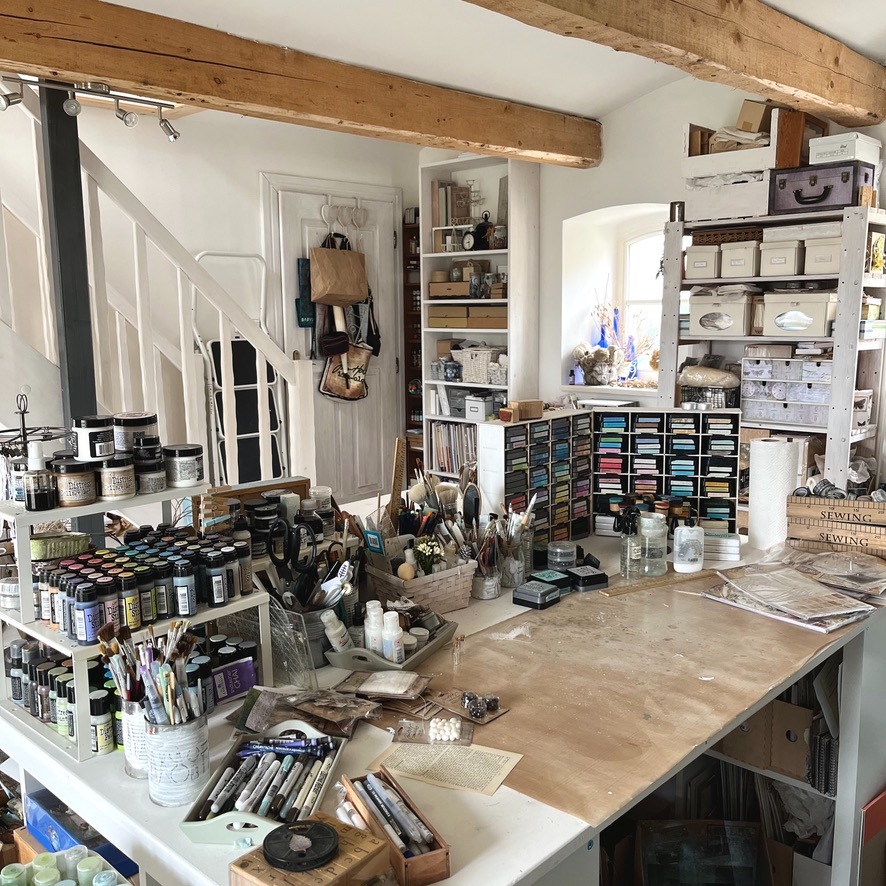
The studio itself is a masterclass in balancing aesthetics and functionality. Open shelving, repurposed wooden crates and vintage furniture – like a family heirloom cabinet that has been passed down through generations – create a space that is both practical and inspiring. “I need to see my supplies to use them, but I also need the space to feel uplifting,” Alison explains. “There’s a real danger with art supplies: out of sight, out of mind. So it was about creating storage that was easy to access but could also show me what I had without looking ridiculously ugly and chaotic.”
One of the most unexpected features of the studio is the use of the beamed ceiling to suspend a camera rig for filming their creative process. “It was a happy accident,” they say. “I realised the beams were the perfect distance apart to lodge a curtain pole, and now the camera hangs right above my desk.”
For Alison, the studio is a place of catharsis and discovery. “The making is the doing,” she reflects. “It’s not about the finished piece; it’s about the process, the moments of inspiration, and the joy of exploration.”
Photographer, Milosz Borowiec
Milosz Borowiec, a freelance filmmaker based in London, thrives on the unpredictability of working on the go. Unlike creatives with dedicated studios, his workspace is wherever the project takes him—whether it’s a bustling market, a quiet mountain lodge, or a vibrant gay club. His ability to adapt to new environments and make the most of limited resources defines his creative process.
“I love photography and videography because of the novelty—it’s always something new: new people, new locations, new funny stories. I hate routine. Going to the same place, doing the same thing with the same people at the same time? That’s not for me.”
For Milosz, filmmaking began as an escape. “When I moved here, I didn’t know the language. My only entertainment was cartoons and movies,” he recalls. That early love for audio-visual storytelling evolved into a career, shaping his identity as a writer, director, and filmmaker.
Unlike creatives who have the luxury of a dedicated studio, Milosz’s work is defined by mobility. “I’m always forgetting something,” he admits. “Once, I brought my laptop but forgot the charger.” Despite these challenges, he’s learned to adapt. “I had three bags for one shoot: a duffel, a backpack, and a giant plastic bag. It’s a struggle, but I make it work.”
His creative process is deeply personal, often requiring the comfort of his own space for writing. “It feels much more intimate and personal when I’m in my room,” he explains. “I find it hard to get in the zone at a café.” Yet, his work frequently takes him outside, where unpredictability reigns. One memorable shoot involved six drag queens strutting through Brixton Market without permits or roadblocks. “People shouted, threw things, even locked their path with bikes,” he laughs. “But if you watched the footage, you’d never know—it looks amazing.”
A small flip notebook is his constant companion. “Ideas come and go,” he says. “Writing them down has saved my life so many times.” This balance of spontaneity and preparation defines his approach, ensuring every project—whether chaotic or serene—captures the magic of storytelling.
One of his most transformative experiences came while working as a camera assistant on a project. “The cinematographer didn’t use a shot list—he just looked at the space, the light, and what the director needed, and created something visually striking with minimal equipment,” Milosz recalls. “It changed my perspective. You don’t need crazy gear to make amazing work.”
For Milosz, the key to success lies in collaboration and adaptability. “Every project teaches me something new,” he says. “It’s about being open to the unexpected and finding beauty in the chaos.”
Wondering How to Create Your Own Creative Space? Hear from the Experts
Designing a space that inspires creativity while being functional can feel like a daunting task. Whether you’re a filmmaker, musician, potter, or visual artist, the right environment can make all the difference. We spoke to interior designers and creative space experts to gather their top tips for crafting a workspace that works for you.
We spoke to Emma Morley, Founder and Creative Director of Trifle*Creative, an interior design studio with over 18 years of experience crafting innovative workspaces, to gather her top tips for creating a space that works for you.
1. Start with Functionality
“Function over fashion!” Emma emphasises. “We love exploring colour and style, but if a space doesn’t function first and foremost, it will fail.” When designing a workspace, consider your practical needs—whether it’s storage for art supplies, a quiet corner for writing, or flexible zones for collaboration.
2. Understand Your Space’s Potential
The first thing Emma considers when designing a creative space is the parameters of the space itself. “What type of building is it? What are its natural features, like light or ceiling height? These elements inform the base of the design,” she explains. If you’re working with limited natural light or a small footprint, get creative with mirrors, lighting, and multifunctional furniture to maximise the space.
3. Make It Personal
“The biggest mistake people make is copying others instead of assessing their own needs,” Emma notes. Your workspace should reflect your unique process and personality. Whether it’s a vibrant colour palette, a gallery wall of inspiration, or a cozy reading nook, personal touches make the space truly yours.
4. Embrace the Mess
Emma’s own workspace at Trifle*Creative is a testament to her philosophy. “Our creative workshop is full of samples, colour, and ideas pinned to the walls. It’s regularly messy, but it’s a hub for collaboration and creativity,” she says. Don’t be afraid to let your space evolve organically—creativity isn’t always tidy.
Final Thought: Your Space, Your Rules
At the end of the day, your creative space should be a reflection of your process and personality. Whether it’s a sprawling studio or a corner of your living room, the most important thing is that it feels like a place where you can dream, experiment, and create.
Now dive into The Hidden Joy of Pottery at BonBon !