
Featured image: photo by Tommao Wang via Unsplash
How Asian traditions can represent friendship, connection and sharing
Circles rarely belong to one person. Unlike lines, which imply sequence or hierarchy, circles need to gather. In all East Asian countries, the circle has long served as a quiet and profound structure of collectivity. Circular arrangements distribute attention evenly, creating a shared space where participants face one another rather than a single focal point, influencing how people eat, celebrate, and exist together.
This shape takes deep root in standard cultural routines. In China, communal dining happens around a round table; in Japan, there is the circulation of tea bowls during ceremonies; in Korea, Ganggangsullae, a traditional circle dance is performed hand in hand. Where Western modernity often prioritises personal space, these cultural circles in East Asia insist on harmony and unity as literal teachings in living together.
But what happens to these cultural circles when a generation grows up moving between continents?
For many young Asians living in London today, the circle remains emotionally resonant, even if its original form feels somehow distant. In this tension between inheritance and reinvention, collectivity continues to transform.
China: The Round Table and Sharing Equality
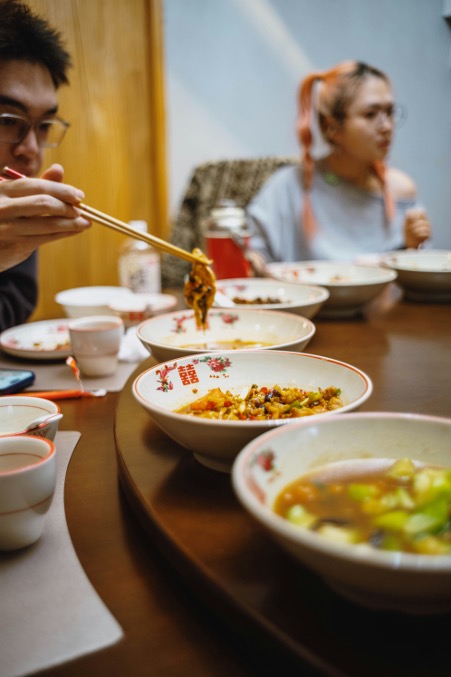
Unlike rectangular tables that privilege position with angled corners, the Chinese round table removes hierarchy among group members. The circular form of a table has more meaning than just making it easier for everyone to see and converse with one another. In Chinese culture, circles are a significant motif that represents harmony and unity. They simultaneously watch others serve themselves, rotate dishes, and participate in a collective pace of eating.
The introduction of the round table, widely known as the Lazy Susan in the UK, further amplifies this logic. Contrary to popular belief, its widespread use at Chinese dining tables did not actually originate in China but emerged through cultural exchange and global adaptation. The device actually originated in Europe and the United States as a rotating serving mechanism. It became widely linked with Chinese dining in the 1950s, when Chinese American restaurateurs in San Francisco incorporated it into banquet tables to facilitate shared dishes. The design quickly became a defining feature of Chinese restaurants around the world. In the UK, the Lazy Susan carries a distinctly colonial-era name and history, yet in Chinese dining culture, its function aligns seamlessly with existing communal values.
For Jinghang Yang, 25, a UCL graduate and London-based Chinese lifestyle influencer, the round table taught her community etiquette from a young age. “Personally, round Chinese tables feel veryfamily-coded,” she says. “They remind me of celebrations, gatherings, and being together rather than just eating and leaving. I also learned to pay attention to others at the table, like rotating the dishes to wait with consideration while someone else is serving.”
These tables also continue to play an important role in building community among Chinese students and young professionals in the city. Marie Adamsopiyeva, 21, former president of the Abacus Society (Association of British and Chinese University Students) at Goldsmiths, shared her experience organising a welcome dinner with large round tables.
“People were reaching across, offering food, asking, ‘Have you tried this?’ It was not just small talk,” she says. “The food gave everyone something easy to connect over. It felt warm and a bit chaotic in a good way, like a family dinner where it was easy for everyone to interact.”
Marie noticed that the circular table changed how people socialised compared to typical student events in pubs or cafés. “People interacted way more evenly,” she says.“There were no cliques forming in corners like at pubs. Because everyone was facing each other, it felt harder to opt out of the conversation but in a comfortable way.”
In London, where individual schedules are often usual, the round table offers a slower and more collective atmosphere. These tables preserve not only a distinctive device for having a meal but also add meaning as a social architecture of togetherness over the continent.
Japan: Chado and Tranquil Harmony
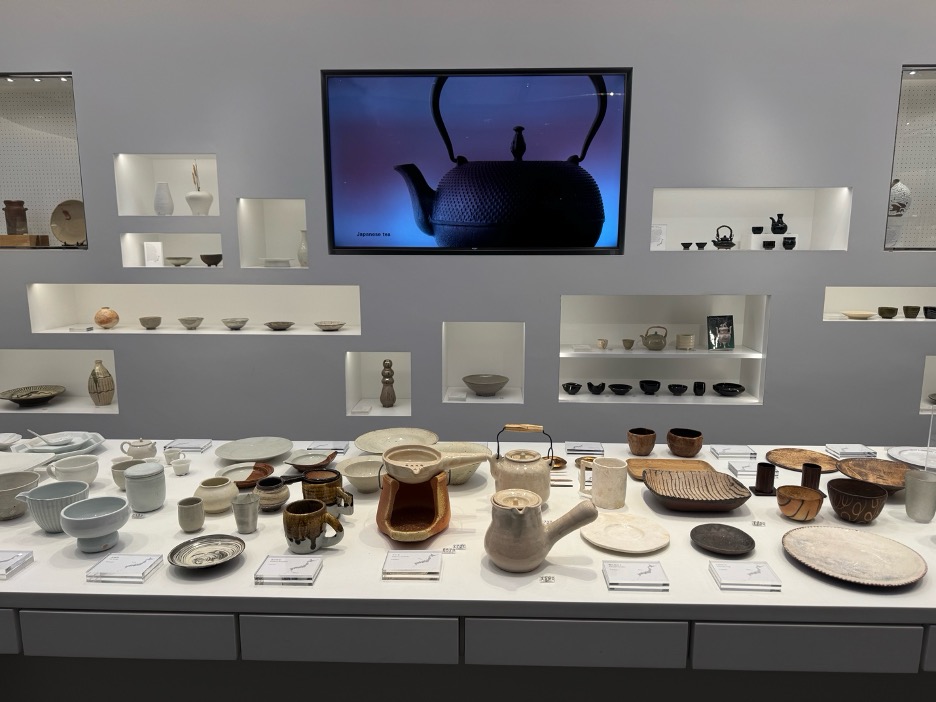
In Japanese tea culture, circularity appears less through spatial arrangement than through gesture over the whole process called Chado. During this traditional ‘the way of tea’, the circular tea bowls are gently rotated while brewing and before drinking. The movement can be seen as a form of social awareness, a meaningful act that acknowledges the host and the shared presence of others while sitting in a circle.
Kazuki Mitsuji, 22, a Japanese member of the UCL Japanese Society, experienced this practice again in London through a matcha ceremony workshop at the society in collaboration with Urasenke tea practitioners. Reflecting on the experience a few months ago, he describes the ceremony as a carefully choreographed interaction to share with his society members.
“We don’t have to directly say how we are considering each other; we can effectively show respect to the craft and the people around us even without words,” he says. “Following the same rhythm of circular movement with everyone makes you naturally become aware of others in the room.”
He thinks this circular harmony creates a rare moment of collective attentiveness within the fast pace of university life. “Tea ceremony is very calm and quiet, but in contrast, it’s also very loud and social in terms of connection. You’re not talking much, but you’re constantly keeping others in mind because the experience is shared.”
This collective rhythm contrasts with how tea is often consumed in the today’s generation, where for many younger people it has become a quick, individual habit of a brief pause between tasks.
Sarah Kapp, 29, shop manager at the London tea specialist ‘Postcard Teas’, sees this difference regularly while introducing customers to tea traditions from around the world.
“Tea is usually getting very personal, just like buying coffee at a café,” she says. “But having tea focuses more on the tea ‘time’, enjoying the calm moment with others. That’s why we also offer tasting sessions to give people a chance to slow down and experience tea together. This ceremonial experience becomes even more pronounced, especially in Japanese tea culture.”
Recently, Sarah has also noticed growing interest among younger Londoners in matcha, the most intricately intertwined one with Japanese tea ceremony. “Matcha has definitely become very fashionable as latte,” she says. “A lot of people first come to it as a drink of trend or health.”
But for Sarah, the growing popularity of matcha among Londoners also opens the door to a deeper curiosity about Japanese tea culture. She explains, “Once people start asking about matcha, the conversation often moves toward the tea ceremony, so I can fill them in more.”
For many young Japanese students in London, however, the ceremony itself appears only occasionally, often through cultural workshops. In London, she looks forward to what starts as a trendy drink might transform into a call to spread the original rituals of unity through the tea ceremony.
Korea: Ganggangsullae and the Collective Body
As a child, you probably held hands with friends and spun in a circle until the world blurred. In South Korea, this circular movement is, for many, not just a whimsical memory but a cultural tradition. Ganggangsullae is the folk dance that represents the collective body; those participating hold hands, spin at the same time, and move the body and soul as well, in a shared movement forming a collective spirit. Traditionally performed by women under the full moon, the dance consists of people holding hands in a large circle to sing together. There is no single dancer who leads the troupe. The movement of the circle emerges from the group itself.
Today, this embodied form of collectivity has begun to reappear in unexpected places, such as large concert crowds. During Coldplay’s Music of the Spheres concert in South Korea last year, Korean fans in the crowd were seen spontaneously forming circles and performing Ganggangsullae, turning the concert floor into a moment of collective spirit. In the excitement of the concert, the crowd shared their emotions by holding strangers’ hands. By forming circles and moving as one, the moment also became a larger collective experience – a single spirit. Among younger generations, this spontaneous experience was almost instinctive; a subtle expression of a cultural tendency to naturally turn shared feeling into shared movement.
The moment was captured by Kyung-jae Yu, 23, who filmed one such scene while attending a concert . Watching the crowd from above, he felt emotional about seeing that as a Korean. “Suddenly a group of fans joined hands and started moving in a circle and made it bigger just exactly like Ganggangsullae,” he says. “I was moved by how these people simultaneously seemed to want to experience that moment together. It felt very Korean in that moment.”
In London, where most diverse cultures constantly intersect, this kind of collective moment hints at another possibility of a cultural circle. The logic of the Ganggangsullae could offer a fresh way for different ethnicities in London to experience a shared sense of unity.
The Circle Today
So how does the younger generation engage with collectivity now? Marie thinks that circles are being reimagined rather than abandoned. “We don’t always sit in literal circles anymore, but we intentionally try to create them through study circles or community dinners,” she explains. “Individualism doesn’t erase collective values, but it competes with them. I think we are negotiating both.” The pace of urban life easily fragments the shared time we spend in a circle. Cultural circles become optional rather than expected.
In London, the circle can take on new meaning based on East Asian culture. It is no longer fixed to geography or tradition, but to intention. We can ask ourselves, not just in East Asian culture: Who would you choose to gather with? How would you share time with the ones next to you?