
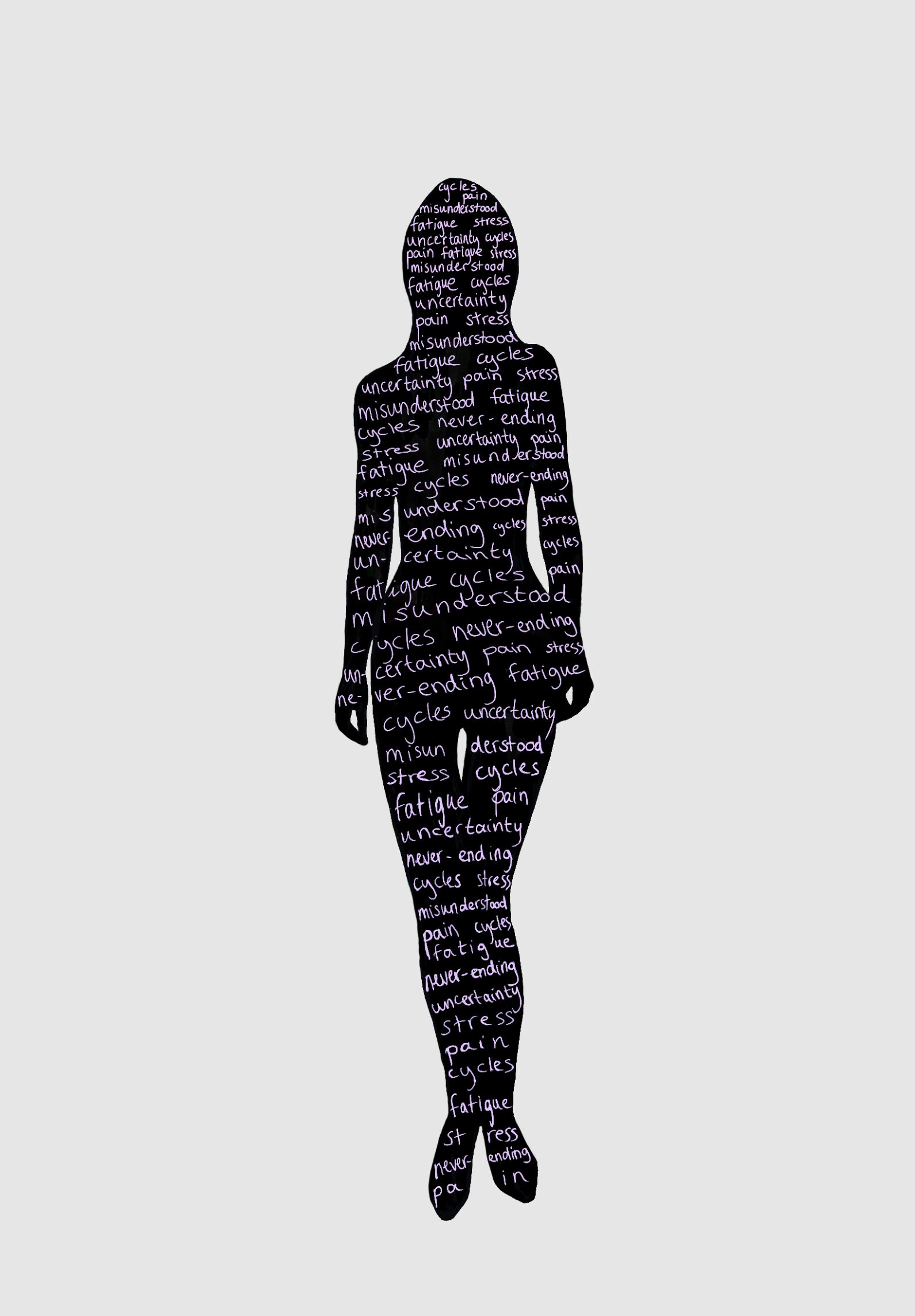
Featured image: illustration by Jane Matheson
Jane Matheson speaks to people who live with lifelong health conditions and learns how they cope…
I wake up most mornings feeling unrested. It’s not a tiredness that comes from a late night or too much screen time, but a heaviness that sits in my body before the day has even begun. There’s a dull but persistent pain in my abdomen that doesn’t seem to follow any predictable pattern. At times, appointments with doctors give me relief, someone is listening; I am not alone on this journey. But I also have a frustration that my questions remain unanswered, that my symptoms, so unusual and varied, are misunderstood.
Chronic illness refers to long-term conditions that require ongoing management rather than a single course of treatment, often varying between periods of remission (a temporary diminution of the severity of disease or pain) and flare-ups (a period of worsening symptoms). Having a chronic illness is a challenge. Not only because of the physical pain and chronic fatigue it brings, but also because often it is invisible to others. The cycle seems never-ending. Being chronically ill means not knowing when flare-ups will appear or how long they will be active. It could span from days to years. It also means living with the uncertainty of your own body, a nostalgia for the person and body that was yours before the illness. That sense of being trapped in a body you can’t fully trust is echoed by Harvey Haworth, 26, a British inflammatory bowel disease (IBD) and stoma advocate who shares his experience on TikTok under the name Harv & Health.

“Living with IBD, even after surgery, is a constant cycle which never really stops,” he says. “You become a prisoner to your own body and your surroundings. In a word, it feels endless.”
My diagnosis still sits in limbo: a 90% chance of Crohn’s disease, possibly mixed with ulcerative colitis, but still uncertain. Some symptoms seem unrelated entirely. At times, I have wondered if it could be endometriosis. There is no all-encompassing curative treatment for inflammatory bowel disease (IBD): it is a chronic and autoimmune disease, the causes are still unknown, as there can be multiple and vary with each person, which means they are under-researched in the medical world. My body doesn’t follow a linear path but something more to the effect of waves and an endless circle; it flares, calms, and flares again.
Being chronically ill is not just a medical reality, as it shapes every moment, every decision, every relationship.
I am not alone. IBD touches more than 500,000 people in the UK, according to Crohn’s and Colitis UK, and more than 4 million people over the world. Amber Tresca, 53, diagnosed with ulcerative colitis in 1989, is an American patient advocate and writer who has lived through surgery and now has a J-pouch (a surgically created internal pouch made from the small intestine after the colon is removed), yet the disease continues to influence her daily life.
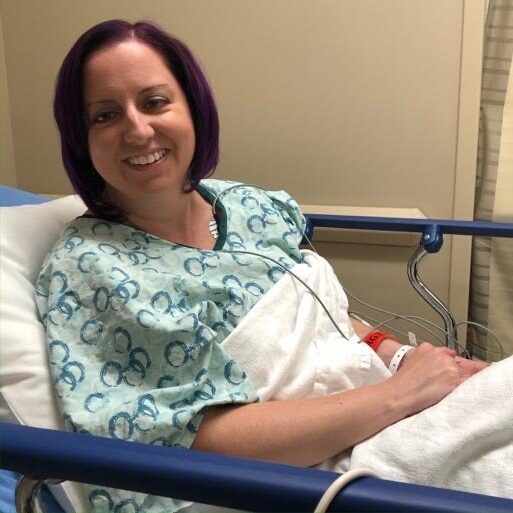
“I’ve learned that you have to get to a certain amount of acceptance, otherwise you are continually in a cyclical fight waiting for the other shoe to drop,” Amber says. Her words resonate with my own experience: the anxiety of unpredictability and the feeling that your body is no longer entirely yours.
Dr Bryan Rade, a licensed naturopathic doctor specialising in complex chronic illnesses, explains why these cycles are so common. He works with patients experiencing persistent Lyme disease, small intestine bacterial overgrowth (SIBO), mast cell activation syndrome (MCAS), and IBD, among other chronic conditions.
“Anything that puts the body into more of a stress response is going to create a more hair-trigger immune system,” he says. “The triggers vary widely: for some, diet or bacterial overgrowth plays a huge role; for others, stress alone, or environmental factors can reignite the cycle.”
People around those who are sick sometimes fail to grasp the reality. “People assume that if you take the right pill or have the right surgery, you should just be better. That’s not how chronic illnesses work,” Dr Rade explains. “Many patients could improve significantly if given the right support, financially, socially, and medically.”
Amber constantly feels hope and wariness at the same time. After her diagnosis, she remembers the rapid deterioration of her health: “I was having 20-plus bloody stools a day,” she says. “I probably lost 20 pounds, and I didn’t have it to lose to begin with. I’m five foot one.”
When the doctors told Amber what she had, she had no frame of reference and knew nothing about ulcerative colitis. At that time, there was no internet yet, research meant hours in the library, and even her doctors admitted they were trying to keep up with new information as they treated her.
“There are times when it does not play much of a mental role in your life,” she says. “And then there are times when the fallout is in your personal relationships, your finances, your career, which is also cyclical.” Amber confirms seeing cycles repeat after living with a disease for more than 30 years. Dr Rade also emphasises that the cycles themselves are a biological reality. “Chronic illness is rarely a straight line,” he says. “Symptoms wax and wane, and even after remission, flare-ups can recur.”
Emily Griffiths, 27, a UK stoma advocate known on TikTok as The Stoma Fairy, with 11,000 followers, shows how the non-linear path can change shape entirely. After emergency surgery, she says she initially felt traumatised and insecure about her stoma bag. This was until social media helped her see people living confidently with one.

“Getting this surgery completely changed my life,” she says. “It gave me my life back in more ways than one.” For Griffiths, what began as fear and embarrassment became something she now says “my stoma was a symbol that life can get better.”
“Chronic illness is never a straight line”
Living with chronic illness also means navigating a healthcare system that is not always built for complexity. Dr Jodie Hughes, a PhD researcher, menstrual health educator, and founder of Endometriosis South Coast UK, approaches endometriosis from her experience with the illness. As a patient and advocate, her work focuses on the structural failures that keep chronic pelvic pain underdiagnosed. Dr Hughes situates this diagnostic delay within a broader pattern of gender bias in medicine.
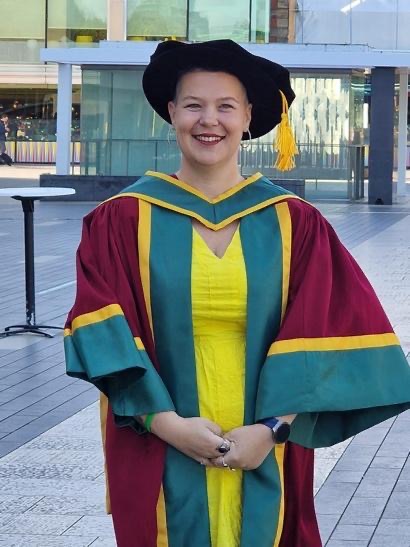
“Historically, women’s pain has been minimised, psychologised, and normalised, particularly when that pain is associated with menstruation,” she says. From a young age, many people are taught that periods are meant to hurt, a belief that becomes embedded socially and clinically, she explains. This framing creates what Dr Hughes describes as a “dangerous feedback loop” where patients delay seeking help, clinicians under-investigate, and years pass without diagnosis. Severe symptoms that disrupt education, work, relationships, and mental health are often seen by the medical world as stress or hormones. In the US, Amber notes, “I spent months in the hospital early on. Now we have amazing medications, but they’re prohibitively expensive.” Dr Rade agrees that “Financial stress and lack of access absolutely exacerbate symptoms. Managing chronic illness requires more than just prescribing medication.”
Even with good medical care, remission doesn’t feel permanent. Amber describes her “surgical remission” after colectomy as years where she did “really, really well” and didn’t need frequent medical intervention. But after giving birth to her children, symptoms resurfaced, requiring medication changes and regular pouchoscopies (a medical exam used for people with a J-pouch). Harvey, who underwent ileostomy surgery (to insert a stoma), explains that even when symptoms ease, the mental cycle persists.
“It’s as mentally exhausting as it is physical,” he says. “You’re always thinking about it, and even when you forget for a moment, it pulls you back in.” Amber has some advice for those newly diagnosed with IBD: “When people are first diagnosed, it’s important to get the disease under control as soon as possible,” she says. “Sometimes that means starting a biologic right away rather than trying something milder, because early treatment can prevent complications.”
You might still experience cycles of symptoms afterwards, she acknowledges, because the nervous system and inflammation are affected by stress, among other factors. While conventional medicine remains central to treatment, Dr Radeadvocates an integrative approach. “I think of the body as a house and inflammation as the fire,” he explains. “You can put out the smoke, but if you don’t deal with what’s driving the fire, it’s going to come back.” He advises his patients on things such as dietary strategies, IV therapies, supplements, and mind-body techniques. Amber’s perspective mirrors this approach. “No single treatment works entirely,” she says. “It’s about layering strategies, listening to your body, and staying adaptable.”
“Managing chronic illness requires more than just prescribing medication”
Chronic illness teaches patience and humility. It teaches you to listen to your body. Amber reflects on the long journey of acceptance: “I’m not sure I could say that I’ve achieved full acceptance,” she says. “But therapy helped me come to terms with the realities of the disease and how it affected my life.” Sometimes, hope looks like understanding the pattern, seeing progress even in small ways, and knowing that you are not alone. The circle repeats but within it, one learns and strengthens.
In living with chronic illness, I’ve realised that the narrative we tell ourselves, and the knowledge we share with others, matters: the cycles will continue; the symptoms will come and go. “That ‘new normal’ becomes something you accept without realising how unwell you are,” Harvey reminds me, showing how easily cycles can disguise themselves as stability. But preparation can make those cycles more bearable. There is hope.
For more information and support, visit: Crohn’s and Colitis UK.