
Featured image: photo by Asya Alekseeva
Professional pool players, and disability rights advocates James Punch and Mohamed Aslam Abubaker, are preparing for the Ultimate Pool Disability Pool Series tournament, this April. Here, they share their journey in disability pool and their efforts to raise awareness about disability in sport
Most people associate pool with beer, pubs and casual games while having a laugh. For James and Aslam though, pool is what supported them through every step of the way. It gave them the medium and the voice to become the advocates they wished to be.
James, 40, was diagnosed with Parkinson’s 10 years ago, but his love for pool began long before that. He first started playing pool at just four-years-old, thanks to his dad taking him to the pub on weekends. “He used to drag me along with him and leave me in the back room with the other kids, where there was a pool table,” he says. “None of us knew what we were doing, we just hit the ball around.”
It was a stranger at the pub, Scott, who taught him how to hold a cue and play properly. As he took it more seriously, Scott became his supporter and friend, alongside his dad. They were, “good level pub players,” James says. “They supported me through coaching, playing me a lot, empowerment and motivation.” Plus, he played endless pool matches with his friends and sister, Alex, which helped him to become the professional player he is now. Eventually, in sixth form, he got a pool table at home where he played against his sister for hours: “I got really good when I was a teenager,” he says. “Me and my sister competed around the country and won quite a lot of competitions.”
When James turned 22, he was forced to take a long break from pool because he got septicemia, a life-threatening blood infection. “I couldn’t do anything at all. Couldn’t hold a cue, couldn’t stand properly, couldn’t focus or see straight, I didn’t socialise or go out for years,” James says. “I definitely thought it was the end of everything to be honest.”
James didn’t completely quit sports though; he was still pretty active and even did a bit of kickboxing in these years. Drawing from his own experience, he was inspired to provide help for people with disabilities. “Even though I wasn’t competing and playing pool properly, I was teaching it,” he says, “I was teaching pool at college and I managed to help a lot of disabled people get into pool and play there.”
However, just 10 years on, aged 31, James discovered he had Parkinson’s, a progressive neurological condition affecting movement. “I believe it was a result from the septicemia, and also from my kickboxing, and unfortunately, getting hit too many times in the head,” he says. It wasn’t until James moved to Leicestershire, that he slowly got back to playing pool at the social club near his house, which is where he met Aslam at Club 147, the snooker and pool venue.
Aslam, 60, a wheelchair user, was diagnosed with polio, a highly infectious viral disease, when he was six-months-old. Aged seven, he began practicing on his school’s pool table every week. As his passion for the sport grew, he started taking coaching classes every Wednesday, after school, at the Willie Thorne snooker centre and by 18, he was so skilled he was competing in able-bodied tournaments too.
“Unfortunately, wheelchair national snooker championships were terminated because many players dropped out due to health issues,” says Aslam. “I won a few wheelchair tournaments across the UK, in the national championship, but as the years went on, they stopped the wheelchair snooker. So, I carried on playing eight ball [pool].” Despite snooker being his first love, Aslam quickly mastered the pool table and won the Eight Ball World Championship four times, first in 2013 and then also in 2016, 2017 and 2019.
Aslam didn’t stop at being a professional pool player. He also used his skill to make sure disability tournaments stayed running even during times when nothing was organised. Besides his work at Club 147 as tournament organiser, he became a disability tournament organiser as part of The English Pool Association (EPA), about five years ago. Through this role he started the Ultimate Pool Disability Series tournament two years ago. “When I saw Ultimate Pool on TV, that’s when I clicked and said, you know what, let’s get disability on Ultimate Pool,” he says.
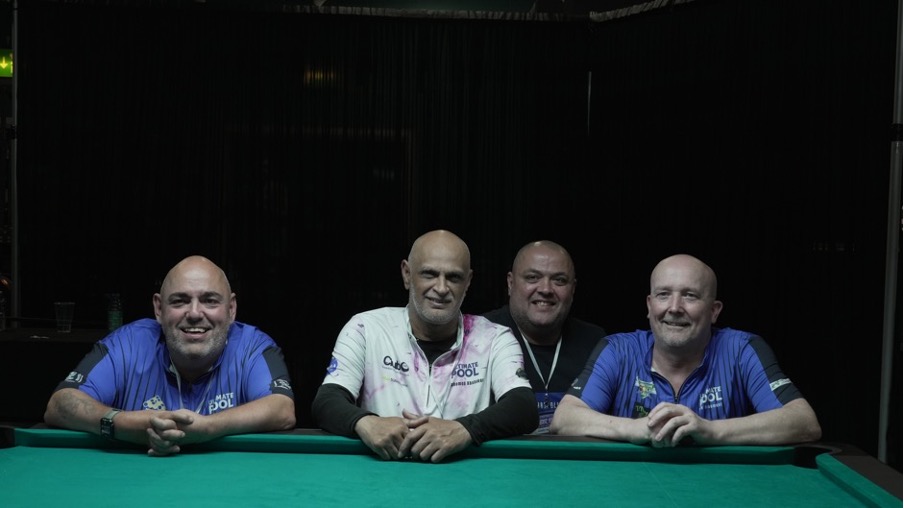
The 2026 tournament, due to be held in April, is the second disability pool tournament since Aslam started it. However, since Aslam is also competing this year, he has stepped down as an organiser for this tournament, so he can give his focus to the game. “My biggest aim was to plan it and let the organisation take over, rather than be running it,” he says.
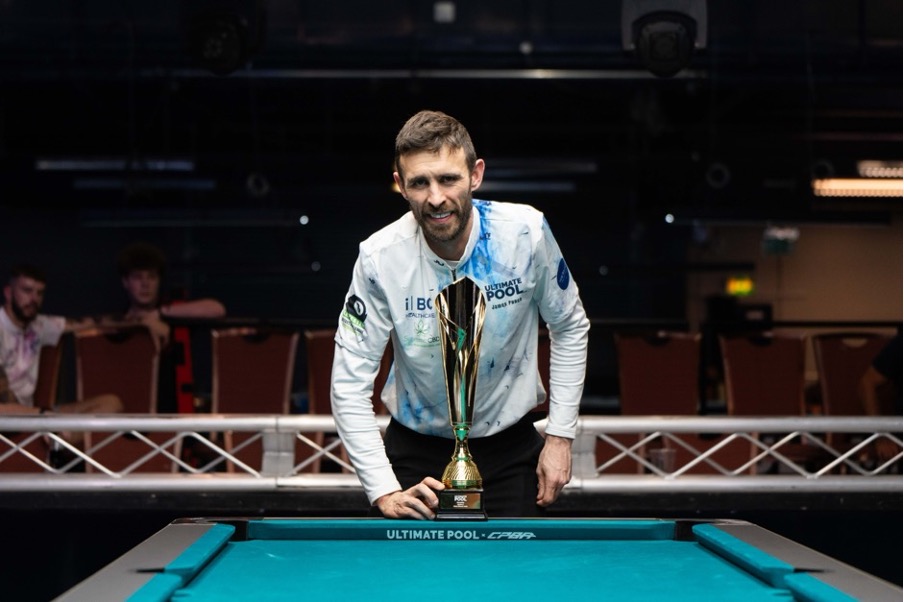
Both Aslam and James have enjoyed great success playing disability pool with both winning a plate tournament at Ultimate Pool last year. James was the Disability Series Plate winner and Aslam won at the Three Man Team Plate tournament with his teammates, Dave Beaumont and Roy Kimberley, where they competed against able-bodied players. Aslam really enjoys playing able-bodied players. “They don’t treat me as disabled person,” he says. “They know how good of a player I am, so they take me really seriously. It’s big challenge, and I test myself.”
Cost is a significant aspect in a pool player’s journey, especially for players with disabilities because tournament expenses, like travel and accommodation, are on the players, and those with a disability may have extra costs such as bringing a carer. “A lot of people struggled with sponsorship because they don’t work, so they rely a lot on sponsorship,” says James. “Pool is not known much for the big sponsors, so they really struggle.”
Another potential barrier for disability players is access, explains Aslam. “Access is one of the biggest issues,” he says. “When I did an event in Mansfield, I had to do a risk assessment, to find out about disabled toilet, parking, moving areas, food, the tables, how close the tables are, where people can move around.” In a disability tournament, the main priority is the player’s comfort, which able-bodied tournaments don’t always consider, especially when it comes to time frames. Some disability players will need to rest, go to the toilet or take a medication at a certain time, so Aslam ensures the typical time frames that are strictly adhered to in able-bodied tournaments are completely removed from the disability tournament, providing more equity and fairness for the players.“You don’t want to penalise people for their disability,” says James.
“They know how good of a player I am, so they take me really seriously. It’s a big challenge and I test myself”
Both Aslam and James emphasise that being vocal when it comes to raising awareness is essential, because information about disability needs and difficulties isn’t as known as it should be. However, they both praise Ultimate Pool for being very adaptive and responsive to all of their requests. “They’ve provided a disability area, so we actually have places to sit and we don’t have to travel far for tables,” says James. “They’ve listened to everything [we’ve said].” Ultimate Pool has also moved all events to the bottom floor of the building to further increase accessibility.
Despite James’s strong passion for playing pool, he views himself as an advocate and a representative of the disability community when competing rather than a competitor. “I want to see myself as a representative, an advocate, and somebody who people can look at and go, if he can do it, then I can do it,” he says. “And hopefully what I do empowers somebody else, even if it’s just one person, if it empowers somebody to get out and have a go, that’s what it means to me.”
Aslam, however, enjoys being a competitor while also supporting and fighting for disability rights. He perceives himself as equally both. This specific upcoming tournament means a lot to both Aslam and James. “The Ultimate Pool Disability Series is incredibly important because of how big Ultimate Pool is,” says James. “It encourages that development, and it means that other people with disabilities are going to be included; that people are going to feel confident in getting involved.” James and Aslam both hope the tournament will contribute to better well-being and more opportunity for an active lifestyle for those taking part too.
Both James and Aslam hope the tournament will raise awareness of disability in large organisations, but will also motivate other disability players to play the sport. “There’s a lot of players out there, especially disabled players, who feel that they can’t play because they can’t compete at that level,” says James. “Join play, learn, enjoy it. We’re all friendly, you won’t be disappointed. We’re here to help you.”