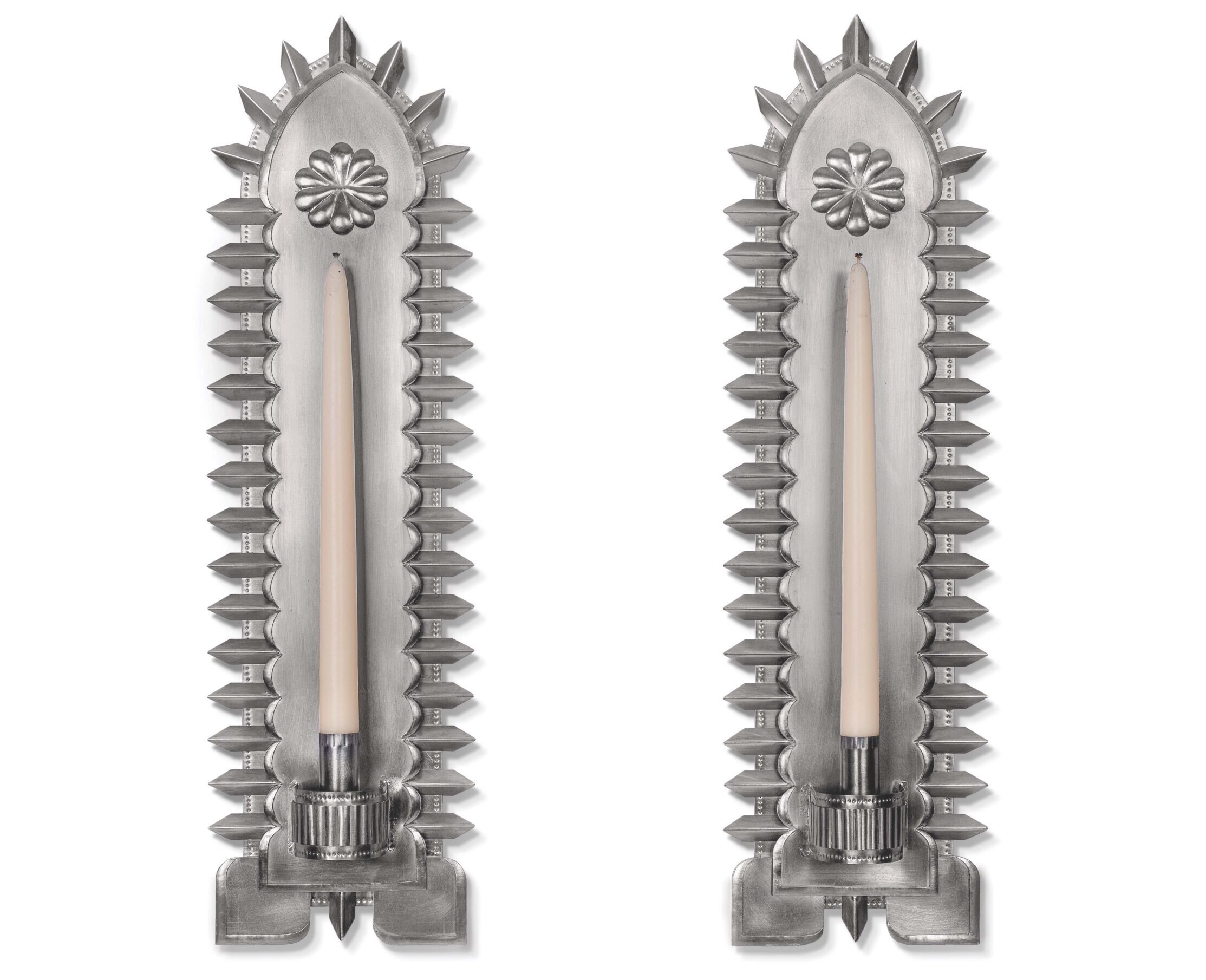
From the unembellished way he speaks to the decisive strike of his ball-peen hammer, Justin Gallegos Mayrant, 40, moves with precision. In his Santa Fe studio, he reinvigorates century-old Carnegie steel, cutting hundreds of pieces by hand before sculpting and soldering them into ornate tinwork.
In their final form, the raw metal sheets become almost unrecognizable: a chandelier, a mirror, a sacred cross, objects whose polished symmetry pushes against the improvised tradition. “I’m not very shy about this,” he says with a smile. “I didn’t really choose to do this. I just had an innate ability from the start.”
Tinwork arrived in New Mexico through two developments that would soon intersect. First, in 1846, New Mexico became a territory of the United States, bringing military supply routes westward and expanding trade on the Santa Fe Trail. As soldiers adjusted to desert life, they relied on supplies from the East, such as window glass, wallpaper and five-gallon tin cans of lard and kerosene.
Second, in 1851, Jean-Baptiste Lamy became the head of the Catholic Church in New Mexico. Looking to reinvigorate local parishes, he called for the creation of new devotional objects. “Tinwork would have been a substitute for silver because it was very scarce,” says Mayrant. Thus, the material from discarded military tins became the base of ornate nichos (frames for devotional prints), sacred crosses, sconces for candles and baulitos (small jewelry boxes).
“Culture always evolves or it dies,” says Cesáreo Moreno, Director of Visual Arts and Chief Curator at Chicago’s National Museum of Mexican Art. “This living tradition they have in New Mexico has adapted to the styles and needs of the people that live there.”
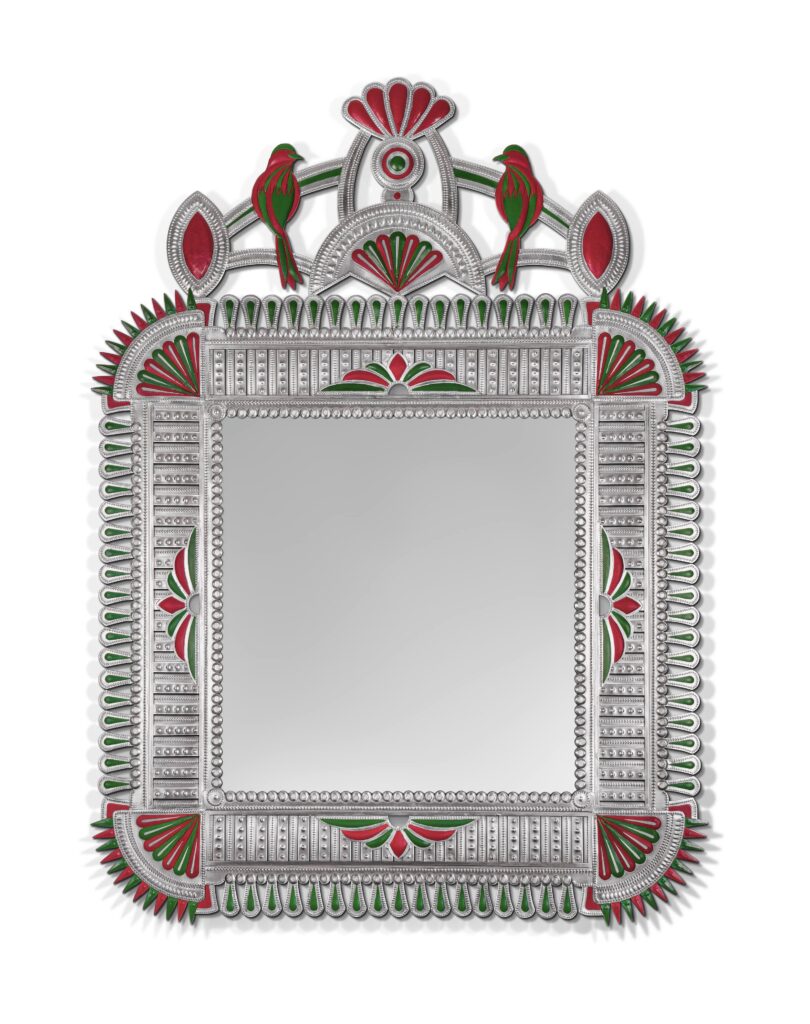
Justin Gallegos Mayrant
(c)2026
Many of New Mexico’s practicing tinsmiths come from long family lineages, where knowledge, tools and materials pass down naturally. “There’s a lot of secrecy in it, especially within the families that have been doing this for many generations,” says Mayrant. “Handmade punches are like a signature. There’s no place to buy them.”
In middle school, Mayrant met master tinsmith Michael E Griego and spent eight years apprenticing with him. “Michael hated the secrecy and gatekeeping around tin work. It was his personal mission to fight against that and educate as many people as possible,” he says. As the first artist in his family, Mayrant had to rely on outside knowledge. “There are certainly benefits for people who come from families of artists, but there’s also less creative freedom. I got a blank slate, so I was able to create anything I wanted.”
Culture always evolves or it dies
He’s aware of criticism from local tinsmiths who worry his aesthetic strays too far from tradition. “I think a lot of people are afraid of change,” he says. “When you come from a family where there are five or ten generations of tinsmiths, that tradition is almost built into your DNA. To see someone who doesn’t have that history, there were a lot of assumptions.” But Mayrant says that by deconstructing the traditional work, he’s honouring its legacy through originality. “I’ve accepted that there will always be people who push back against it, but I think it creates important debate and conversation.”
At Santa Fe’s annual Spanish Market, where colorful colcha (quilt) embroidery, painted woodwork and punched-tin ornaments fill the city’s plaza, Mayrant’s booth stands apart from the others. He’s shown there since 1998 when, at 13, he sold his first tinwork chandelier to the permanent collection of the Museum of Spanish Colonial Art.
He recalls a moment when two strangers stopped to examine his tinwork. “It’s almost too perfect,” one murmured to the other. He didn’t take this as a compliment. “It really gave me something to think about,” says Mayrant. “It made me try to understand where people connect and that it’s important to have that feeling of the human hand.” The off-hand comment followed him back to his studio, where he began leaving small irregularities, mainly tiny flecks of solder, in his pieces. “I don’t want the work to feel sterile,” he says. “And I certainly don’t want people to have the perception that it’s machine made.”
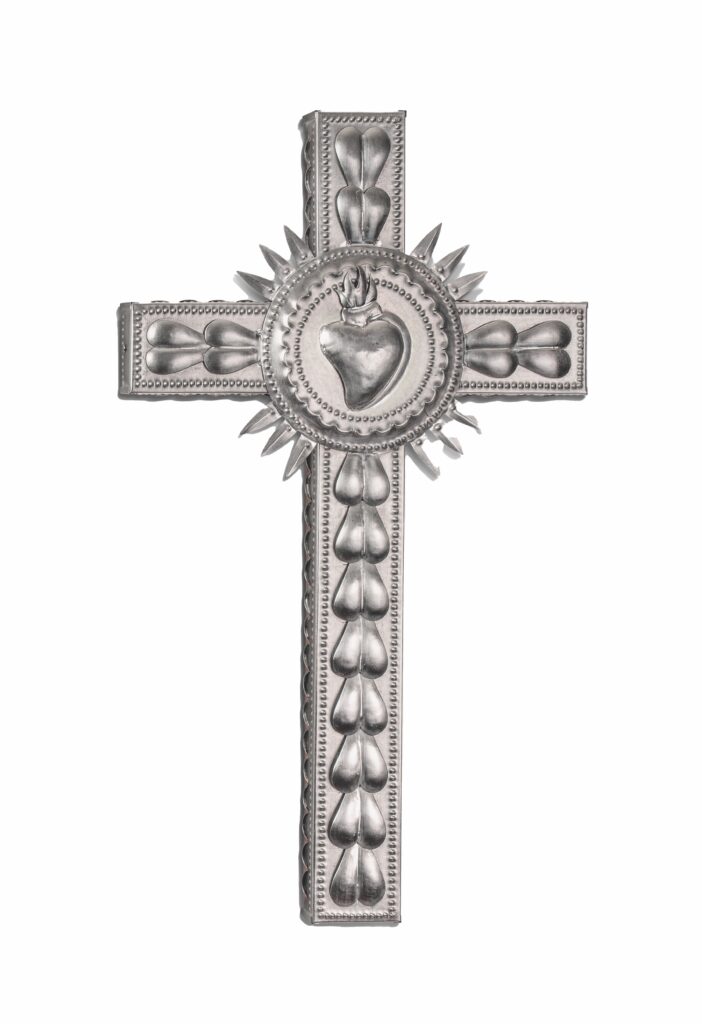
Justin Gallegos Mayrant
(c)2026
In a sense, that tension is inherent to the form. “As an outsider looking at folk art, you might not see the changes all that greatly. But trust me, the older generation will notice what the younger one is changing, what they’re leaving out or adding in,” says Moreno. “It’s a very important step because if they don’t take the past and adapt it to the present, it becomes meaningless.”
While today, Mayrant has a comfortable life as a full-time artist, he once contemplated giving up on tinwork entirely. His antique material supply was running out and he couldn’t continue his detailed practice with “garbage” modern material. “You can’t really solder it, it has a grainy look to it and it’s just designed for a different purpose,” he says. Unable to find a new supply of the scarce material, he sought guidance from a local master tinsmith and long-time supporter of his work who was retiring. That tinsmith was Robert Woodman, known locally for working under John Gaw Meem, the architect credited with revitalising the Pueblo Revival style; a blend of Native American and Spanish Colonial architecture which has a clear influence on Santa Fe’s aesthetic today.
Trust me, the older generation will notice what the younger one is changing. It’s a very important step because if they don’t take the past and adapt it to the present, it becomes meaningless
Woodman pondered Mayrant’s situation for half a year, before deciding to hand over his entire supply of antique steel. “That ties into my thoughtful process,” says Mayrant. “Being very careful with how it’s used and paying respect to that material and the fact that I have it in the first place.”
While Mayrant is one of the lucky ones, he still worries about the future of tinwork and has spent hours researching foundries, hounding local shop-owners and ordering samples to no avail. “I want to see someone that’s inspired by the work done before me, possibly even by my own work, and see what they do with it,” he says. “How they’ll become a bridge for the next generation.
“If I don’t figure that out, I might be one of the last practising tinsmiths of New Mexico tinwork.”