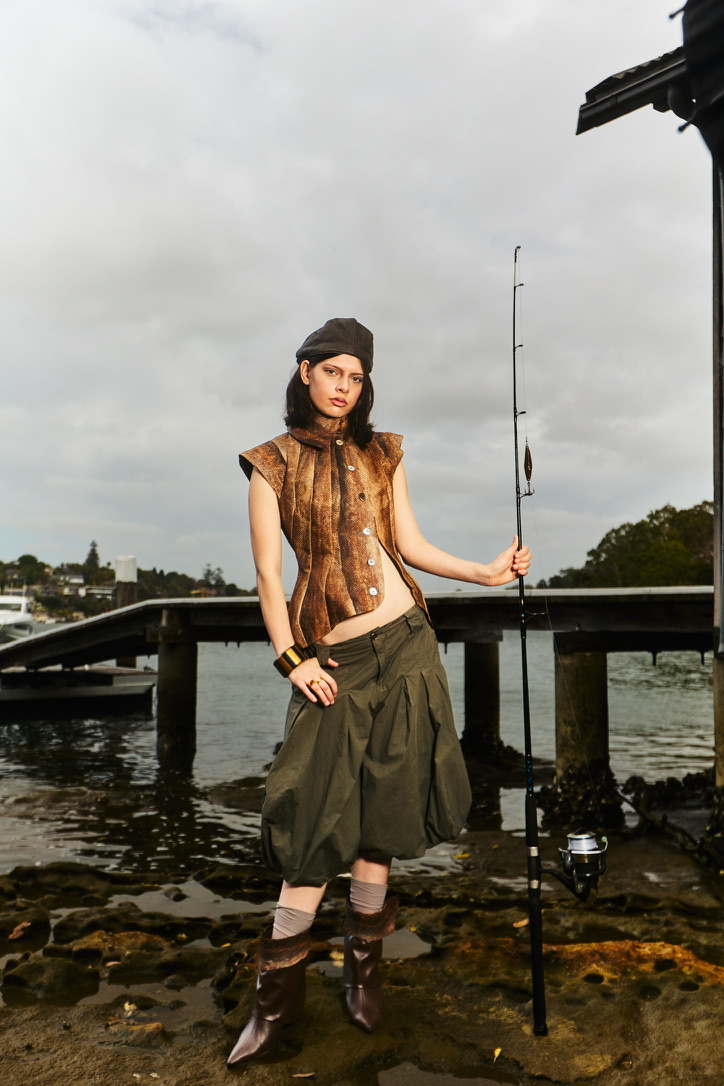
Making clothing is one of the most ancient human art forms. For millennia, clothes have served not only for warmth, protection and durability, but also as symbols of who we are and where we come from. Pre-Industrial Revolution clothing was all made by hand, intended to last a lifetime and then some. Over the last decade, the fashion industry and consumers alike have become increasingly aware of the perils of fast fashion, the business model where retailers mass-produce trending products, often in unethical conditions, and sell them cheaply, enticing consumers into a cycle of constantly buying new, low-quality items. These garments are intended to be worn once and thrown away, amounting to the fashion industry making up 10 percent of global carbon emissions.
While in recent years many brands have pledged to implement more sustainable practices, and secondhand platforms such as Vinted and Depop are more popular than ever with younger generations, in Britain alone an estimated 1.4 billion items of clothing are still thrown away each year.
Hen’s Teeth spoke with three designers, who are honouring ancient practices of craft, creating with intention and material resourcefulness to bring something new, unique and environmentally friendly into the world.
“Some people see fish leather and think it’s horrible”
Laura Brown, designer, Mercury
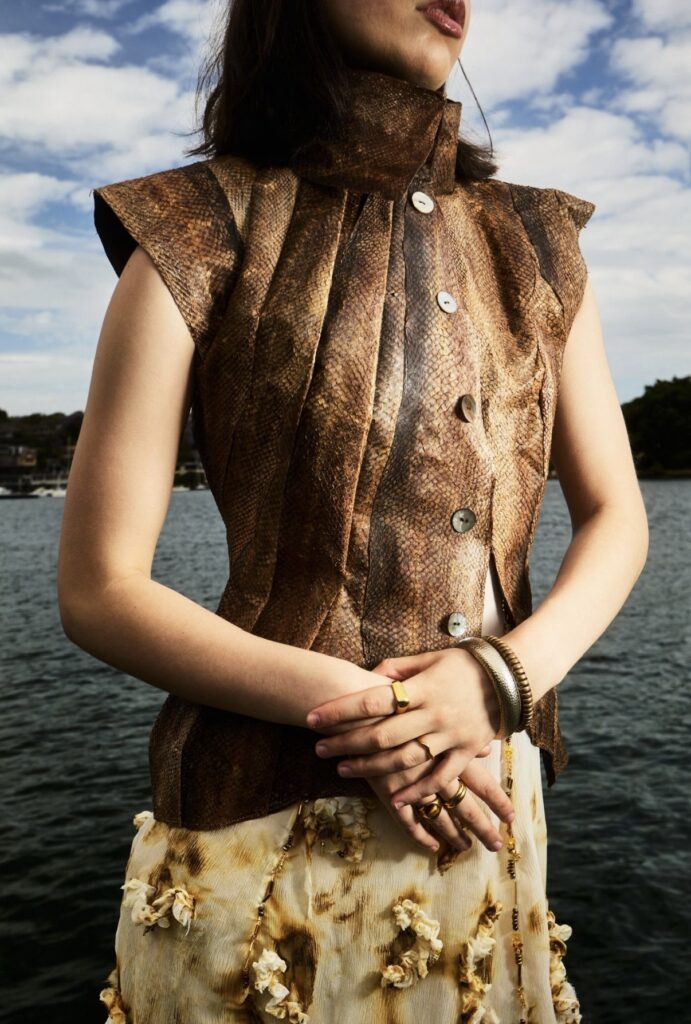
Laura Brown, 23 , lives in Sydney. Her fashion label, Mercury, repurposes discarded fish skins to make sustainable leather garments
Born and raised in Sydney, a stone’s throw from the Pacific, designer Laura Brown, 23, spent long summers as a child on her Nonno’s boat. A fisherman by trade, who emigrated to Australia from a remote Sicilian island in the 1940s.
“A lot of my memories and family history are rooted in the ocean,fish and fishing,” saysBrown, whose label Mercury, pioneers discarded fish-skins to make sustainable leather garments.
Perhaps next in line for a fish-leather look would be Laura’s Nonno, who cried when he was told Mercury was inspired by his 70 years spent at sea: “He thinks it’s crazy, but he thinks it’s cool too,” says Laura.
Though using fish skin as a textile may seem novel, indigenous practices of utilising fish skin to make garments can be traced back thousands of years to Arctic, Japanese and Chinese traditions. Laura, who was initially inspired to experiment with fish skins by a fashion student in London via TikTok, somewhat ironically, learned the ancient practice of making ‘fish-leather’ by following YouTube tutorials created by indigenous people.
The process begins with a trip to the fish market and in the last three years, the designer has become well-known among the local fishmongers who give her their discarded salmon skins by the bucketload.
“They just have heaps of tubs, and at the end of the day, they throw them out anyway,” she says. “I get salmon skins specifically because they’re a lot tougher, and especially if you need a lot of them for a look. They’re big, and they’ve got good gradient so they’re very easy to work with.”
The real work begins once the skins get home.
“It’s not for the weak, says Laura, who handwashes the skins wearing gloves, goggles and an apron resembling a hazmat suit before descaling and scraping off the remaining meat, which she collects and throws back into the ocean to make a tasty dinner for the gulls. The scales are also saved, later to begin new lives as sequins.
The skins are washed a second time. By this stage, the odour is gone, and they’re slippery and soft to touch. Laura then begins the two-week tanning process, which involves a bath of black tea and water. The natural tannins in the tea pierce the fish skin, stiffening the fabric and preventing it from rotting. Whilst it is being treated, Laura hand massages the skin once a day to keep the leather supple and to prevent unwanted crinkling. The fish-leathers are then pinned to a board and left to dry for three days before being oiled and dried once more. Finally, they’re ready for sewing.
“I think the reason more designers don’t do it is that it is a very involved process, it’s pretty hardcore and not that glamorous,” says Laura. “A lot of things can go wrong. It takes a lot of time to nail the formula.”
While the process of making cow’s leather has a huge environmental footprint from farming to chemical treatment, requiring a cocktail of harsh chemicals, fish leather made from waste products is inherently sustainable, especially when treated using natural products such as black tea.
“With fish leather, probably the most wasteful part is the amount of water you use, which isn’t even comparable to the amount needed for making cow’s leather,” says Laura. “The water also only has tea in it, so you can just pour it down the drain.”
However, it seems unlikely that fish leather pieces will be found on the high street anytime soon. Though, with its naturally forming scales and unique patterns, the textile lends itself effortlessly to runway looks, on top of the arduous and lengthy treatment process, the fabric can be stiff and thus, impractical for everyday use. Though Laura is convinced that this is a tanning issue and that with some tweaks in the formula, fish leather could become more mainstream.
“Some people wear fur coats, pony-skin bags and croc-skin shoes, but they see fish leather and think it’s rancid or horrible,” says Laura. “I have a really big issue with that. But mostly, people are into it; my goal for Mercury is to make fish leather accessible to the ready-to-wear market.”
“How can I use these beautiful objects to make something new”
Rhiannon Davis, designer, Epona
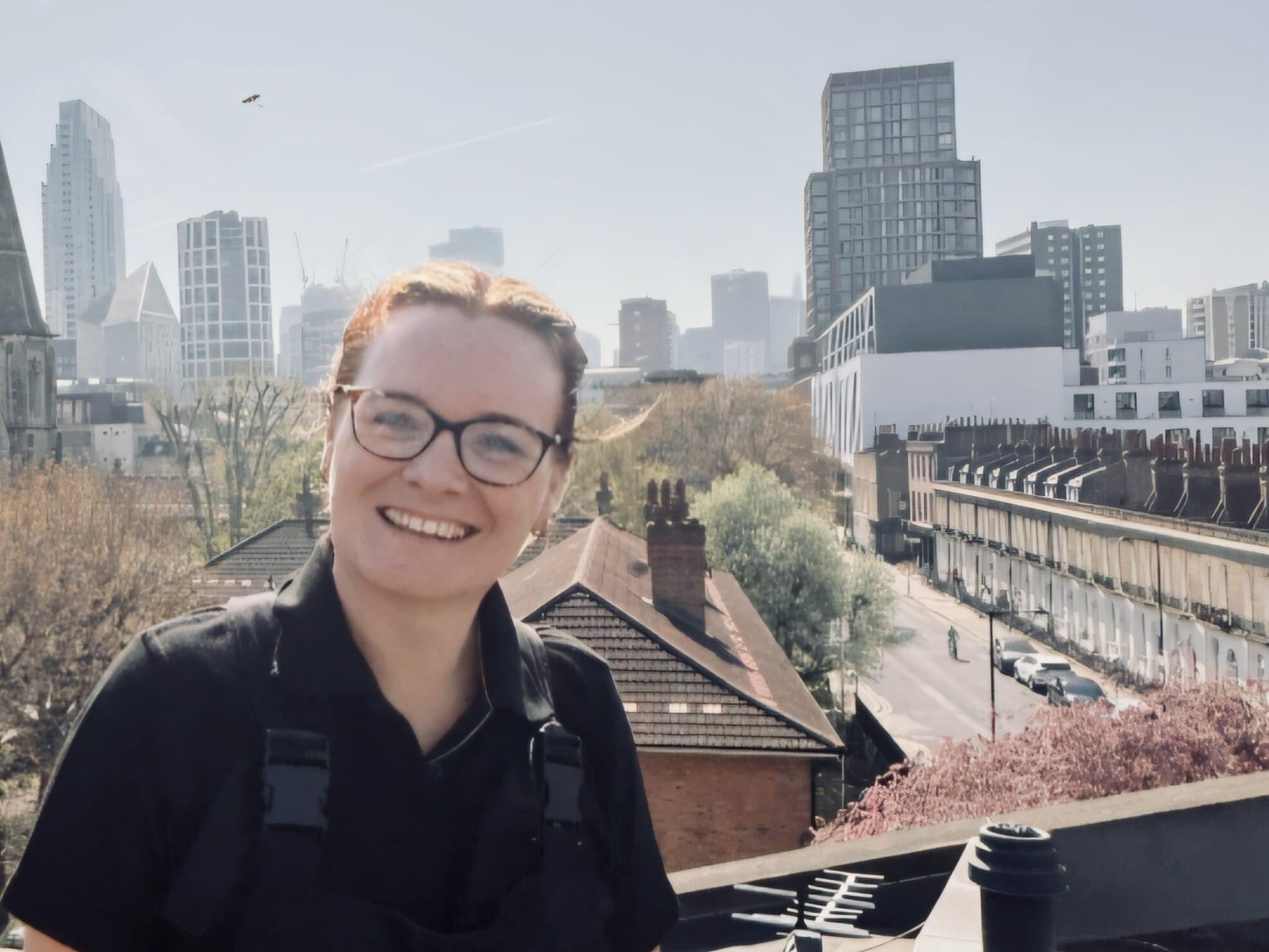
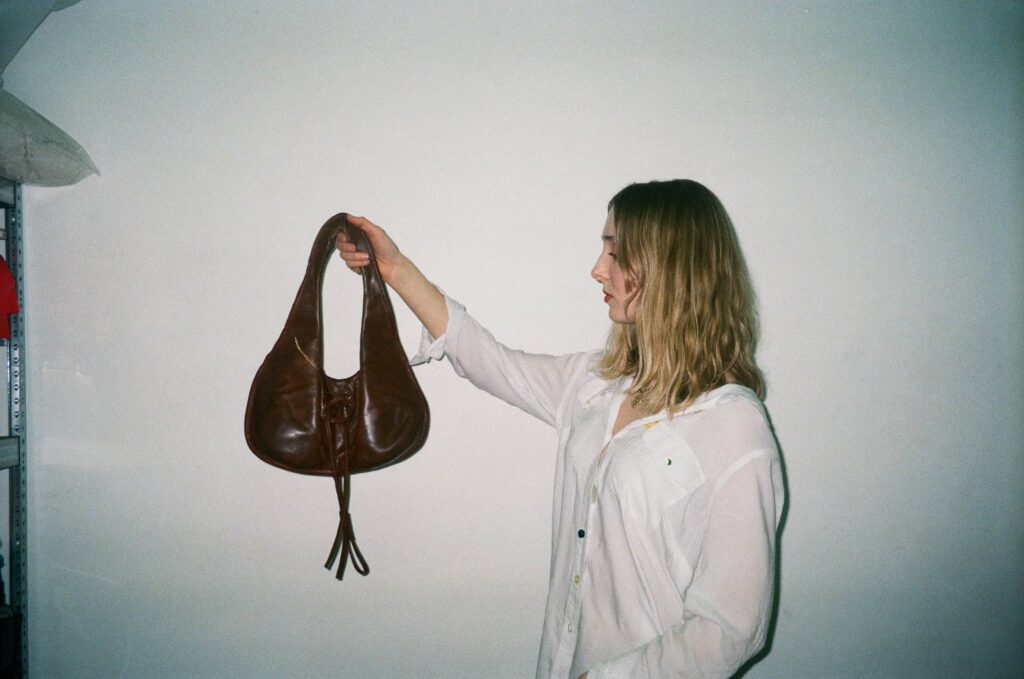
London based label ‘Epona’ founded by Rhiannon Davies, 28, repurposes discarded horse saddles to make couture garments inspired by Celtic tradition, folklore and craft.
In her studio space in Whitechapel, East London, designer Rhiannon, pulls open a drawer and lifts out panels of worn leather in chestnut and umber. Since founding her label Epona in 2020, she has been repurposing discarded horse saddles and transforming them into anything from corsets to handbags. To date, her designs have been worn by K-Pop giants BTS, singer Ashniko, and she is currently working on new pieces for iconic 70s fashion designer Mary Quant.
Epona was born in the stillness of the first national lockdown. Rhiannon, then in her final year at Central Saint Martin’s, was forced to move out of London and back in with her parents in Somerset. With little else to do besides walk and think, Rhiannon’s idea of revisiting a traditional craft began to grow.
“I found I felt really connected to the landscape around me,” says Rhiannon. “I got really interested in British folk traditions, heritage and craft and all the art that comes alongside that.”
During her research, she found that in ancient Welsh folklore, Rhiannon is the goddess of horses, fertility and the moon, symbolising strength, grace and resilience.
“I immediately connected with the image of horses; they’re so majestic and magical and have this feeling of romance and royalty,” she says. “Growing up, I could never afford to ride horses; it was a bit of a fantasy for me, but when I found out my name has this close association with the equine world, it sparked the imagination of the whole brand in itself”.
Epona, the brand’s namesake, was the Gaulish (Continental Celtic) goddess of horses and ponies, though Celtic scholars generally agree that both figures Rhiannon and Epona evolved from a much older, lost pan-Celtic horse goddess.
“I realised the saddle was a really interesting piece of art in itself that would have traditionally been hand-crafted by highly skilled leather artisans. I thought, ‘How can I take these apart and use these beautiful objects to make something new?”says Rhiannon.
Over the last five years, the designer has collected numerous unwanted saddles from eBay and equine Facebook groups and explains how there’s a story in every saddle.
“Some of the people I was taking the saddles from weren’t necessarily people who didn’t want them,” says Rhiannon. “One lady had Multiple Sclerosis, so she was forced to give up riding. She was so excited for me to take her saddle and give something that had given her so much joy a new purpose. It felt like a great responsibility to take that from her.”
It takes more than a day to break a saddle down into panels. From there, the construction of a garment can begin. Davis will then treat the leather and colour it, though she is conscious not to erase all trace of the life it had before.
“Most of the saddles I source are marked in some way, whether it’s scratches or general wear and tear, which I think is beautiful in itself, in the same way that wine can be aged over time,” she says. “I hope my customers embrace that, and I can get a balance where maybe I don’t have to make this necessarily perfect thing.”
On Davis’s workbench, sitting beside the panels of leather, is a shoebox brimming with nuts, bolts and buckles in silver and brass: “I keep every little bit of every saddle; these are all the scraps.” She points at the box, “I’ll do something with them one day, it just feels like a sin to throw anything away.”
Epona custom-makes most of its pieces for clients or to be pulled and loaned by stylists for editorial photoshoots and events, and will always be ‘slow fashion’ because of the time it takes to source the saddles, take them apart and construct the garment.
“I think accessibility is really important when it comes to sustainability, says Rhiannon. “I’m currently trying to think of ways to make Epona more widely available without compromising on craft and quality.”
“I love the history of the kilt… it’s a family history that can be passed down through generations.”
Lesley Morgan, 58
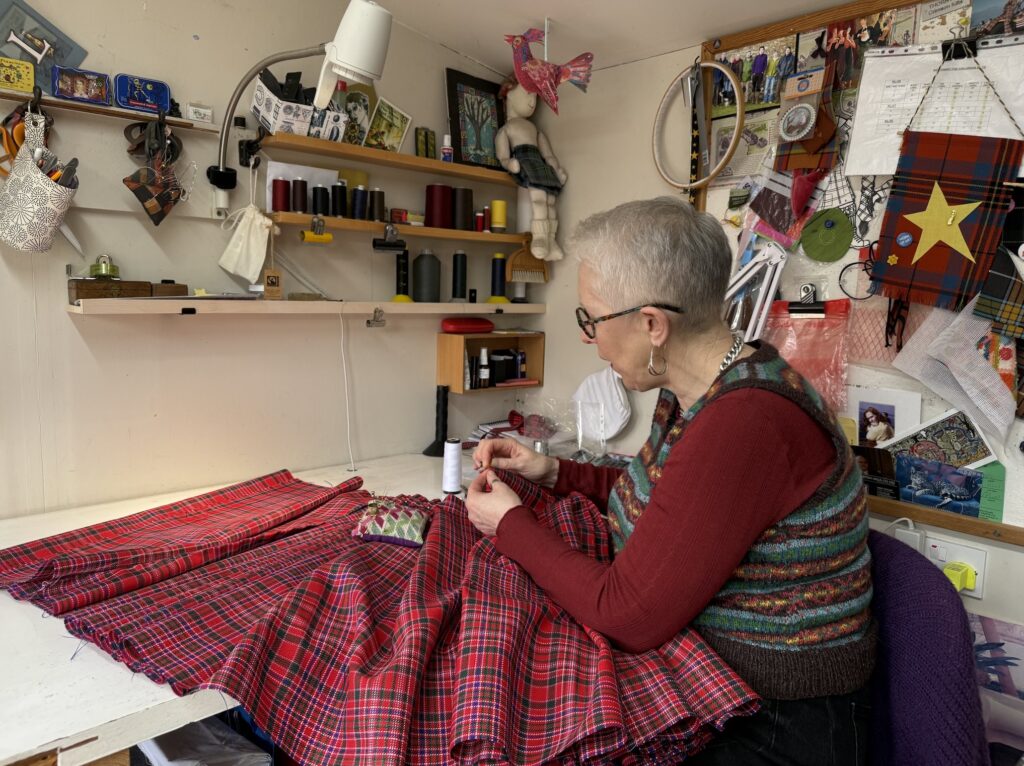
Lesley Morgan, 58, is a bespoke Kilt Atelier working out of her garden studio at the foot of the Ochil Hills, in Tillicoultry, Scotland. Morgan has been making entirely hand-sewn kilts for over 30 years, with each kilt taking between 24 to 30 hours of stitching.
Since the 19th century, the kilt has become a romantic emblem of Scottish identity as well as a cultural symbol of both royalty and rebellion. The British royal family has been sporting highland wear since Queen Victoria’s reign in the 1840s, while Vivienne Westwood made tartan a defining symbol of the punk aesthetic in the late 20th century , paving the way for designers such as John Galliano and Alexander McQueen.
“I knew that I wanted to be making something that would last,” says Leslie. “The fashion industry is very transient and seasonal and I didn’t want to put a lot of work into things that weren’t going to be kept for a long time.”
“There are many myths about the history of the kilt,” she adds.“I believe that originally it would have been woven from fleece from the sheep which the Highlanders would have owned. Wool is weatherproof, so it would have been ideal for the Scottish weather. Originally it would have just been a cloak or a blanket type garment, nothing like we have now.”
It is traditional for Scotsmen to wear the kilt at formal celebrations, with each tartan belonging to a different clan, originally intended to symbolise where you came from and the family you belonged to. “The majority of the bespoke kilts I make are for grooms,” says Leslie. “There seems to have been a resurgence in Scottish identity, the kilt has gotten more and more popular with younger people in recent years.”
Part of the beauty of the kilt is that when well-made, it promises to outlive all of its wearers, explains Leslie, who finds a lot of her work is reshaping kilts for people in their 60s who had them made when they were much younger and are looking for their original kilt fabric to fit them now.
On the worktop, pleats are taking shape in a swathe of crimson and mauve fabric, a new life is being given to a kilt that belonged to a customer’s late father. The customer, who remembered going with his parents to buy the kilt in Edinburgh as a child, is having the original fabric reworked to wear on his own wedding day. Leslie said “I love the heritage of the kilt, the fact that it’s a family history that can be passed down through generations. Every kilt is attached to a story.”
Featured photo by: Lachlan Connor