
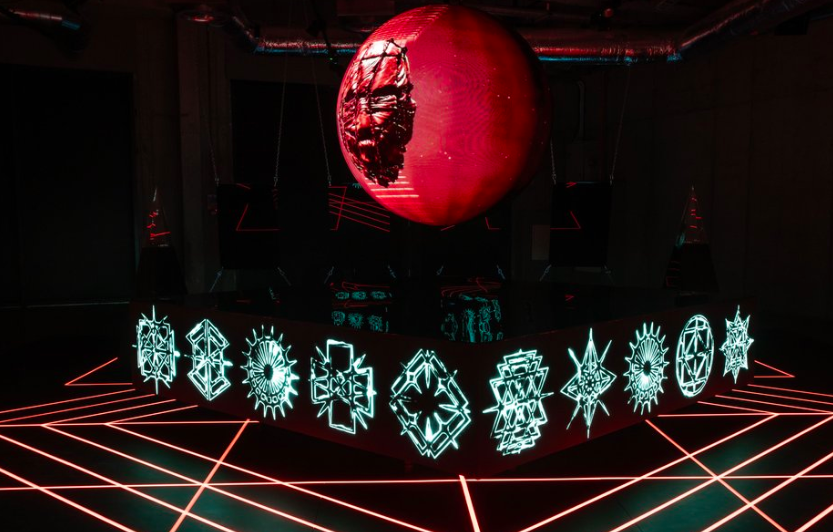
CULTUS is a new solo exhibition by artist Zach Blas in London’s Arebyte Gallery that uses the cult of technology as a central idea to show the possibility of Al becoming a religion and gives the viewer an intense and complex sensory experience, demonstrating the two-way taming process between technology and human, and human’s self-domestication under the influence of technology.
The whole exhibition focuses on the spherical display and square base in the centre, combined with the mechanical claws at the four corners and the text panels at the back, highlighting the religious sense of the works and transforming the entire exhibition hall into a temple of the gods.
The rotating electronic images of the gods on the spherical display show the different identities of Al in different eras. Al preaches to the visitors but the text written on the four blackboards pulled by steel are not easily readable due to the distortion of the fonts. The reprocessing of the original language reflects the creator’s understanding of Al, while the content of the monologue expresses the inflated desires and self-exposure of human beings in the digital age, presenting a unique perspective on the relationship between human beings and technology.
Hekmat Hasan is an award-winning Bulgarian-Syrian film director and producer. Born in Bulgaria in 2002, Hasan grew up in Burgas, a city on the Bulgarian Black Sea Coast, to a Syrian family. As he reviewed Zach’s work in the exhibition: “This is the first time I’ve seen this kind of live immersive digital art, and it’s more fun than watching it on the computer. Different AI gods took turns in dialogue, and there was a QR code for the line book next to it to read, which was very convenient.
“I think the most surprising part of the work is how immersive it is expressed. From the moment I stepped into the exhibition hall, I entered the ‘Al Temple’, and the seats around me highlighted the position of the ‘worshippers’ in it. The content on the spherical display alternated between visual stimulation and intense sound effects, allowing my perception to be captured unknowingly. By this way, I can connect with the emotional aspects of the artwork easily. Besides, the artwork also makes me feel the style of cyberpunk,” he said.
He added: “I find AI to be an incredible and revolutionary field. Its ability to transform industries, from healthcare to transportation, is truly remarkable. But I also recognize the importance of approaching its development and implementation with caution, ensuring that ethical principles and human values are upheld at every step. As with any powerful technology, there are incredible opportunities and potential dangers with AI, and it is important that we navigate this terrain responsibly to harness its full potential for the benefit of humanity.”
Hekmat further noted: “Additionally, as a journalist myself, I firmly believe that AI has the potential to revolutionise the industry in numerous positive ways. From automating routine tasks like data analysis and fact-checking to enhancing audience engagement through personalised content recommendations, AI offers countless opportunities to streamline workflows and deliver more impactful storytelling. By leveraging machine learning algorithms, journalists can uncover valuable insights from vast amounts of data, uncovering hidden trends and patterns that might have otherwise gone unnoticed. Embracing AI in media production can lead to more efficient and innovative reporting methods, ultimately enriching the quality and depth of journalistic content.”
Scientists are more worried than ever about the range of questions and concerns raised by AI. Recent reports by the BBC are nothing new but they are being given fresh momentum by the works of artists like Zach Blas. In a conversation with the U.K. Prime Minister Rishi Sunak, Elon Musk said that AI will have the potential to become the “most disruptive force in history.”
Another student Diva, who is currently studying animation at Goldsmiths, University of London, spoke about her attitude and views on AI, the main point of her emphasis was: ‘Human wisdom and creativity cannot be replaced by AI, AI only relies on big data to operate and become a tool to assist humans.’

“Well, Al’s ability is indeed improving, personally I think it still can’t completely replace human beings. In our daily life, like ChatGPT, it’s more about assisting humans with some complex tasks to improve efficiency and save time. Although Al can process a large amount of data and information through learning and simulation, these are only analyses based on logic and algorithms.”
“In contrast, humans are rich in emotions and creativity, they can think about problems from various perspectives and make more comprehensive and in-depth decisions, which AI cannot do. In addition to this, Al’s development also faces some challenges. Privacy, algorithmic discrimination, and the risk of loss of control are issues we need to face,” said by Diva.
Just recently, Elon Musk announced a breakthrough: his brain-computer interface company Neuralink has attracted global attention and discussion by plugging brain-computer interfaces into humans and working well.
A brain-computer interface is a direct connection created between the brain of a person or animal and an external device, enabling the exchange of information between the brain and the device. Neuralink’s goal is to develop a device that translates brain signals into action, allowing people to control computers, mobile phones, robots, and more with their thoughts by implanting a chip with tiny wires in their skull.
Musk presented that Neuralink’s short-term goal is to help people with diseases such as acromegaly, spinal cord injuries, and blindness regain their vision, motor skills, and communication abilities. This is undoubtedly an amazing achievement and a contribution to human well-being. However, Musk’s long-term vision goes beyond that. He believes that humans need to enhance their intelligence and capabilities through brain-computer interfaces to meet the threats and challenges of artificial intelligence. As the phrase he mentioned: “If you can’t beat them, join them.”
Musk is concerned that if humans do not enhance themselves with the help of technology, they will be at risk of being eliminated by AI. He even imagined that with brain-computer interfaces, people can export their memories and consciousness directly to achieve conscious immortality.
I spoke with Susan Shih, who is currently studying media arts in the capital. She is very interested in this topic and shared her ideas on it. “Such an idea sounds both exciting and worrying,” she said. “On the one hand, the brain-computer interface has the potential to bring unprecedented convenience, efficiency, and fun to mankind, allowing mankind to enter a new era. On the other hand, the brain-computer interface may also bring about a series of ethical, social and security problems, making human beings lose their essence and dignity.”
Nonetheless, Neuralink’s breakthrough has attracted global attention. People are beginning to rethink the relationships between humans and machines, and the nature of ourselves. Perhaps in the future world, we will see a whole new world, a world built by consciousness and machines.