With plans to take place on 2 May 2024, the London mayoral election is imminent.
Current mayor and Labour candidate Sadiq Khan is running alongside the Conservative Party candidate Susan Hall, Rob Blackie of the Liberal Democrats, Zoë Garblett of the Green Party, Reform UK’s (formerly known as the Brexit Party) Howard Cox, Amy Gallagher of the Social Democrats and independent campaigner, Shyam Batra. Khan has served two terms as London mayor, first assuming the role in 2016. If successful, he would be the first candidate to serve a third term since the role’s creation in 2000.
In 2023, YouGov published a report following the local elections in England. The data the population’s engagement with the voting process by age and gender.
From the 18-24 age bracket, thirty-eight percent of respondents who voted in the last election agreed they knew ‘a great deal’ about the upcoming London mayoral election. On the other hand, five percent of 18-24 non-voters stated that they did not get any information on candidates or knew what they stood for. Similarly, of the same demographic, five percent expressed they simply did not want to vote. The 18-24 cohort ranked the highest on statements concerning a lack of information and desire to vote.
So, what can the new London mayor do to get young people into polling stations? We set out into the city to find the answer.
First, I spoke with Alex Smith and Dev Shiva, 24, who are MA Education students at Goldsmiths University in Lewisham, Greater London.
Do you know who the current mayor of London is?
A & D: Yes, Sadiq Khan.
How do you feel about Sadiq Khan?
D: On one hand, he’s progressive. His policies refer to the little man, looking out to help them. My dad used to be a cab driver and he imposed a lot of new regulations on cab drivers. A lot of people who come here as first-generation immigrants are getting into that, so I think there’s a disregard. I might be slightly biased, though I think he’s disguised in red but operates in blue.
One of the regulations Dev is referring to is the Ultra Low Emission Zone (ULEZ), first proposed by then-London mayor and former Tory PM Boris Johnson in 2015. ULEZ took effect in 2020, under Khan’s Labour administration, allegedly to combat climate change caused by heavy-polluting vehicles. A daily charge of £12.50 is levied to drivers passing through this zone. While the city’s iconic black cabs are exempt from the charge, private hires and minicabs are not making the profession wildly more expensive to work in.
Did you know that there’s a mayoral election coming up in May?
A & D: Nope!
Khan is running again this year. Do you know of any other candidates?
A & D: Nope!
Did you vote in the last mayoral election?
D: I did not.
A: I just got my citizenship, so I couldn’t vote
What is the first thing the next London mayor needs to do to get your vote?
D: Renege on ULEZ! The fact that ULEZ has been expanded to the entire Greater London area is disgusting. Khan acts as if it’s in London’s best interest, for more ‘green’ solutions when all the money is being funnelled into Transport for London. It’s a clear money grab. The only people who are going to be affected are the people with older vehicles who cannot afford to replace them, so again, it’s a ‘green-washed’ policy. By that, I mean it’s one of the policies lawmakers make to challenge climate change because it’s a new fad. On the other hand, it has the underlying effect of hurting people who do not have money. Electric cars are expensive and need to be replaced every five years, so it’s clear that he does not care about the people.
Is there any London celebrity you would like to see as London mayor?
A: Maybe somebody with a science background. We need somebody who can show they can handle a lot, but also somebody who can prioritise what’s important.
Do you think young people care about the mayoral election? Or that mayoral candidates care for young people?
A: They appear like they’re trying to get the young crowd. We would need somebody with empathy. Somebody who can remain nice under pressure.
D: Yeah, there are clearly underfunded boroughs of London. We are operating in an underfunded borough of London.
A: To me, there is no point of a Mayor.
Now that you’re aware of the election, will you do further research and vote?
A: Probably not.
D: No, it feels like a two-party system anyway. And I don’t resonate with either of them.
As the 2021 London mayor election results show, the vote is predominantly split between the Labour Party and the Conservative Party. Khan received 40% of the vote, with Shaun Bailey of the Conservatives following close behind with around 800,000 first-choice votes. However, young people might slowly be dismantling this complex.
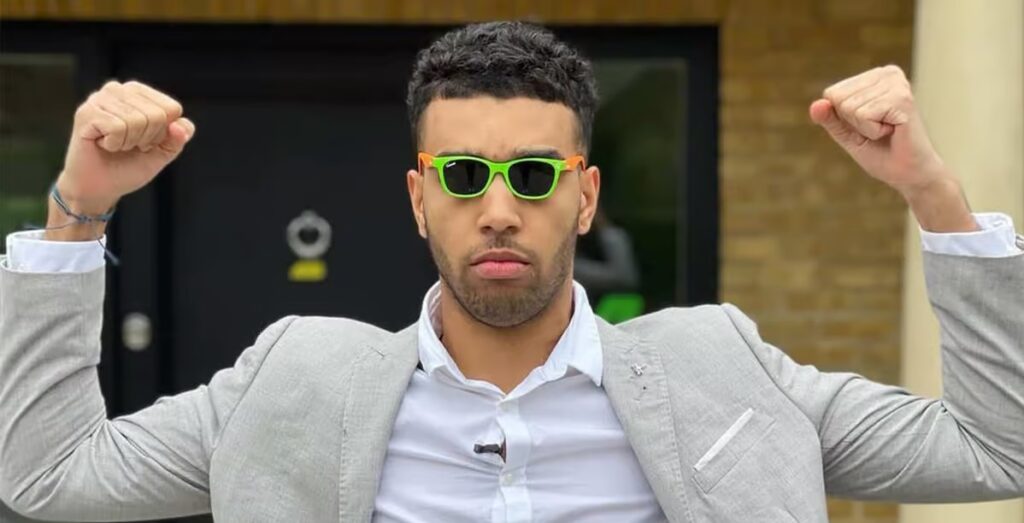
Collecting 49,000 first-choice votes, 23-year-old Independent candidate and YouTuber Niko Omilana placed fifth in the polls with a manifesto predicated on telling then-PM Boris Johnson to shush. He outvoted well-established parties such as the Social Democrats, Reclaim Party, Rejoin EU and UKIP. Perhaps, the youth of London don’t want a new mayor, but some peace and quiet.
Fellow YouTuber Max Fosh also ran for London Mayor but actively told followers not to vote for him. The race ended with Fosh receiving 0.2% of the vote. In an interview with the BBC, Fosh asserted that his main endeavour whilst running for Mayor of London was to increase the youth turnout: “I looked at the data in previous elections and the youth turnout in the UK is really, really low and so I thought that hopefully by having a horse in the race or a YouTuber who’s there, who’s doing it would slightly encourage more people to vote.”
Aaron, 20, commutes across the capital to get to work. Starting his journey in Seven Sisters, his day of travel is spread across the London Overground and new Elizabeth Line to Whitechapel. Despite only opening in 2022, Aaron insists the Elizabeth line needs a great deal of improvement for Khan to get his vote. He claims he faces delays and cancellations daily, and the price he pays for a monthly travel card – upwards of £200 – is not justified by the quality of the service. Aaron tells us he wrote a letter in February 2024 to the Oyster Fulfilment team after once again having to call an Uber to work due to defective service and “does not care if he has to make social media posts or write to Sadiq Khan himself, he will not keep quiet about the state of London for its price.”
Aaron’s frustration is widely shared, with train fares set to increase by 4.9% in March 2024. Khan has frozen this charge for Londoners until March 2025, though the reliability of TfL itself remains a point of contingency for many Londoners.
In a final interview, we spoke to Corinna and Latifah, 20, who are Goldsmiths students studying BSc Psychology and BSc Creative Computing, respectively. They shared with London London London how vectors such as race, age and candidates’ alleged empty promises allegedly sway their vote.
If you’d like to make your voice heard, you can register to vote here. We await the results.