
Featured image: photo by Maria Budanova via Unsplash
Experts explain the science behind hypnosis
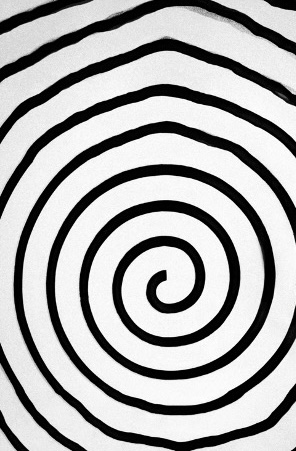
The hypnotic spiral is a recognisable image in popular culture, but do they really have anything to do with hypnosis? Here two experts explain the science behind hypnosis, suggestibility, and why the spiral has become its iconic symbol.

Psychologist Devin Terhune is an Associate Professor in Experimental Psychology at King’s College London, where he leads the Awareness & Modulation Lab. His research focuses on hypnosis, suggestion, and
how perception and consciousness can be altered.

Anthropologist Nicholas Long is an Associate Professor in the Department of Anthropology at LSE, researching hypnosis, hypnotherapy, and consciousness.
Q: Why are spirals associated with hypnosis?
Devin Terhune: The specific origins are not completely clear. Spirals and related props are not necessary for hypnosis. There is no evidence they enhance response to hypnosis, and they were never incorporated into hypnosis practices. My understanding is that they were introduced as a visual analogy, as spirals are associated with visual illusions – effectively a visual way of depicting how hypnosis can alter your perception. It seems some stage hypnotists and entertainers used such techniques, perhaps to capitalise on these depictions in popular culture, but again, they don’t appear to have been widely used. However, I suspect they would function as a distraction that might impair performance on any task requiring attention.
Nicholas Long: Hypnosis can happen whenever attention is focused on a single point, and while spirals or concentric circles can help with that, they’re not unique; many hypnotherapists simply use a finger or a fixed point in the
room. Circles are more of a visual shortcut: they’re dramatic, easy to draw, and clearly signal that something unusual is happening. Over time, they’ve become a kind of shorthand in films and cartoons. This can even create “expectancy
effects”, where people believe spirals will hypnotise them, making them more open to suggestion in the first place.
Q: What happens in the brain during hypnosis?
Devin Terhune: Hypnosis is better understood as a set of techniques rather than a fixed state. People will vary their response to verbal suggestions. In response to a hypnotic induction, most people experience greater relaxation and feel somewhat detached from their bodies. In the brain, there is evidence that this is associated with reduced activity in areas linked to mind-wandering and self-reflection. This may reflect a way in which someone is not critically evaluating their experiences in a way that we might otherwise do, meaning more suggestible individuals tend to experience stronger effects.
Nicholas Long: There’s general agreement that hypnosis involves a state of intense focus and absorption. People often experience more vivid mental imagery and become more responsive to suggestions, sometimes feeling as
though actions happen automatically. Beyond that, there’s still debate, and researchers and practitioners offer different explanations, and several cognitive processes are likely involved, rather than a single mechanism.
Q: Why do some people seem more hypnotisable than others?
Devin Terhune: We don’t have a deep understanding of this. There is some evidence that hypnotic suggestibility is heritable, so one’s suggestibility is partly influenced by genetics. There is also some evidence that parental encouragement of imagination may facilitate a higher level of hypnotic suggestibility. Accordingly, children who are encouraged to learn an instrument, take part in drama, acting or art, or have imaginary friends may end up being more suggestible. There is also some evidence that those who are more suggestible may have a poorer time distinguishing the sources of control.
Nicholas Long: There’s no single explanation. Hypnosis is partly a skill that can be developed: the more people practise it, the more responsive they can become. Factors like personality, environment, and expectation all play a role. For example, someone who wants to be hypnotised, or is in a calm, focused setting, is more likely to respond. Certain symbols or props, like spirals, can also increase suggestibility by reinforcing the expectation that hypnosis will happen.