Category: Intuition

  • Can You Really Spot AI-Written Work?

    Can You Really Spot AI-Written Work?

    Last year, a national survey found that the majority of journalism students had used AI tools to assist with their coursework at least once. Most said they didn’t consider it cheating. Many said their universities had never told them it was. The debate about artificial intelligence and academic integrity has generated significant coverage — but the more specific question of what it means for a profession that runs on human judgment has received considerably less attention.

    Strange, isn’t it? That paragraph, the one you’ve just read through, felt off. Like something was wrong, but you weren’t sure what. 

    The excerpt was entirely generated by AI — specifically, a prompt I gave to Claude in which I asked it for “AI text that’s recognisable as AI to a trained eye, but not so lifeless that a casual reader bounces”.

    “Your brain has already begun developing a ‘sixth sense’ for separating what’s human from what isn’t”

    Since ChatGPT was made publicly available in 2022, writing on the internet has changed substantially. The capacity to generate text on more or less any subject matter, in merely a few moments, irrespective of writing ability, has resulted in, at the end of 2024, over 50 per cent of new articles published online being written by generative AI, according to research conducted by Graphite, an American AI and search engine optimisation (SEO) firm.

    Image: Graphite.io

    It becomes inevitable, then, that those of us who spend time reading or writing online will come across AI work, in one form or another.  If you did experience that ‘strange feeling’ I talked about earlier, your brain has already begun developing a ‘sixth sense’ for separating what’s human from what isn’t. It’s learned through exposure and developed subconsciously, akin to a musician who can identify an incorrect note as it sounds, or an editor who can sense a weak lede before going through the rest of the story. 

    A study from the University of Massachusetts Amherst found that, among annotators who frequently use large language models (LLMs) for writing tasks, the incorrect detection rate is only 1 in 300. This is a near-perfect rate and outperforms every AI detector commercially available. It also, crucially, supports the idea that a new form of intuition has been developing in the minds of those working closely with AI. 

    Image: Steve A Johnson on Unsplash

    Out of 1041 students surveyed by the Higher Education Policy Institute in 2025, 92 per cent reported that they used AI in some capacity for university work, a 25 per cent increase compared to 2024, with 51 per cent using LLMs to work directly on their assessments, an increase of 29 per cent. Eight per cent of these students said they used AI in their assessment without editing, meaning the AI writing you and I have developed a ‘sixth sense’ for will, undoubtedly, be somewhere at some academic institution, away from public view. 

    The hallmarks of AI writing, once you are familiar with them, are remarkably consistent. There is an overuse of certain words, like ‘tapestry’, demonstrated by research in Proceedings of the National Academy of Sciences, and a tendency to be “hyper-adjectival”, according to Wendy Laura Belcher in The Chronicle of Higher Education, dressing up a lack of conviction in some pretty sounding words or metaphors, irrespective of accuracy. 

    More importantly, the writing lacks any of the little quirks that make it human. Certain word choices or sentence structure choices that, while maybe not the most algorithmically efficient way of producing prose, represent a decision, made by a person, indicative of his or her lived or learned experiences, for a reason we might never know.

    LLMs aren’t capable of that nuance, instead producing, by design, a statistical average of all the writing that they’ve been trained on. What you read when you read AI work is an amalgamation of all that human context and feeling, watered down into a formula. Take em dashes, for example. Once a slightly more niche form of punctuation among your everyday person, the extent of their inclusion in AI training data —  work from Emily Dickinson being a well-known example — has meant they now appear absolutely everywhere, irrespective of whether or not a comma or semicolon would, perhaps, be more appropriate contextually. 

    While these markers serve as a useful tool in analysing AI work, they don’t constitute a final verdict in determining whether or not the writing was entirely AI-generated. 
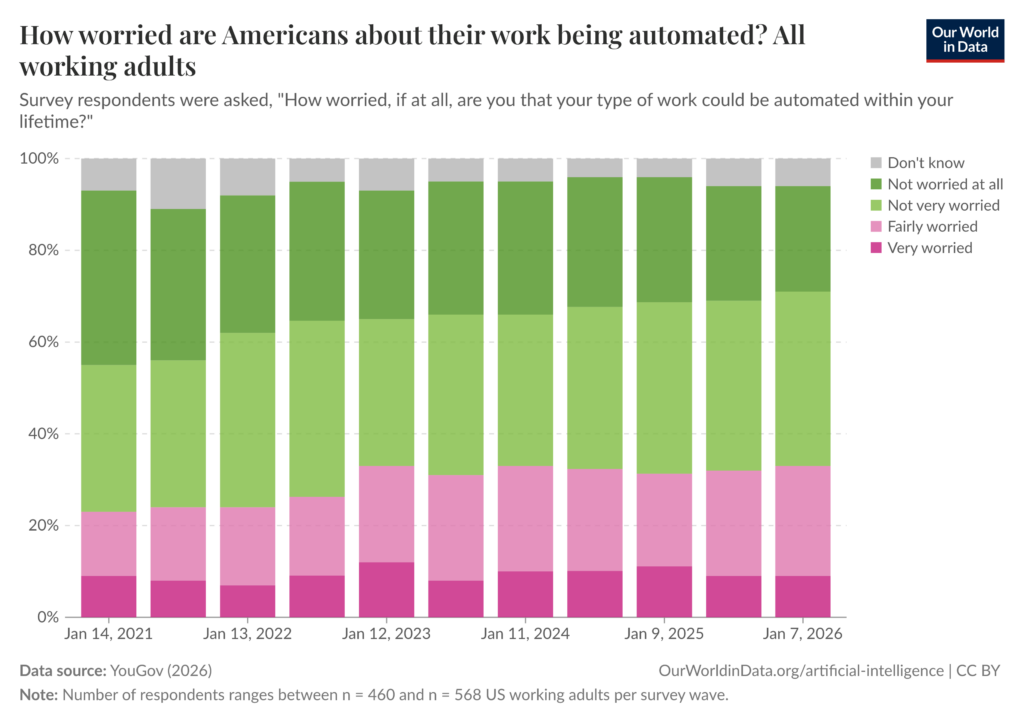
    Image: Our World in Data

    One former student, who has asked not to be named, says she faced backlash on her work from her professors, despite no AI involvement, and that her work was “questioned”, with claims of not being how she would “normally say things”. Even with no formal disciplinary action, she felt as if the accusations resulted in her being “marked down on essays”. 

    Ironically, the crux of the allegations made against her stemmed from a professor getting her to attend an English as a second language course, which she was “involuntarily signed up for”, because of her northern accent. After the course, she altered her writing style to “sound more professional”, leading to the loss of her own voice and eventually to the accusations of AI usage. 

    Rory, whose name has been changed for privacy reasons, was an international student at a London university in his second year when he was accused of using AI in his work. The professor — who was also the head of assessments — making the claims, Rory says, was someone whom he had never met, nor did he teach on the module for which he was making allegations.

    “Despite his passing grade, the professor still tried to have him withdrawn from the course”

    A Zoom meeting was arranged to discuss the accusations, where the professor revealed that he put Rory’s work “through an AI checker, and he said that the feedback came out 100 per cent AI-generated”. Rory notes that the teacher, with no prior knowledge of his writing style, failed to compare the accused work with work he had done in September 2022, his first year, and a month prior to ChatGPT’s release. Rory maintains that the writing style was consistent throughout. After the meeting, he was told he could either accept the allegations and rewrite the essay in person, capped at 40 per cent, or he could raise the issue through a hearing. Rory chose the hearing.

    His course coordinator, a module professor, and the initial accuser were present. “I showed my essays from before generative AI, my notes from lessons, which I used to write the essay, some of the drafts, and explained my thought process behind the essay,” Rory says. He was cleared of any wrongdoing, despite evidence “only being to the satisfaction of two of the members”.

    Unbeknownst to Rory, his initial accuser then went back through each of the submissions he had made while at university. He found a formative 500-word essay, which Rory says was submitted only two days late in the first term of his first year. He notes that, at the time, the “submission was accepted and graded, and I passed the first year with no problems”.

    Despite his passing grade, the professor still tried to have him withdrawn from the course. Rory raised a ‘Stage 1’ appeal, which is designated to the head of assessments, and he was, inevitably, rejected. He then escalated the appeal to ‘Stage 2’, which involved showing photo proof of submission, passing grade, and the final marksheet. The accuser argued that the late submission should count as a fail, and that Rory should be “withdrawn from the course”. Rory says the head of assessments did not wait for the outcome and tried to have him preemptively kicked out of the university. 

    “I had to get lawyers involved,” he says.

    Rory was permitted to proceed to the third year, but his disillusionment with how the university handled his alleged AI usage left him with “a bad taste and distrust in the organisation”, and he opted to leave. 

    Image: Edwin Andrad on Unsplash.

    In both instances, generative AI, or the suspicion of it, had a direct impact on the students’ degrees, pointing to a broader failure with universities in adapting to the technology, both from an education and detection standpoint. Although the unprecedented nature and access of commercial LLMs mean the failures are not necessarily the fault of universities, rather, they are dealing with a unique issue, relying on ill-equipped tools and frameworks. 

    Failings of AI detection — including a disproportionately high level of false positives attributed to non-native English speakers, according to research by Nathan Garland, such as Rory, who use punctuation like em dashes, as it promotes a ‘professional tone’ — have fostered a culture that is now hesitant to reprimand students for fear of getting it wrong. 

    Felix Simon, a researcher at the Reuters Institute for the Study of Journalism at Oxford University — whose work has informed evidence given to both the House of Commons and House of Lords on AI and Journalism — believes that the research surrounding AI usage in journalism training is “under-explored”. He recognises the difficulty in applying the tool, noting that journalism schools are “grappling with the question of how to integrate AI into their curriculum and how to educate the next generation of journalists for a challenging news landscape”. 

    “Why does it matter so much if text was generated with the help of AI, if the facts are accurate?”

    On the topic of detection, Simon remains a sceptic, even when it comes to trained professionals. “My hunch is that the answer is ‘no’”, he says when asked if competent editors can reliably detect AI-generated writing. “They might be able to detect unedited text that comes straight out of an AI, but I doubt they can say if it was AI or not if the text has been edited afterwards”. Simon also sees AI-detection software as being “unreliable”, and that he is “not convinced that it works apart for [sic] text that comes straight out of a generative system and has not been edited”.

    Felix Simon. Image: Reuters Institute.

    Simon notes that the “ground is constantly shifting as these models improve and as text is further processed”. This complicates research from the University of Massachusetts Amherst cited earlier, and the idea of a learned intuition for spotting AI-written text. Simon believes the detection tools can’t keep up with the continuous upgrades to systems and advanced prompting that remove the hallmarks of AI writing. By extension, that ‘sixth sense’ may already be failing to keep up with the models it is trying to read. 

    “Both came away disillusioned, and both felt they weren’t taken seriously”

    “Why does it matter so much if text was generated with the help of AI, if the facts are accurate?” he says, a question harder to answer than it appears. A 2025 study by Alexandra Fiedler concludes that even lecturers aren’t capable of reliably identifying AI text, further blurring the lines between human and AI-produced work. 

    ‘Perplexity AI Dashboard’. Image: Aerps.com on Unsplash.

    In a bid to address some of these issues, certain publications have started applying ‘AI-Generated’ labels to headlines. But the solution may not be so straightforward, as, according to research from Sacha Altay and Fabrizio Gilardi, the designation lowered readers’ perceived accuracy and willingness to share the pieces. In other words, the ‘AI-generated’ tag acts less as a transparency label and more as a burden for the piece it’s attached to, shifting the task of deciphering what’s trustworthy and what isn’t onto the audience. 

    For people like Rory or the unnamed student, the early overcompensation of universities has left a mark on their education that is hard to erase. Both came away disillusioned, and both felt they weren’t taken seriously. Now, they may feel the pendulum has shifted in the opposite direction. 

    Simon believes the conversation surrounding AI should be more nuanced, and that “the simple dichotomy ‘AI/Not AI’ isn’t very helpful at this point”. He suggests the debate may not even be starting in the right place.

     “Are we asking the right question?” 

    The question of authorship has never been straightforward. Long before language models existed, writers borrowed, echoed, and absorbed the voices around them — editors shaped prose, collaborators dissolved into single bylines, ghost-writers vanished behind names that were not their own. What artificial intelligence has done is not invent a new problem, but accelerate an old one past the point where the existing language can keep up. Perhaps the more honest question is not whether a piece of writing is human, but whether it is true.

    Did you spot that?
  • Hidden Energies of Greenwich: Where Time Begins

    Hidden Energies of Greenwich: Where Time Begins

    On a hill in Greenwich Park, a thin metal line runs across the ground, marking zero degrees longitude, the point where east meets west, and the world’s time begins. Beneath your feet runs the Prime Meridian, the invisible line that divides east from west and anchors global time. Each day, visitors queue outside the Royal Observatory to stand astride the line, one foot in each hemisphere, smiling for photographs as if they have briefly stepped outside the ordinary rules of geography. Yet many visitors describe something else when they arrive on the hill: a subtle feeling that the place carries a particular presence. Not necessarily mystical, but intuitive. A sense that certain landscapes seem meaningful before we fully understand why.

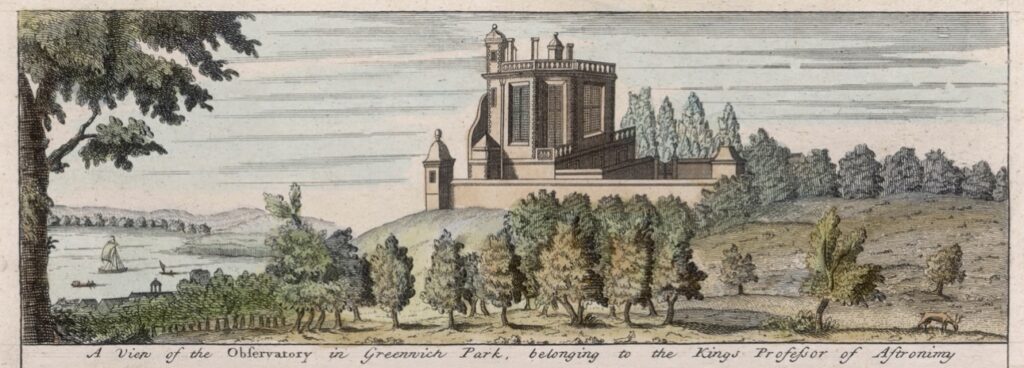
    Sketch of the observatory. Image: Adobe Stock

    It is a playful moment, but the setting lends it unexpected weight. The hill rises above the Thames, open to the sky, with sweeping views across London. For many visitors, the experience feels strangely grounding, as though the landscape itself carries a quiet significance. Some might find themselves wondering, “Why here?”

    It is the kind of question that sits somewhere between science and human intuition. Maps and measurements explain part of the answer, but human beings have long relied on intuition when choosing where to build, gather, and observe the sky. The true answer, historically speaking, is surprisingly practical. When the Royal Observatory was founded in the seventeenth century, its purpose was to solve one of the most pressing problems of the age: determining longitude at sea.

    Accurate navigation depended on understanding the relationship between time and position, and astronomers needed a location where the stars could be observed clearly. Practical reasons may have determined the final decision, but the qualities that made Greenwich useful for astronomy, elevation, open horizons, and distance from the noise of the city are the same qualities that people instinctively respond to today. Intuition often begins with the body: a quiet sense of stillness, perspective, or clarity in a particular place.

    According to Louise Devoy of the Royal Observatory Greenwich, the site was chosen largely for logistical reasons.

    “When the Royal Observatory was established in the seventeenth century, Christopher Wren [the architect of the Observatory] was actually looking at a couple of different places,” she explains. “There was an option near Chelsea to be closer to the royal court, and another in Hyde Park. But Greenwich was ideal mainly because it was free.”

    The land sat within a royal park and was readily available to the Crown. Geography also played an important role. “That hilltop location gives you good visibility,” Devoy says. “You can see the stars rising and setting across the horizon.”

    Distance from London’s smoky centre also mattered. In the seventeenth century, the city’s fires, chimneys, and growing population produced a haze that interfered with astronomical observations. “It was about five or six miles away from the main city,” Devoy explains, “so away from smoke or interference. But you still had the river, which enabled the Astronomer Royal to get the ferry back into town to meet with other scholars. So it seemed like a good option all around.”

    On the surface, Greenwich’s story is one of pragmatism. Yet the qualities that made the site scientifically useful, elevation, open sky, and distance from urban noise, are the same qualities that shape how it feels today.

    Long before telescopes were installed, the hill already held historical significance. The site once hosted Duke Humphrey’s Tower, a medieval structure associated with an early royal library. The surrounding park contains traces of Roman activity and centuries of layered history.

    As Chris Hawkins, a volunteer with Friends of Greenwich Park, explains, “Greenwich is a place that has been chosen again and again across history. Its beauty, elevation, and wide views over the Thames have consistently drawn different groups to it, from royalty to scientists.”

    That sense of continuity is reflected in its royal past. “Before it became a scientific landmark, Greenwich was closely tied to the life of Elizabeth I, who was born at the Palace of Placentia, which was demolished in the 17th century to make way for the Royal Navy hospital that stands there now,” Hawkins says, describing a time when the area was a centre of royal power and court life.

    The landscape itself may help explain this enduring appeal. “The hill in Greenwich Park would have stood out in any period; it’s a natural vantage point over the Thames, and that alone would have made it significant,” he notes.

    Devoy is also careful not to suggest that ancient symbolism influenced the Observatory’s location. “As far as I know, the choice was much more pragmatic,” she says. And yet visitors often experience the place in ways that go beyond practicality. For many people, the Meridian line itself triggers a subtle shift in perspective.

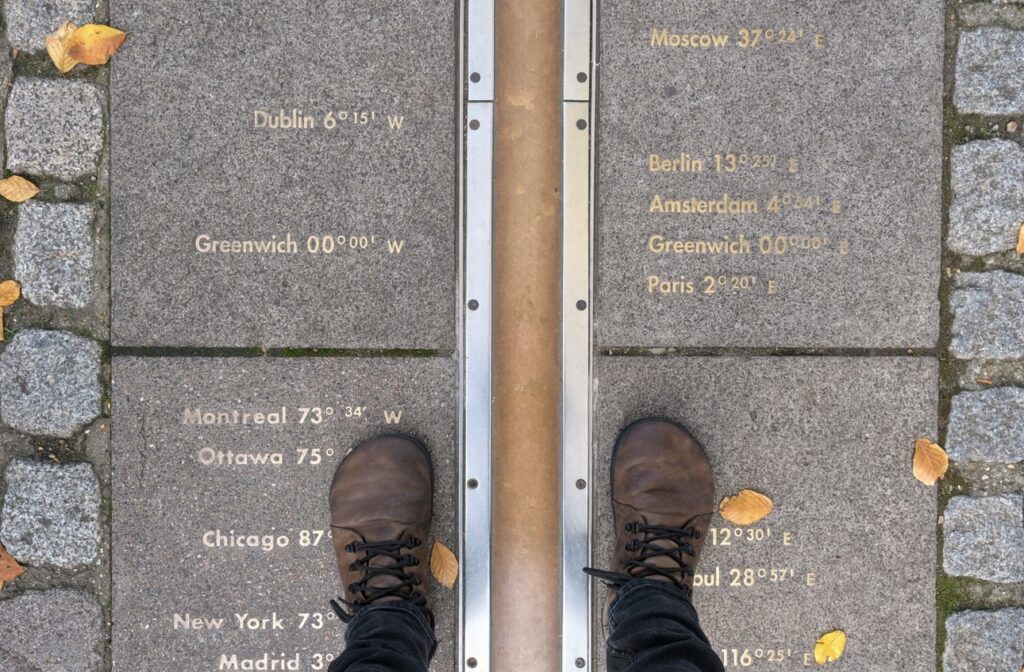
    “When you look at the line and see place names like New York, Sydney, or Beijing, it’s a reminder that we’re on a planet,” Devoy says. “Our time and location here is completely different from what it is somewhere else. I think it just reminds us how small we are.”

    The Meridian, after all, is not a natural feature but a human decision. “A meridian is just an imaginary line that goes from the North Pole to the South Pole,” Devoy explains. “There’s no natural start or finish point. Any meridian could be significant.”

    For centuries, different nations used different prime meridians. Lines passed through locations such as the Canary Islands, the Azores, Baghdad, and Paris. By the nineteenth century, more than ten competing systems existed. “If you bought a map in Brazil, zero degrees would go through Rio de Janeiro,” Devoy says. “In Russia, it would go through St Petersburg.” As global trade expanded, this confusion became impractical. In 1884 representatives from around the world gathered in Washington DC to agree on a single international standard.

    Meridian Line. Image: Unsplash

    Four observatories were considered: Greenwich, Paris, Berlin, and the US Naval Observatory. Greenwich ultimately won. “Greenwich was chosen because the majority of shipping companies were already using British charts,” Devoy explains. “Seventy-two percent by tonnage. It was a very pragmatic decision.”

    Even the systems that organise our world, it seems, begin with collective agreement. Today, Greenwich continues to draw visitors from across the globe. 

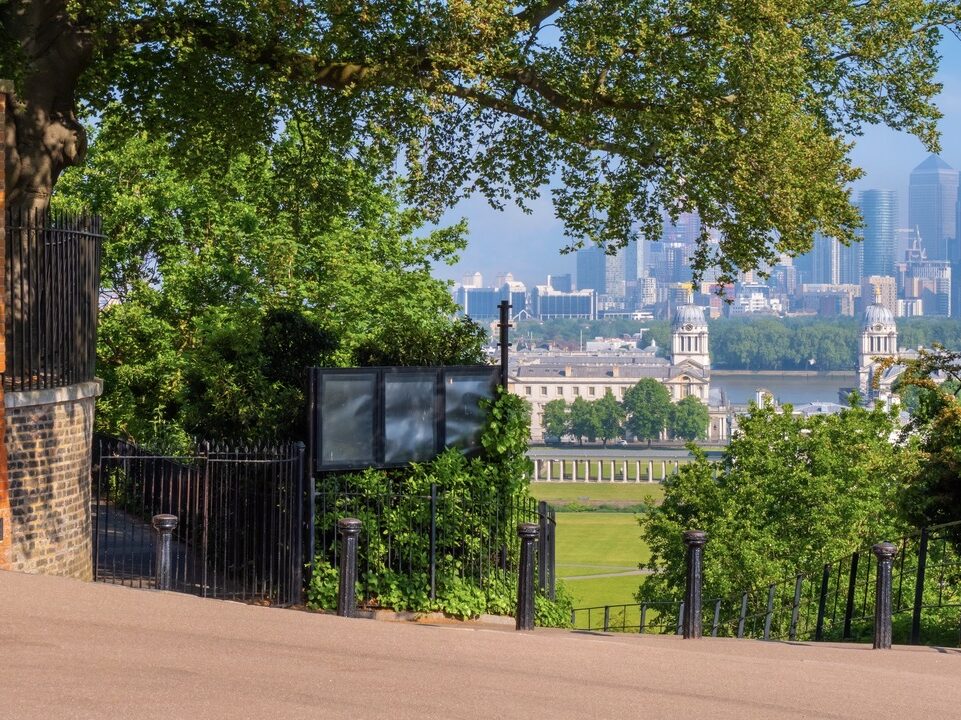
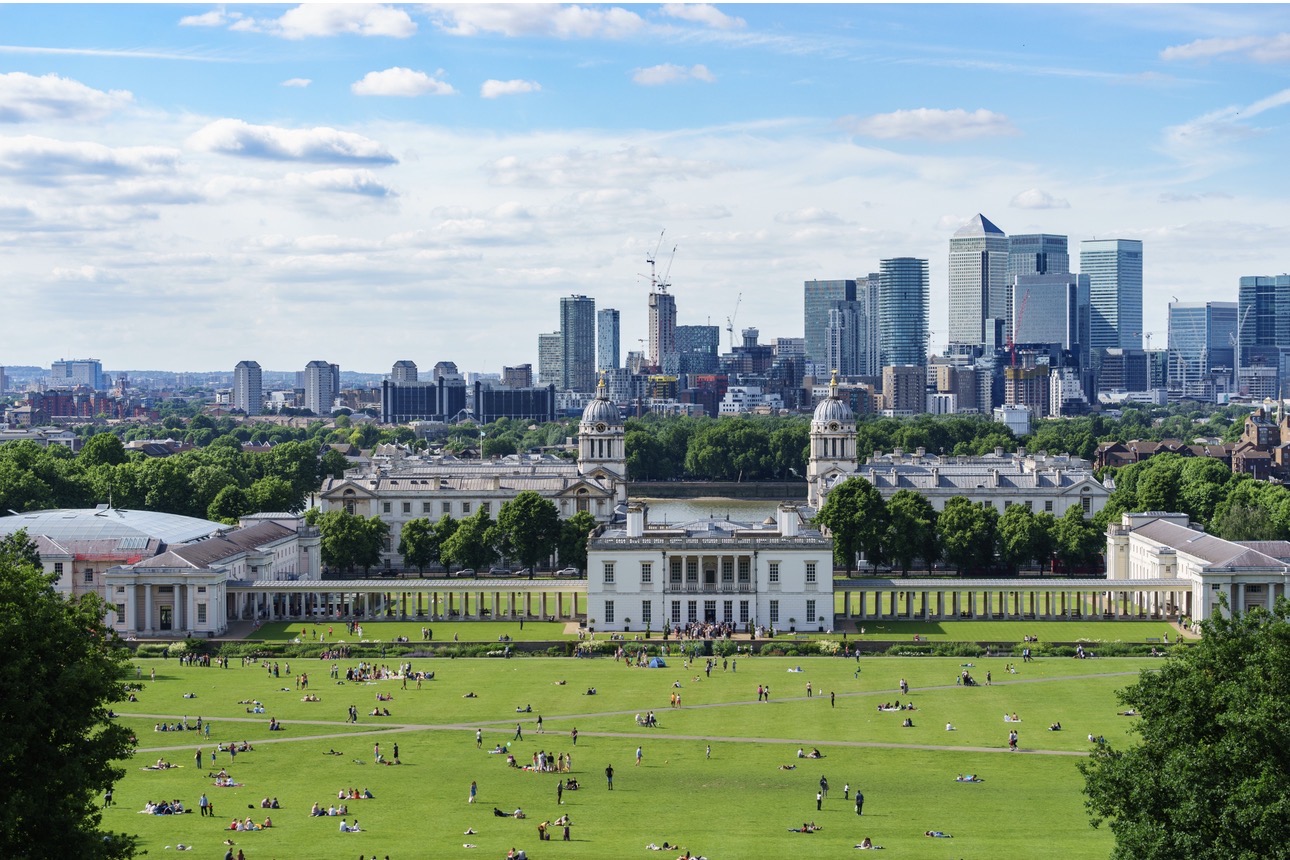
    From the hilltop, London spreads out in two directions at once. Below lie the historic buildings of the Old Royal Naval College and the National Maritime Museum. In the distance rise the glass towers of Canary Wharf, glowing at night with financial power.

    “The contrast is incredible,” Devoy says. Yet the pull of the park is not purely visual.

    View from Greenwich Hill. Image: Unsplash

    Paul, a 52-year-old London resident visiting the park on a quiet afternoon, struggles to explain why he returns regularly. “I don’t believe in all that energy stuff,” he says with a laugh. “But every time I’m here, I feel oddly grounded. Like this is where things line up. I can’t explain it.”

    Others describe a similar sensation in more deliberate terms.

    Jemima, 37, says she has been visiting Greenwich to meditate for several years.

    “I moved to South London about a decade ago,” she says, “and I always come back here when I want to feel grounded.”

    Experiences like these may not be measurable, but they are increasingly common in contemporary city life. Practices such as meditation, mindfulness, and embodied awareness have become part of everyday urban culture.

    In this context, Greenwich occupies an unusual position. It is simultaneously one of the most scientifically defined places on Earth and a location where many people report an intuitive response.

    Perhaps the two are not as different as they appear. Long before modern science, ancient communities observed celestial movements, tracked seasonal cycles, and chose locations that seemed significant in relation to land and sky. What we now describe as intuition once functioned as a shared method of understanding the world.

    Greenwich, in its own way, still reflects that intersection. Here, a line that exists only by agreement organises global time. Ships once navigated oceans using measurements taken from this hill. Satellites now orbit the planet guided by even more precise systems.

    And yet visitors continue to stand quietly beside the Meridian, looking out across the river, sensing something difficult to name. Measurement and meaning coexist here. The place where time begins is also, perhaps, a place where people pause.

  • Above the Clouds: Where Instinct and Training Align 

    Above the Clouds: Where Instinct and Training Align 

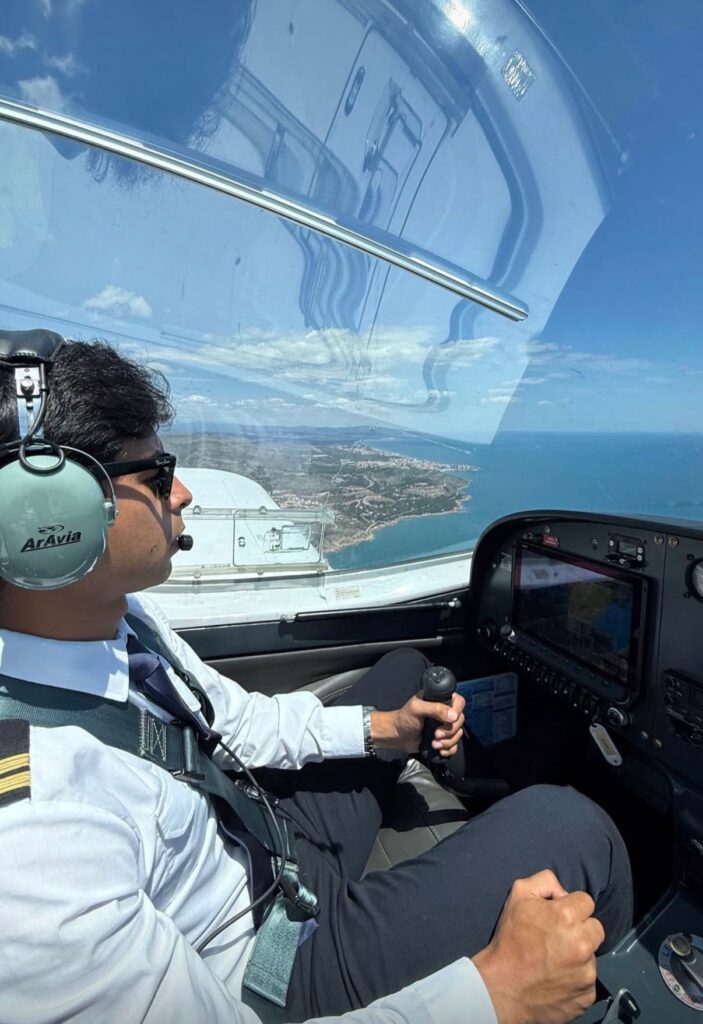
    In the cockpit, Nicolás Pescador is learning that intuition can be as vital as training. 

    Every time a plane takes off, more is at play than instruments and checklists. Beyond weather reports, procedures, and technology, pilots rely on something less visible but equally vital: intuition. When conditions shift, and decisions must be made in seconds, it is often this internal compass that guides their actions, operating quietly alongside the measured logic of aviation systems. A study in Human Factors found that experienced pilots made faster, more accurate decisions than novices by noticing subtle cues that signalled problems, showing that cockpit “intuition” is built on trained perception, not guesswork.

    Nicolás Pescador. Image: Fly School Air Academy Madrid

    For Nicolás Pescador, 23, a trainee commercial pilot taking his second year at Fly School Air Academy in Madrid, intuition has already proven indispensable. He does not speak of heroics or near misses, nor does he frame his experiences as exceptional. Instead, he chooses his words carefully, almost as if naming the experience too loudly might diminish its meaning.

    “It was during a routine simulator session,” he recalls. “The aircraft was stable, autopilot engaged. Everything was reading green. But as we descended through a thick layer of cloud, a sense of unease crept in.”

    He pauses, searching for precision rather than drama. “Nothing was technically wrong,” he says. “But something didn’t feel right.”

    Trusting that feeling, he disengaged the autopilot and adjusted the flight path manually. Moments later, a wind shear warning triggered a sudden, dangerous shift in wind speed or direction that can make landing unsafe if not addressed immediately. Had he hesitated, the landing could have become hazardous.

    The story has the shape of a cinematic moment, but Pescador treats it as something quieter and instructive. For him, it is evidence that flying is not purely mechanical. “We are trained for every scenario,” he says. “But sometimes instinct leads before calculation has time to catch up. It’s subtle. Almost invisible if you don’t know what to look for.”

    He reflects further on that sensation: “It was like a tightening in my chest, a micro‑alert that something in the environment wasn’t matching the data. In the simulator, I had no real danger, but the feeling is exactly what would guide me in the air. It’s a warning before the instruments can show it.”

    Commercial pilot certification typically requires a minimum of 1,500 flight hours, much of it in simulators designed to replicate high-stress and emergency conditions. For trainees, these hours are not simply a regulatory threshold. They are a process of immersion and repetition, through which the aircraft becomes familiar not just as a machine but as a responsive system.

    Those hours cultivate an almost subconscious understanding of flight: the vibrations transmitted through the controls, the way the aircraft responds to different air masses, and the small changes that signal larger shifts ahead. Over time, reaction becomes anticipation.

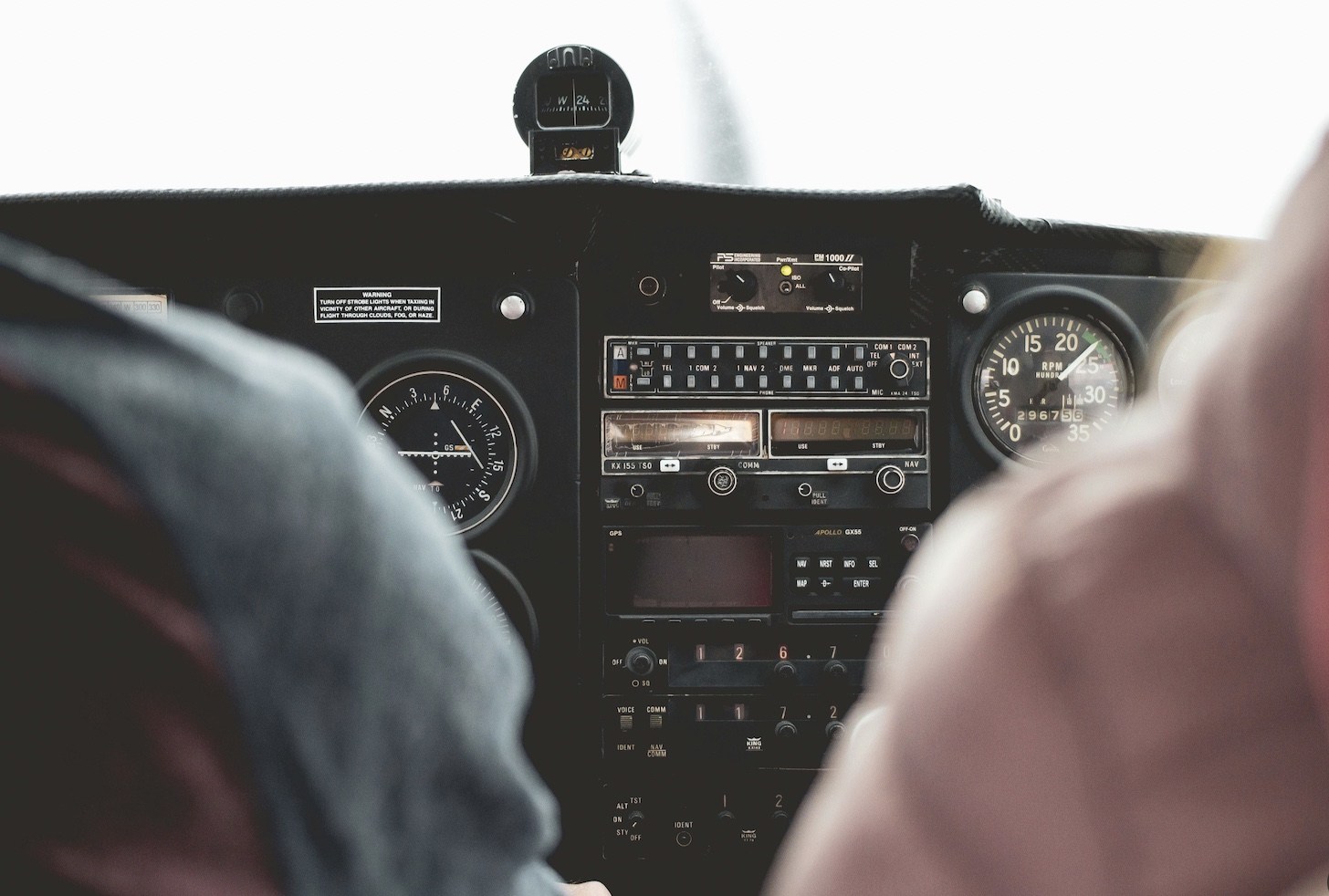
    Training plane. Image: Unsplash

    Early training, Pescador explains, is as much about avoidance as reaction. In summer, student pilots are taught to steer clear of areas with strong thermal activity, rising columns of warm air that can destabilise flight. “In hot weather, there are many thermals and birds,” he notes. “They create instability, so we try to avoid those zones.”

    Timing is another variable drilled into students from the outset. Training flights are often scheduled for early morning, when the air is calmer and winds are lighter. “By midday, in both winter and summer, turbulence increases,” he says. “The atmosphere becomes much more unstable.”

    Certain conditions demand strict discipline rather than instinct. “When there is fog, you fly purely by instruments,” he explains. “You cannot trust your senses.” That principle, known as instrument flight discipline, is rehearsed repeatedly until it becomes automatic, a safeguard against disorientation caused by visual illusions.

    Other environments demand heightened physical awareness. Flying over mountainous terrain introduces a particular risk. “You get mountain waves,” he says, describing the way wind is forced up and down by the landscape, creating strong vertical air movement. “You can feel the aircraft rise and fall sharply. It’s something you must anticipate rather than react to.”

    Psychologists describe what pilots call intuition as rapid cognition developed through repetition and experience. Ana Jiménez, who has studied decision-making under pressure, says the phenomenon is often misunderstood. “What feels like instinct is actually the brain processing hundreds of small cues almost instantly,” she explains. “Pilots are reading the aircraft and the environment on a level most people never experience.”

    Jiménez stresses that intuition does not replace procedure. “It complements it,” she says. “It allows a pilot to act when there isn’t time to consciously gather and analyse every piece of information.”

    “In high-speed environments, delayed decision-making can be as dangerous as incorrect judgement,” Jiménez explains.

    As experience grows, the boundary between training and instinct begins to blur. Pescador describes moments when he has sensed subtle changes in wind pressure or vibration through the controls, cues too delicate to appear on any display. “You learn to trust that feeling,” he says. “Ignoring it can be costly.”

    Modern pilots operate under significant pressure. Airlines demand efficiency, precision, and constant readiness. Long-haul pilots may spend much of their lives away from home, while trainee pilots often face financial strain even before securing stable employment. Fatigue, stress, and cognitive overload are part of the profession. Yet despite increasing automation, the human mind remains central to safe flight.

    Autopilot systems and artificial intelligence now handle much of what was once done manually, Jiménez notes, but they do not replace judgment. “Machines follow algorithms,” she says. “They don’t feel the aircraft or sense subtle environmental changes. When seconds matter, it is often experience, what we label intuition, that makes the difference.”

    Nicolás Pescador training. Image: Nicolás Pescador

    Pescador is uninterested in dramatising these moments. He speaks of vigilance, observation, and patience. Mastery, for him, is not measured solely in logged hours or technical knowledge, but in presence: the ability to remain attuned to what the aircraft is doing and what it might do next.

    “The instruments tell you what is happening. Intuition tells you what could happen,” Pescador says.

    For passengers, a flight may feel serene, even effortless. Behind the cockpit door, however, there is a constant negotiation between procedure and perception, technology and human awareness. For pilots like Pescador, intuition is not an optional extra. It is an essential skill, quietly woven into every adjustment that keeps an aircraft and everyone on board safely aloft.