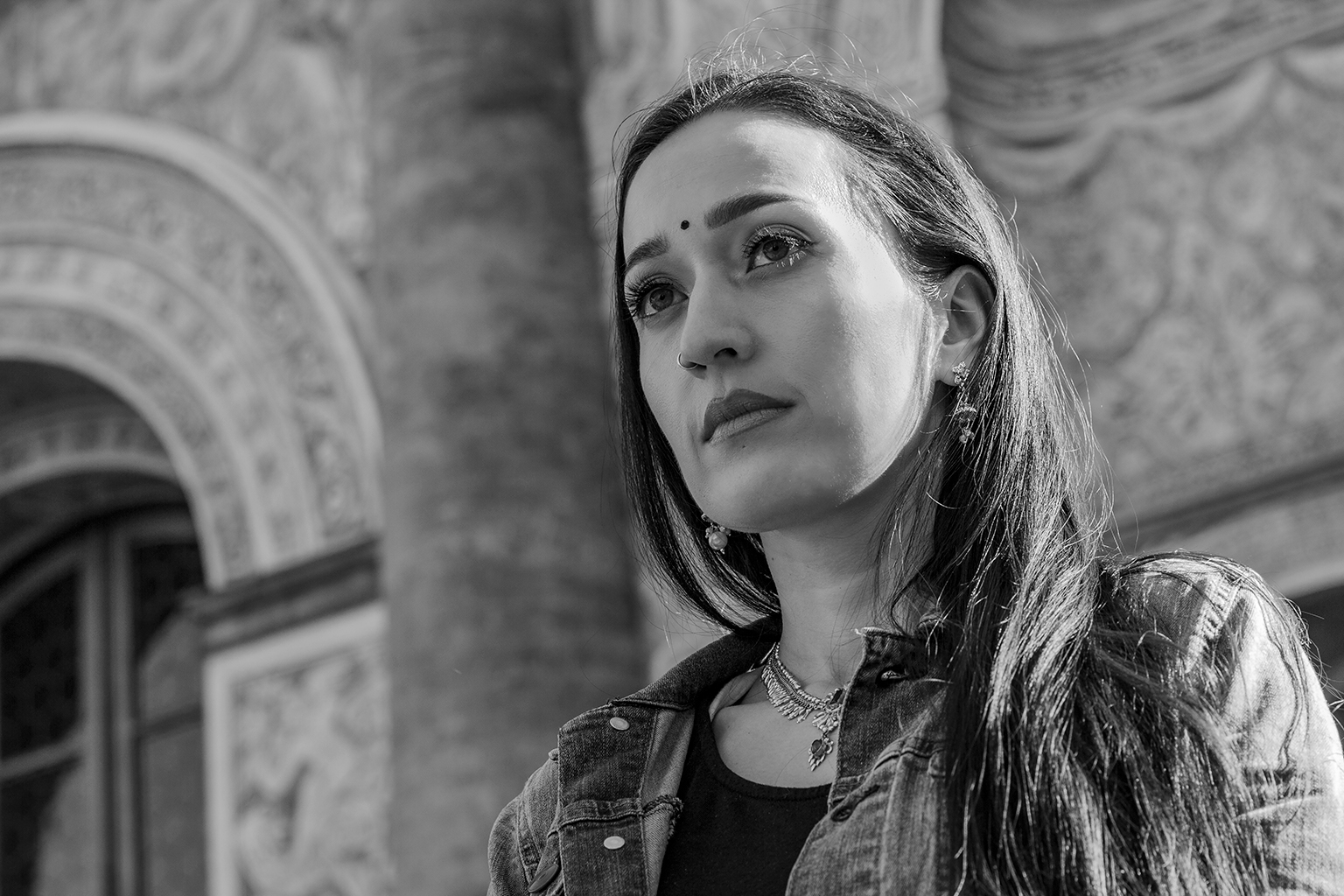
Emascultor’s Mallika Sundaramurthy shares her experience with Katyayani Nath as a renowned artist in the male-dominated Death Metal genre – and opens up about how trauma, religion, race, and angst play into her art.
It’s rare to see women in Death Metal. Rarer to see women in Brutal Death Metal. And extremely rare for them to be women of colour.
Tamil-origin Mallika Sundaramurthy has been carrying the torch for women in this genre for over 20 years, making music with multiple bands, including Unfathomable Ruination, Abnormality, and now the women-of-colour-led band Emasculator. A 43-year-old mum of two, Mallika Sundaramurthy, spoke to SlashHer from a bathroom in her sister’s house – the only place where she could find some quiet. But Mallika is not just a regular mum; she’s also a Death Metal icon. She joined her first band at 21 years old in Barcelona, where she was studying abroad. “I’ve always been singing; my parents took us to singing lessons as children. As I got older, I started to listen to heavier music. I started listening to Death Metal as a teenager. It was a great way to express anger and rage in a healthy way and feel less alone.”
Mallika’s admiration for Death Metal comes from its unflinching nature: “It is an exciting genre. The music is often emotionally or politically charged and is unafraid to challenge the status quo. It is able to look deeply and directly at difficult topics such as death – and loyal fans expect nothing but genuine passion and art.”
Mallika has taken this resolute spirit of Death Metal to channel trauma and angst about her life, and her struggles as a woman, to create a rarely-seen-before, for-the-girls and feminist niche in the genre: “There are few places where women are allowed to show anger and rage in society, and holding it in can eat away at us. Women are often punished for showing certain emotions and strong traits, but those feelings are respected or admired for men. Music and art are safe spaces in which we can express those feelings in a positive way. It can be healing and cathartic.” Mallika says.

Creating this style of music meant combining the influence of music made by men with a rebellion fuelled by women. “Musically I was initially inspired mostly by male musicians, spiritually I was always inspired by other women. That is, in our sound we were inspired by the great brutal Death Metal bands of the early 2000’s like Disgorge, Disavowed, Inveracity,
Suffocation, Defeated Sanity and Deeds of Flesh. Regarding a feminist message in music and art, I’m influenced by Bikini Kill, Wendy O Williams, The Guerilla Girls, Judy Chicago, Frida Kahlo, and other feminist and female artists who aren’t afraid to be different.”
The fight to carve a radically feminist space in the genre is also what inspired the name for her latest band “I looked for a name which gave the impression that we were ready for battle! Emasculator seemed suitable.”
Emasculator’s latest EP, The Disfigured and the Divine, is the perfect example of this movement in action. As the lyricist, Mallika combined Greek, Sumerian, Egyptian, and other mythologies, feminist themes, personal experiences and classical miniature Indian paintings. In everyday life, we have seen these ancient themes have been appropriated by the conservative classes as depicting vulgarity, reasons for shunning women’s free will – think about the stories of Pandora and Eve –, or even to uphold archaic structures.
Emasculator uses them to channel their innate goddess-like power, and hone in on their internal turmoil: “In particular I’m proud of our song about goddess Durga, Eradication of the Asuras. Her epic battle with the buffalo demon Mahishasura for me symbolises the battles we women face every day, challenges we must overcome in the modern world and the patriarchy…There was a time when the Goddess was worshipped above all other gods and I think if we can get back to that the world will be more peaceful and harmonious.”
“I never worried about not being feminine. I refused to be defined and controlled by men or society’s expectations.”
This resonant imagery and their cutting lyrics have amassed Mallika and Emasculator a strong fan base. “Some fans have been supporting me for decades and for that I’m very grateful. Some men and women tell me that I inspired them. I love to hear that, especially from other women, and especially from women of colour. Even fathers reach out to say that they are glad we exist and are sending a strong message of female empowerment. I think they are glad to see women who carry themselves with respect, who exist in a male dominated field and are succeeding.”
What we often forget, and something I truly internalised upon my conversation with Mallika is that femininity is not the one thing – the electric fence around which we dance carefully. “Unfortunately, because of a difficult childhood I associated being overly feminine with weakness, which I have since processed and unlearned. This led me to seek out my own female role models and created my own vision of what it can be to be a woman. I reshaped it to embody strength, resilience, and the ability to speak my mind. I never worried about not being feminine. I refused to be defined and controlled by men or society’s expectations.” This is the reason why stretching the limits of femininity, through practicing and protecting it in rebellious and atypical ways, makes more space to empower women.
Yet, performing in this cis-het male dominated industry remains a fight for equality. “One of the hardest things about it was dealing with sexism, being sexualised, harassment from other bands and fans at concerts or on tour.” Mallika says. In a stroke of optimism, however, Emasculator’s journey has reflected the willingness of the audience to face harsh truths and reward talent. “We have been accepted, thanks to the band being built off our work in our previous bands. We are signed to one of the most respected Death Metal label and we feel respected and well supported by our label and label mates.”
The Death Metal space grows in size and in its heart, as we build togetherness and foster a sense of radical community: “I made some of my best friends through music, and I met my husband through it as well. We also benefit from male allies. Established artists can be mentors for the new ones to share wisdom, provide encouragement, and help them succeed.”
The listeners are also growing to accommodate bold and uncompromising feminist messages, which is no surprise for a group of people who enjoy bold messaging and the sounds of internal turmoil, created with heavy instrumentation and laid bare as a tool for catharsis. Mallika and Emasculator have not just transcended the glass ceiling, they’ve made the way for more young women of colour to bear the heritage of this musical style. This is testament to the way the culture of music grows and beats along with our hearts.