Serra Umur
When war photographs move from news pages to gallery walls, do they retain their power to provoke change? Or would they simply be viewed as art pieces, admired from a safe distance while the suffering they capture fades into aesthetic detachment?
Soft echoes of footsteps in a silent room. White gallery walls stretch wide, carrying the whispers of passing visitors. A framed photograph hangs at our eye level: a man on the back of a truck in Cambodia. His body is broken, his eyes are drifting away from the world. The lighting and the print are perfect. Visitors pause, fold their arms, nod once and move on to the next photograph.
Photojournalists document some of the world’s most horrifying moments. The ambush, the blood, and the danger. Don McCullin, who took the photo of the broken Cambodian man, was wounded by mortar shrapnel while raising his camera in 1970 Cambodia, paratroopers dying around him.
In galleries and museums across the world, war photography has entered the art market. The suffering of photographers and the people in front of their lenses is now held behind glass.
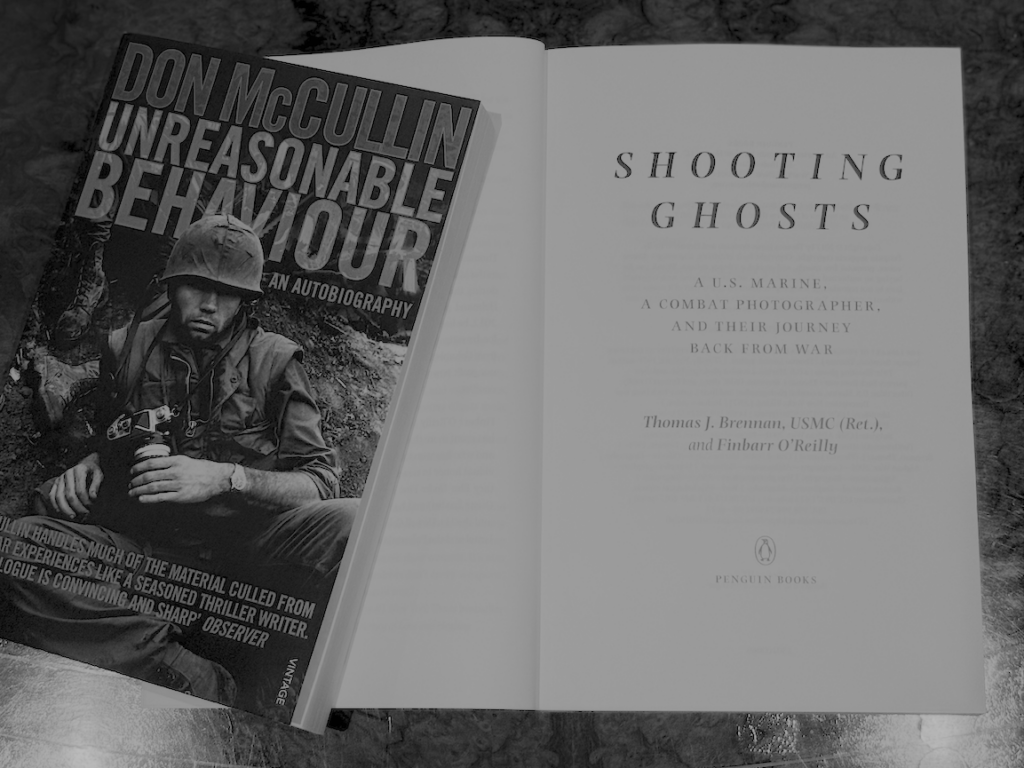
Don McCullin has spent a lifetime behind a camera during some of the world’s most violent conflicts. His photographs have been shown in major exhibitions at Tate Britain and are also held in museum collections, including the Victoria & Albert Museum in London. He has repeatedly said, “I am a photographer, not an artist”. Agreeing to show his photographs in a gallery left him “in a very funny place”. But he saw it as a necessary compromise. “If I leave my photographs in yellow boxes in my house, no one will ever see the work I’ve done that condemns war, famine, starvation and tragedies,” he said in interviews reflecting on his career. The gallery was an opportunity to release what he called “the propaganda of all the evil things I’ve seen in the world”. Although he remains uneasy, McCullin believes calling his images iconic risks turning suffering into composition, pushing his photography too close to the art world. “I like to keep photography really pure,” he says. “I’m a bit prickly about this art stuff.”
Art critic John Berger once wrote that “the camera makes everyone a tourist in other people’s reality.” In these rooms, we are exactly that: viewers of someone else’s catastrophe. No one in the room knows of the man in McCullin’s image. Few will read about or ask what happened to the people on that truck after the camera clicked. The image has detached from the day it was taken and from the lives it froze in time. Initially intended for documentation, it is now an object of admiration and a symbol of war. This detachment turns raw records of pain into aesthetic pieces, raising the central question: what happens to war images when they become “art”, and does that dilute their power to effect change, especially in an era of endless digital circulation?
Lee Miller, the American photographer and former Vogue model who became a war correspondent, felt the same contradiction. On assignment for Vogue — a magazine built on glamour and beauty — she carried her camera into war, documenting scenes from the London Blitz to field hospitals after D-Day, the siege of St. Malo, the liberation of Paris, and concentration camps like Buchenwald and Dachau. After the photographs were published, she said, “I’m busy making documents, not art.” To be called an artist, she believed it was almost shameful when using other people’s suffering to picture a situation.
Zahid R. Chaudhary is a scholar of visual culture at Princeton University who studies how photographs shape political and emotional life. He says that once a photograph enters the world, it escapes its maker’s control.
“A photographic record always exceeds the uses to which it’s being put,” he says. Images gather new meanings, new audiences, and new consequences.
Zahid R. Chaudhary
Finbarr O’Reilly, an award-winning conflict photographer with the VII Foundation who has documented wars and humanitarian crises in Gaza, Congo, Sudan, Afghanistan, offered a photographer’s perspective in real time. He argues that viewers approach conflict photography differently in art institutions than in everyday media. “Generally, when we compare it to social media or legacy media, these are kind of ever-present around us. They are saturating us. But in art galleries or museums, they go with a specific intention: to see an exhibition or a particular show; to see the work of a specific photographer or a specific theme. They’re there to view those images with a different intention than we use when consuming our daily media. There’s a different kind of engagement in that setting.”
But in our digital environment, where images of conflict circulate constantly, desensitisation becomes a real risk. O’Reilly confirmed this: “Yes, it’s the short answer, it definitely can […] We can become desensitised to the real scale of human suffering; there’s a real emotional disconnect, and it becomes a voyeuristic experience.” He continues “there’s certainly a risk of that happening, and we certainly saw that with the coverage of Gaza, some of the most horrific images and scenes you could imagine appearing on our screens and then there’s still an ability to not engage with it.”
O’Reilly also addressed the ethics of photographing vulnerability:
“This is one of the most important aspects of our work; there is a power dynamic, it is essential to understand the context, and to operate in a way that upholds dignity. I really only work in situations where I have the consent; those exchanges are the reason that I do this work, those human interactions that take place during the course of my work give it the meaning that motivates us.”
Finbarr O’Reilly
On whether images still matter for change: “I no longer hold the naive belief that any single image will necessarily lead to major change. But what I do believe is that collectively, there is a contribution: each of us contributes a drip to the flow of information that keeps the public informed. It is those human interactions and the trust that they put in me to tell their stories that motivate me.”
He reflected on a personal turning point in Gaza 2014: “There was one moment at a morgue where children had been brought, it did start to feel a little bit obscene. I had to step away and take a couple of years off from photography. I wrote a book instead about these dilemmas, moral quandaries, ethical concerns, and their emotional and psychological impacts. I think I now do it in a way that I’m more comfortable with.”
Regarding galleries: “People who would go to a gallery show are trying to understand the situation to some extent of the human experience […] the distance is closed […] I would hope that people are seeking these kinds of shows out of concern, interest, and a desire to gain a greater understanding of history.”
As viewers, we are not just spectators. When war photographs enter galleries and magazines, they invite attention, but they also risk becoming objects of admiration rather than calls to action. For all the debates about meaning and aesthetics, war photography remains physically and psychologically risky work, which is why these images should not be reduced to detached art when real lives and witnesses are at stake.
In 2014, German photojournalist Anja Niedringhaus was killed while covering elections in Afghanistan. After her death, Jean-Francois Leroy said, “Every time we lose a photographer, our eyes on the world are closing a little bit more.”
Lynsey Addario describes her profession’s responsibility as “not being a hero.” She says, “We bear witness to history, and we shape policy. I had the privilege to travel and to walk away from hardship; most people didn’t have an exit door.”
As viewers, we stand at the final stage. We do not feel the heat of the fire or the dust in the lungs.
Don McCullin, now in his eighties, looks back, “I’ve tried to show these terrible things, I have an enormous guilt, it hasn’t changed the world one bit. There are even more terrible images coming out of Gaza, which I can’t even bear to look at, so heartbreaking.”
For readers who want to support those who continue this work today, organisations such as the Rory Peck Trust and the Ian Parry Grant provide funding, training, and protection for freelance photojournalists working in conflict zones. Organisations such as The Aftermath Project fund photographers who document what happens after war and trauma, not just the moment of war.
For those living in these conflicts, humanitarian organisations, including the Disasters Emergency Committee, Action Against Hunger, and the International Rescue Committee, deliver food, medical care, and emergency relief in Gaza, Sudan, Ukraine, Syria, and other crisis zones.