Jemima Roques
A site of political discussion throughout our lives, we explore how shared dining can help us to learn, unlearn, and build bridges
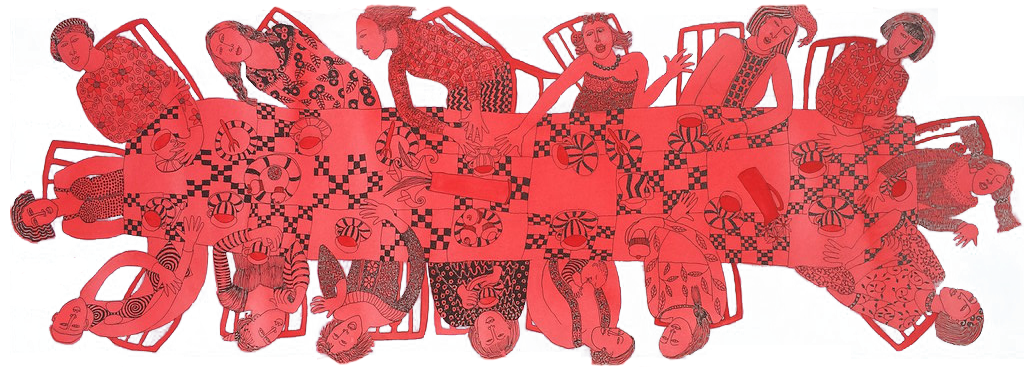
Whether it’s family dinner time or a lunch break at work, sitting down for a shared meal is one of the most universal experiences. So, too, is the tension that can stir when a political disagreement arises, from parents expressing an outdated view to university students grappling with what they believe about the world. Dining provides a comfortingly confrontational environment which allows us to tease out our thoughts with one another. It can sometimes result in storming off, but what happens when we use meals to build bridges? This idea is known as culinary diplomacy — exploring how cross-cultural understanding can be fostered through food. In the hyper-polarised political climate of the modern world, it offers the hope of an appreciation for other people’s views, or at least for a good meal.
How we develop political views differs for everyone, but we know that parental influence is particularly strong because people tend to grow up socialising with their parents the most. Dr Emily Willoughby, research professor at the University of Minnesota, has studied the influence of parents by comparing adoptive and biological families. “Political attitudes are caused by a combination of genetic propensities, parental influence, and innumerable other things like friendships, life experiences, workplaces…,” she says. Parental influence is strongest when the household is politically engaged and both parents share the same views.
“How do you know what you believe if you’ve never been challenged? Never had to defend it, to think critically about it?”
Dining together offers a space carved out for debate without distraction in a household, something which can be less common in a technology-obsessed world. Research by the American Psychological Association and the University of Houston shows that children are more likely to internalise their parents’ views when they can accurately understand what those attitudes are. “Dinner-table conversations might be one of the key settings where children develop that accurate perception,” says Willoughby. Interestingly, some attitudes transfer easier than others. “Religiousness and social liberalism showed the strongest parent-child resemblance, driven by both genes and environment,” says Willoughby, “political orientation and egalitarianism were especially responsive to the home environment.”
Whilst data shows that parental influence is still clear when people are in their early 30s, other environmental factors can also affect our politics, especially when we are young adults. “Later in life, your discussion networks, your social circles, and explicit political discussion we think matters on some level,” says Jeffrey Lyons, political science professor at Boise State University. One example is moving to university, a time which introduces people to an intense new environment. Shared dorms and social gatherings can often lead to discussions over dinner. Whilst some people settle into groups that match their views, others will have their politics challenged and this can have a lasting effect. “If somebody is surrounded day to day with people of different beliefs […] we tend to see over time they move their opinions in the direction of the folks they’re around,” says Lyons, “but it’s not immediate.” This can be due to the information we receive as well as social cues and pressures to conform. Relationships are developed through shared social spaces, such as a common room or dining room. Late nights around the table at flat dinner parties soaking up conversation can encourage thinking.
Challenging what we believe is an important, but sometimes uncomfortable, necessity. “How do you know what it is that you believe if you’ve never been challenged? If you’ve never had to defend it, to think critically about it?” says Lyons. From randomised university dorms to colleague lunches to dinner parties, mealtimes provide a venue for these meaningful exchanges. Shared dining can often force us into interactions that we don’t get to curate, bringing us into contact with people who think differently. Although it seems confrontational, the table setting takes some of the pressure off politics by allowing it to become a natural part of the meal. “Something that’s really nice about shared dining is that you are forced to be exposed to other ideas, but it doesn’t have to be the main part of the conversation – you can talk about food, you can talk about wine,” says Lyons.

The power to build bridges by breaking bread has been harnessed by a number of organisations. The Guardian magazine’s weekly segment Dining Across the Divide invites two readers with opposing views to discuss a hot political topic. By the end of the meal, they almost always report that the other person is not as left or right wing as they had expected and that they’d like to go out for another drink. In the US, supper club Make America Dinner Again hosted small group conversations to build understanding for four years after the 2016 election. Following its success, they’ve set up an online toolkit for people to host their own meals. The initiative has united Republicans and Democrats in what might be the most polarised moment in US politics. The most exclusive edition of culinary diplomacy is the Club des Chefs des Chefs, a society of personal chefs to heads of state. Founder Gilles Bragard writes that “if politics divides people, a good table always reunites them.”
In my own life I too have found dinner time sets the perfect scene for meaningful conversations of a depth, and sometimes intensity, not achieved at other points in the day. This is partly due to the length of a meal, and the face-to-face set up which forces confrontation. The dining table removes distraction, aside from the food on your plate, creating a space to think which can be rare for those of us lucky enough to live a fast-paced life.
“I think you’re missing out on a lot of things if you just live in this world of stereotypes”
In an ever-changing world, it is crucial to constantly challenge and update our views. This is important not only to encourage critical thinking about politics, but also to encourage tolerance between individuals. In many societies, party affiliation has developed into a powerful social identity. This can affect how we think about ourselves and other people. Lyons describes the latter as viewing the world through an “in” group and “out” group lens – binaries that can dictate how we live. Many people are reluctant even to visit certain cities because of the local government. “There’s a lot of people who are living their life through this lens of politics,” says Lyons, “I think you’re missing out on a lot of things if you just live in this world of stereotypes.” A recent study by Pew Research Centre found that 17% of people in the UK view their fellow Brits as morally bad, exemplifying the necessity for encouraging conversations with diverse perspectives. “The evidence we have about it is pretty powerful: people who actually talk to folks of different views […] may seem more nuanced and tend to have higher levels of tolerance,” says Lyons.
In a time as politically tense as ours, culinary diplomacy holds the seemingly rare potential to foster understanding. The conversations may be difficult, the tension may be uncomfortable, but if we don’t at least try to recognise one another, we surrender the very possibility of common ground.