From developing an anarchist food system that is ‘free in every sense’ to criticising the ‘genocidal rhetoric’ of invasive species, relational artist Gaye Chan is making waves in Hawai’i’s foraging landscape
Location: Oahu, Hawai’i, US
Description: Warm and balmy, with mild temperate weather; home to tropical rainforests, shield volcanoes and sparkling beaches with welcoming bays.
Common edible plants: Kukui, breadfruit, papaya, banana, mango
Common edible weeds: amaranth, ivy gourd, common plantain, peppergrass, oxalis and purslane
Transferable tip: Forage where you are every day. Most importantly, try to see the value of what’s in front of you rather than what you think is supposed to be in front of you.
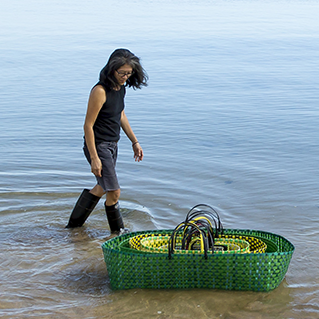
Credit: Rae Huo
Peppered with huge swathes of feathery amaranth, breadfruit and trees bedazzled with exotic guava and mangoes, Hawai’i has much more to offer than the perfect surfing wave. Known for their lush landscapes and scenic beaches, the Hawaiian Islands are teeming with biodiversity and rich tropical ecosystems – a forager’s paradise.
But they weren’t always like this.
“It’s quite a fragile ecosystem,” says relational artist Gaye Chan, a professor at the University of Hawai’i at Mānoa, “Hawai’i is the most isolated place in the world. Before human arrival, it is arguable whether there was sufficient food source to sustain human life.”
The great majority of plants in Hawai’i are introduced. It wasn’t until Polynesian voyagers brought ‘canoe plants’ to the islands between 1000 and 1200 AD for food and medicine that the geographically secluded archipelago in the heart of the Pacific Ocean began sustaining broader forms of life, she explains.
The great majority of plants in Hawai’i are introduced. It wasn’t until Polynesian voyagers brought ‘canoe plants’ to the islands between 1000 and 1200 AD for food and medicine that the geographically secluded archipelago in the heart of the Pacific Ocean began sustaining broader forms of life, she explains.
In the strictest sense of the word, the canoe plants are non-native species, often called ‘Polynesian introductions’.
The colonists, along with each group of indentured labourers and immigrants, continue to bring and add plant varieties to the ecosystem.
To Chan, who views relationships and concepts as the medium through which she creates her art, this nuanced evolution raises questions of when, why and how some species are classified as native, non-native, or invasive. In particular, she considers how the process of categorisation works in the popular imagination in relation to ideas of belonging.
“Who belongs? Who doesn’t belong? What and who has to be eradicated?” she asks. Chan believes the predominant discourse of eliminating lifeforms designated ‘invasive’ is, “genocidal rhetoric and emblematic of a xenophobic world view.” While many would regard this as an admittedly extreme view reserved for the destruction of a group of people, the practice of mass eradication of lifeforms such as goats, pigs, or guavas is common in Hawai’i. A form of violence that is taught in elementary school and to community volunteer groups is pono. These questions led Chan to her ongoing project WE(ED)S, a provocation.
The politics of foraging
Weeds – plants that grow wild and strong but aren’t valued for their nutrition or beauty – can be a sustainable and free alternative to conventional produce, says Chan.
The idea of weeds, she says, “is driven by political ideologies about belonging. Whether at a golf course, commercial farm, or spaces claimed by ‘nations,’ weeds are plants labelled as interlopers, ones we are taught to disdain…. then eradicate.”
Since 2015, Chan has led her project, WE(ED)S, where she publishes weed identification guides, hosts cooking demonstrations and shares information in person and online.
While learning how to cook with weeds is a huge part of the process, that appreciation extends far beyond eating them. The movement Chan is leading chimes with deeper philosophical principles – and has more in common with the UK than one might think.
EATING IN PUBLIC (EIP) which Chan co-founded in 2003 with her partner Nandita Sharma, Professor of Racism, Migration and Transnationalism in the Department of Sociology at the University of Hawai’i at Mānoa, is a movement based on subverting capitalism through art and education.
It draws inspiration from The Diggers – 17th century agrarian commoners in England who planted edible food as an act of protest against the expropriation of their commons by the burgeoning nation-state and capitalist system, Chan explains.
When the once self-sustaining people had their common lands taken away from them, their act of defiance was an anti-capitalist revolt. As Sharma has explained in a video, “Knowing how to eat weeds is a way for us to reclaim our freedom from capitalists.”
x
“When we plant papayas, we aren’t continuing the work of the diggers, we are the diggers. We’re still fighting against the system. Continuing the work of reclaiming the commons.”
x
Today, EIP’s many projects help position foraging as an effective way to combat food insecurity and live a lifestyle less reliant on capitalist structures. EIP plants papaya trees, makes anarchist recycling bins, runs free stores and encourages seed sharing – in packets made from a delightful zero-waste method of cutting junk mail envelopes and filling them with excess seeds.
Unlike Santa, EIP is a system that equally favours the naughty and the nice. In effect, Chan says: “When we plant papayas, we aren’t continuing the work of the diggers, we are the diggers. We’re still fighting against the system. Continuing the work of reclaiming the commons.”
EIP also arranges Diggers Dinners, described as exercises in radical sharing, both of food and ideas. Along with training in self-sufficiency skills, including sharpening knives, making chopsticks, cleaning fish and pickling kimchi, the culminating open-to-the-public potluck dinner invited everyone to come and share the backstory of their contribution, particularly how they had, “grown, hunted, fished, foraged, bartered, gleaned, gifted – or stolen – the primary ingredient/s.”
Foraging against hegemonic ideals
Chan’s journey into foraging began out of irritation and curiosity.
“Our home was a space that was over-cared for. Previous owners were using a lot of pesticides and herbicides. It didn’t have any bees or butterflies or worms, so whatever I grew was attacked by aphids. It wasn’t a healthy environment,” she explains.
Her frustration with conventional gardening practices led her to reconsider what a garden should be. “I had these hegemonic ideas of what a good garden is – I’d pull out the things I thought were not supposed to be there,” Chan says. But this perspective shifted dramatically when she discovered that many of these weeds were not only edible, but delicious.
When Chan and Sharma encountered tart, lemony purslane – one of the most abundant weeds on the island – in their salad at a restaurant, they were hooked.
“I said, ‘Oh my god, what is this?’ because it was already in our yard. This is the stuff I’d been pulling out,” says Chan. It turned out the chef’s mother was visiting from France and had harvested the overlooked herb near a bus stop because she recognised it as a delicacy. Beyond the unexpected burst of flavour, Chan was captivated by the idea that an oft-overlooked weed could fit so beautifully, both in her salad bowl and her wider belief system.
The concept of foraging extends beyond mere survival; it encompasses a broader philosophy of living harmoniously with the environment. Chan emphasises the importance of understanding and respecting the ecosystems we inhabit. “When you have a hegemonic worldview, you see this kind of ideal picture. Whatever doesn’t match, you either don’t see, or see it as not good.”
This realisation prompted her to take foraging classes with ethnobotanist Nat Bletter of Natty by Nature to learn about the plants already present in her environment and how to incorporate them into her diet. Today, she estimates a third of the vegetables she consumes are foraged weeds, depending on the season.
“I’m not that exotic forager going into the forest,” she smiles, “I’m the quotidian forager looking where I am.” In fact, she recommends this permaculture approach to connect with what is growing and in season, “You know what’s going on. You know what happens there.”
Now, she’s the one using purslane to make delicious, steamed purslane salad – along with myriad other nutritious dishes. Community members around her also prepare amaranth dinners to help merchant sailors docking in Hawai’i up their fibre intake. “Foragers perform a bit of a vital function in dealing with overabundance,” she says, “A lot of plants thrive in recently disturbed soils, like the sides of highways. They are remediation plants, and if you don’t harvest them, they will make so much more.”
In many ways, her Robin-hood like system outside of rigid structures is a journey of redistribution and reclamation of the commons. So, is the approach to foraging she advocates an anarchist free-for-all where public/private ownership ceases to exist completely?
Not quite.
As Chan says: “In the commons I’d like to work towards and live in, there’s respect for human labour. Not total chaos. Instead of foraging someone else’s rose bush – that would be rude – it’s a world of mutuality and respect that includes all other life forms.”