Is it time to stop foraging for content online?
Is it time to stop foraging for content online?
Social media is awash with glossy foraging content – but how do our nature lovers cope in the digital space?
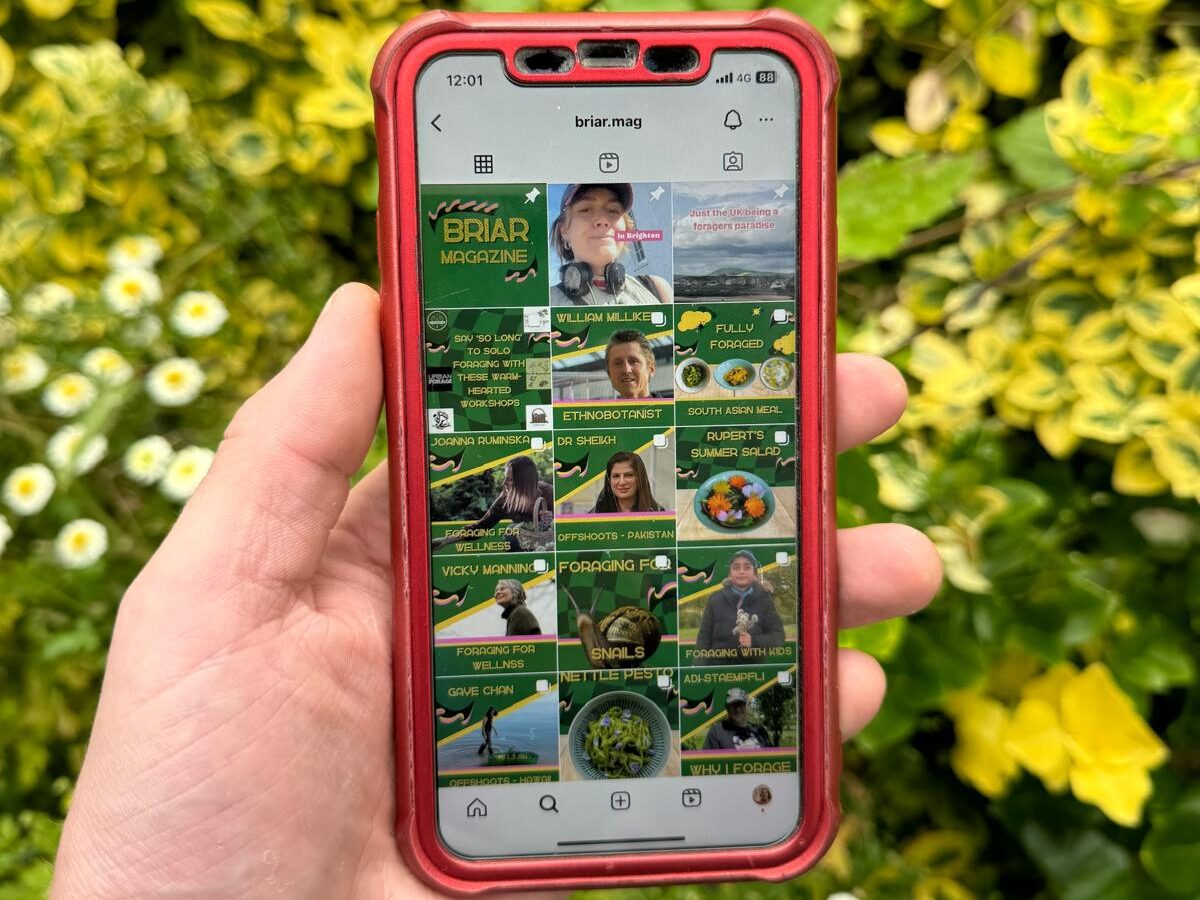
What springs to mind when you think about foraging? Perhaps immersive walks through long grass, woodland and streams, rummaging through bushes and nibbling berries in the sun.
But here’s another question: where does this image come from? Is it from your own experiences, or is it from content beamed onto your face by blue light whilst you recline on the sofa?
The two are worlds apart. The essence of foraging – immersion in and connection with nature – is the antithesis of doomscrolling. Surely those passionate about foraging would shun the artificial luminary world of social media?
Yet, foraging content has exploded in recent years: the UK Wild Food Larder Facebook group is about to reach 200k members; Seth Hughes, a forager in his mid-20s, has 204k followers on Instagram; and Fern Freud, behind the wildly popular foragedbyfern account, has 1.4m likes on TikTok.
Described by a member of the Association of Foragers (AoF) as “the best and most respected forager of the last 50 years”, Fergus Drennan is an incredibly experienced wild food expert. His verdict on social media? “I hate it with a passion. It sucks the life out of me.” He has an Instagram account with a relatively modest following of 9000 to which he posts much less regularly, and much more reluctantly than others in the field.
“I have a real problem with modern technology,” he explains. “People say we are disconnected from nature, but we are just disconnected generally. We put a phone between ourselves and the experience we could be having.”
Fergus insists the demands of social media content creation erode the joy of foraging: “For me, foraging is about slowing down, and getting out in beautiful wild spaces. It’s not about putting a camera or phone in front of my direct experience, just so I can document it.”
He even says he’d “rather be poor than be better off but having to constantly think ‘Is this going to make a nice video?’”. However, he recognises that he is from a different era: “Because young people have grown up with social media, they just think that’s normal”.
Fergus has been foraging for decades and, significantly, since long before the covid-19 pandemic. This is relevant because research suggests that lockdown lifestyle was the catalyst for the recent boom in digital foraging content.
A study by Dr Leanne Townsend, also an AoF member, found that foraging gave people the “opportunity to access nature during their allotted daily exercise sessions” during lockdown, and that it is “positive in terms of both physical and mental wellbeing”.
x
“For me, foraging is about slowing down, and getting out in beautiful wild spaces. It’s not about putting a camera or phone in front of my direct experience, just so I can document it.”
X
Townsend believes the “surge in interest in wild food, including people without the correct knowledge taking risks around toxicity”, prompted wild food experts to “adapt their roles to those of online educators.” So, the initial spike could have been reactionary, to prevent over enthusiastic amateurs gobbling poisonous mushrooms in the local park.
But of course, not all foraging social media accounts are purely educational. Social media is a great – and free – way of promoting your business, something Jim Parums has discovered.
Jim founded Forage Box in January 2020, just as the country slunk into lockdown. He adapted by launching a wild food subscription box, before moving on to wild food workshops once restrictions allowed. These workshops are the main source of income for most professional foragers in the UK.
“I couldn’t run the business now without social media,” he says. “You can’t promote your stuff without it; everyone relies on it. You can either swim against that current or lean into it.”
Even though Jim relies on social media, he is far from enthusiastic about it: “Overall, I think social media has had a net negative impact on the human race. Who knows what it’s doing to our mental health and our kids?” Despite his moral objections, Jim concedes that when “a post lands” and increases sales, it “does feel good”.
Jim describes himself as a “selfish Instagrammer”. He puts out content when he can be bothered, and doesn’t spend much time consuming others’. He hasn’t invested much time in trying to game the algorithm but will take notice of what works.
“I made a throwaway reel [Instagram video] about dandelion seed heads recently – no production or music. For some reason, that got loads of views, which probably would encourage me to go and replicate that.”
The content on Forage Box is geared towards the enthusiastic amateur. “I’d like to think that my followers get out and forage for themselves,” says Jim. Fergus’s content is even more hard-core – often instructing on advanced foraged creations such as salmon skin leather drums.
There is, however, another class of foraging content creators. Some accounts centre around an individual’s persona, and prioritise aesthetics and tone over utility. Often, accounts like this are the ones that gain huge followings.
Fergus is concerned that “someone who is just out of school, but is good at social media and takes a good photo, can start running courses. Then, people go there, rather than to someone who has 30 years of experience but doesn’t like posting on Instagram.”
Jim is slightly more forgiving, and says it’s “easy to be cynical”. He thinks that we need to recognize these accounts are “influencers” with a different aim: producing content. “They are different jobs, but they happen to share this small, weird sector we call foraging.”
Whichever way you look at it, almost all significant foraging accounts are associated with people who are competing to sell workshops. It would be a shame if everybody made their decisions based on the number of Instagram followers a forager has. Jim puts it well: “Social media is not proportional to how good you are – it more reflects how loudly you want to shout about it.”