Briar’s guide to crayfishing
Many don’t realise crayfish are freely available in most of the waterways around the country. You’ll never think of splashing nearly a tenner on a Pret a Manger crayfish salad again!
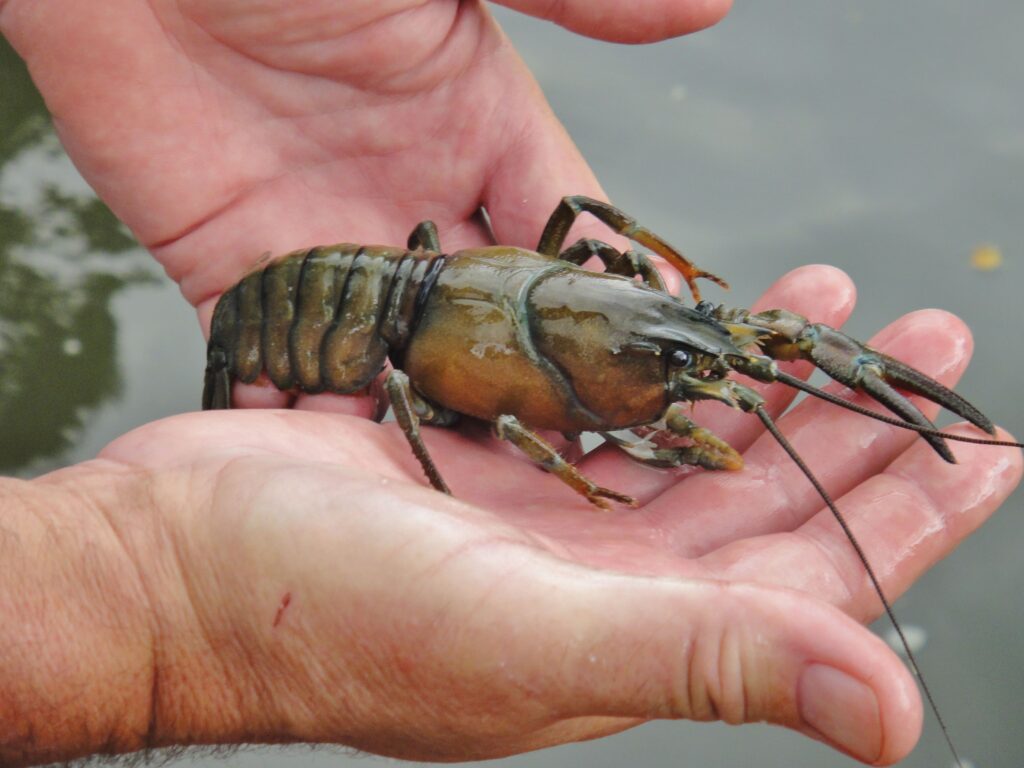
What’s the best way to catch an American?
That’s right – raw bacon and a net.
We are of course talking about crayfish, not humans. It is actively encouraged to catch American signal crayfish because they are an invasive species, and they pose an existential threat to the native British white-claws.
Since their accidental introduction to our waterways in the 70s, the larger, more aggressive American signal crayfish has decimated the native population. This is partly due to their dominance in hunting, but is mostly due to the deadly crayfish plague they carry but to which they are immune.
Their spread has been so prolific that they can now be found in rivers, lakes, canals and ponds in almost all parts of the UK. As well as damaging animal populations, the 3ft-long burrows they dig cause riverbanks to erode and some rivers to change course.
It is legal to trap signal crayfish in most cases, and it benefits ecosystems by removing the invasive predators. However, it is strictly illegal to trap or remove the native white-claws, so it is important that you can tell the difference.
The key differences are:
- Size: American signals are generally larger growing up to 16-18cm whilst white-claws tend to be under 12cm.
- Colour: The most reliable difference is that the underside of the signals’ claws are bright orange or red, whereas the natives have a dirty-white colouring. The upper sides of the bodies are more similar, both a brown to greenish brown.
- Claws: The claws of signals are much larger in comparison to their bodies than the white-claws.
- Body: American signal crayfish have smooth bodies, whereas the white-claws usually have spines.
It is critical that you avoid removing any of the surviving native species. If you do happen to catch one, return it to the water immediately near to where it came from.
As a precautionary measure, the Environment Agency (EA) requires anyone who wishes to trap crayfish to apply for a licence. You need to fill in this form, providing precise details about the stretch of river and proposed method of trapping. Once approved, the EA will send you tags that must be attached to your equipment. You must also gain the landowner’s permission if on private or commercial property.
Red tape out of the way, it’s time to trap some of the critters.
You first need to decide which method to use. The main two options are with a trap (similar to a small lobster trap) or a net.
There are regulations around the dimensions of the trap to avoid accidentally catching other species. To abide by legal regulations, a trap must:
- Be no longer than 600mm
- Be no wider than 350mm at the widest point
- Have an entrance no more than 95mm wide (unless fitted with an otter guard)
- Have mesh no bigger than 30mm at its widest point
Put some bait in the trap – anything pungent such as fish, meat or cat food will work well – and leave it on the waterbed in an area known to contain crayfish. Check the trap regularly, about once every 24 hours, to remove any trapped crayfish and replenish bait.
Using a net can give a greater return in one session but requires a longer period of work. A simple fish landing net will do the job. Drop some bait into the water near the bank where crayfish are likely to live. When you see one move to take the bait, sweep the net over it and lift it out of the water.
To maximise your chances of catching crayfish, consult local anglers to discover spots where they are known to be present. Timing is also important; crayfish are most active when the weather is warmer and do most of their hunting at night. So, an early morning/late evening session at the end of spring or during the summer months will offer the best opportunity for success.
While crayfish do not hold a huge amount of meat, what they do contain tastes delicious! The meat is often considered a delicacy, and the sweet, luxurious taste is similar to lobster. A crayfish salad from Pret A Manger will set you back a hefty £8.30 – by trapping them yourself you can eat in style for free!
To cook the crayfish, simply boil for 3-5 minutes depending on size, until the shells have turned a brighter orange. For a more humane process, put them in the freezer for a few minutes first to numb them.
Find your favourite crayfish recipe (we humbly recommend this one) and enjoy!