
Artificial Intelligence was formerly a nightmarish conjecture, an alien concept far out of reach, one explored in sci-fi films and space-age novels. It has been written and depicted as rogue humanoids intent on the destruction of mankind, or as hyper-futuristic aids to the human race. Friend or foe, it was written as fiction.
Presently, it couldn’t be more fact: AI and its utilisation have become formative in the digital age, manifesting in customer service, virtual assistants, art, and algorithms, harnessed within video games to ensure an engaging playthrough, and rising to popularity recently, ChatGPT, a chatbot with infinite conversational, academic, numerical and social ability. It formats responses to users’ questions using natural language processing, which creates disturbingly human dialogue. It can and will do practically anything users request, as long as it falls within company guidelines. By January 2023, the chatbot had “reached over 100 million users, making it the fastest-growing consumer application to date.”
For those unfamiliar with ChatGPT, here’s a video that summarises its capabilities for beginners!
With boundless outcomes, possibilities, conversations and concepts, one question is where such easy access to AI will lead us. So far, it has wormed its way into education, and has, since its unparalleled virality, become an academic hurdle, tool and barrier. Students utilise it in an abundance of differing ways, asking it to proofread their work, come up with concepts for essays, construct scripts, stories, and reviews, rewrite and restructure work, decide titles and essay questions, and even write entire essays for them. The chatbot can construct whole essays in a matter of seconds. Institutions have utilised applications such as TurnItIn, to proofread students’ work for plagiarised content but TurnItIn then implemented an AI writing detector, designed to assess students’ work for AI-generated content too.
For many, access to a tool so vast and ever-growing is a temptation too great, even if only using it for the mundane, or small enhancements, and it is something concerning academics; will the nature of assessments need to be changed entirely to ensure a student’s work is entirely their own? Can the overtaking and expanding nature of AI be kept under wraps? To what extent is it an aid versus a hindrance?
Dr Dan Mcquillan, a Lecturer in Creative and Social Computing at Goldsmiths University of London, shared his thoughts on the possibly detrimental impact of rising AI within education. Before academia, Mcquillan worked as Amnesty International’s Director of E-Communications and has written a book on machine learning and AI.
After asking him about his concern about the rise in popularity of AI/ChatGPT, we got some outlook on whether it should be a worry that students abuse it. He told us, “Of course, students will be tempted to use it, although that’s a mistake as it will undermine their learning. But the real abuser here is OpenAI who have unleashed ChatGPT as a giant beta test on society without thinking through the implications or building in any way whatsoever to address the potential harms. “
There are also general concerns about what the future of essay writing is considering platforms such as ChatGPT. Will the nature of assessing need to be changed? Mcquillan also touched on this, stating, “I can already see the effects of ChatGPT in written assessments, and it’s not great. While the text can be superficially fluent and knowledgable-sounding, an experienced reader soon starts to sense the shallow and subtly repetitive way it extrudes forms of noncommittal. Essentially it’s what it’s designed to be, which is a fabrication machine; it imitates but understands nothing.”
Likewise, one has to question to what extent is it an aid versus a hindrance. Should it be banished from academic settings or incorporated into education? Mcquillan also shared thoughts on this, responding, “It’s overwhelmingly negative, and not just for education, but it’s certainly boosting the share price of OpenAI, of Microsoft who host the servers, and of Nvidia who make the chips while sucking up massive amounts of energy to power it and water to cool it. A critical education, of the kind that Goldsmiths excels in, is one that challenges ChatGPT rather than accepts it. Anyone who wants to find out more about my reasons for resisting ChatGPT can read my evidence to the House of Lords Inquiry into Large Language Models or read my book Resisting AI.
The vice principal at Edinburgh also acknowledges the impact of AI on education, specifically how it now has a place in society and needs to be adapted to. He states: “Universities will now have a responsibility to ensure their students are AI literate, both to support their use of these tools in their learning but also more widely to equip them with the skills they need to use these tools appropriately through their careers – because it seems very likely every job and sector will be transformed by AI to some extent.”
The board for Russell Group universities released a list of guidelines for how professors and educators should aim to incorporate AI into their student’s learning, knowing that AI would not simply disappear, and is too widespread and easily accessible to try to prohibit. These guidelines are outlined below:
Universities will support students and staff to become AI-literate;
- Staff should be equipped to support students to use generative AI tools effectively and appropriately in their learning experience;
- Universities will adapt teaching and assessment to incorporate the ethical use of generative AI and support equal access;
- Universities will ensure academic rigour and integrity is upheld; and
- Universities will work collaboratively to share best practices as the technology and its application in education evolves.
Dr Tim Bradshaw, the Chief Executive of the Russell Group, is very open in his support of universities adapting to AI, stressing the importance of finding a way to incorporate it. The future is very much AI-based; it will likely wind its way into jobs and everyday lives, so students need to become AI-literate. In reference to the newly released guidelines, he states: “The transformative opportunity provided by AI is huge and our universities are determined to grasp it. This statement of principles underlines our commitment to doing so in a way that benefits students and staff and protects the integrity of the high-quality education Russell Group universities provide.”
However, these principles, although they address how AI will be incorporated into university education generally, do not outline how assessments and assignments will be impacted. Of course, aids such as TurnItIn are one of the main examples of how universities are attempting to navigate AI inside educational settings. The fear is generally of students abusing ChatGPT. However, Ethan Mollick, an Associate Professor at Wharton School of the University of Pennsylvania, is taking AI in his stride. He has published an article where he outlines his success in embracing AI within his classes. He states that it was extremely successful, but there is a lot to learn about the process going forward.
This is the prompt he provided to his students:
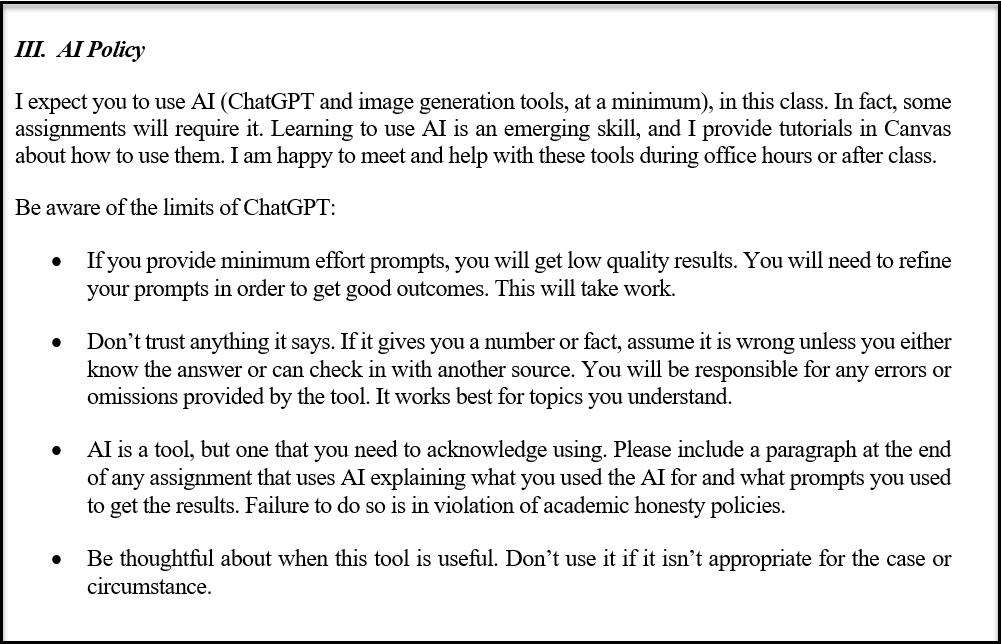
He believes that students need to be taught to use AI effectively and efficiently, rather than deeming it taboo.
Hoping to gain some understanding of students’ relationships with their work when AI is added to the mix, we gathered together some interviewees. These university students are in the midst of the fire, writing essays and either embracing or avoiding the pull of ChatGPT.
One student, partaking in their second year of study at Goldsmiths University of London, stated that there is temptation. “It thinks like a human, and so you can literally ask it to write an entire essay for you, which I have never done, I think it’s too risky – I’ve used it for finding sources.” The risk this student refers to is the AI detection software in TurnItIn previously mentioned. This is one of the many outlets through which AI is trivially controlled. “AI detection works in Turnitin by breaking submitted content into smaller chunks of text or sentences. Those segmented sentences are then overlapped to help capture each portion in context.”
This student stated that her main utilisation of the AI chatbot is its speed. “When you’re trying to find a source to back you up, you can ask it, ‘Oh find me sources about this theorist’, and it will straight away give you a load, and then in a way, I guess that isn’t cheating, you’re just using it to help you. If I did use it to write an essay, I know it would take me a while to get absorbed into it because it wouldn’t be personal; I’d feel so disconnected from the work. I’d be more tempted to use it for introductions and things, not entire essays.”
This is a common outlook on ChatGPT; oftentimes equally out of fear of plagiarism accusations, but also due to the inherent disconnect from work that it poses. Another student at Goldsmiths came to similar conclusions during the interview, stating: “It takes the passion out of the work if you use it too avidly. I wouldn’t ask it to write an entire essay, but I know it’s entirely capable.”
The third interviewee used it for different purposes, commenting: “I use it for every assignment, but not for big things. Sometimes if I’m unsure of a concept or theorist, I’ll ask it to summarise the key points, especially for summarising books or articles. Sometimes it’s hard to find that on the internet, so I guess I mainly use it for citations and summaries.”, proof that it is just as much of an academic tool, as it is a possible issue for educators.
Through interviewing students, it became apparent that although the vast majority of them do not utilise ChatGPT to construct entire essays, many are using it as an accomplice in their work, resulting in essays that are partly AI-generated, whether elements are written using it, or concepts and premises are taken from its answers. Most students don’t go without it when completing an assignment now; the nature of work has become a hybrid of human and robot.
Truly, the future is looking more and more like a science fiction film as the months roll on, and it is clear that our grip is slacking on understanding and control of such a huge tool. It will be interesting to see how students’ relationships with their work develop as AI, too, develops infinitely.