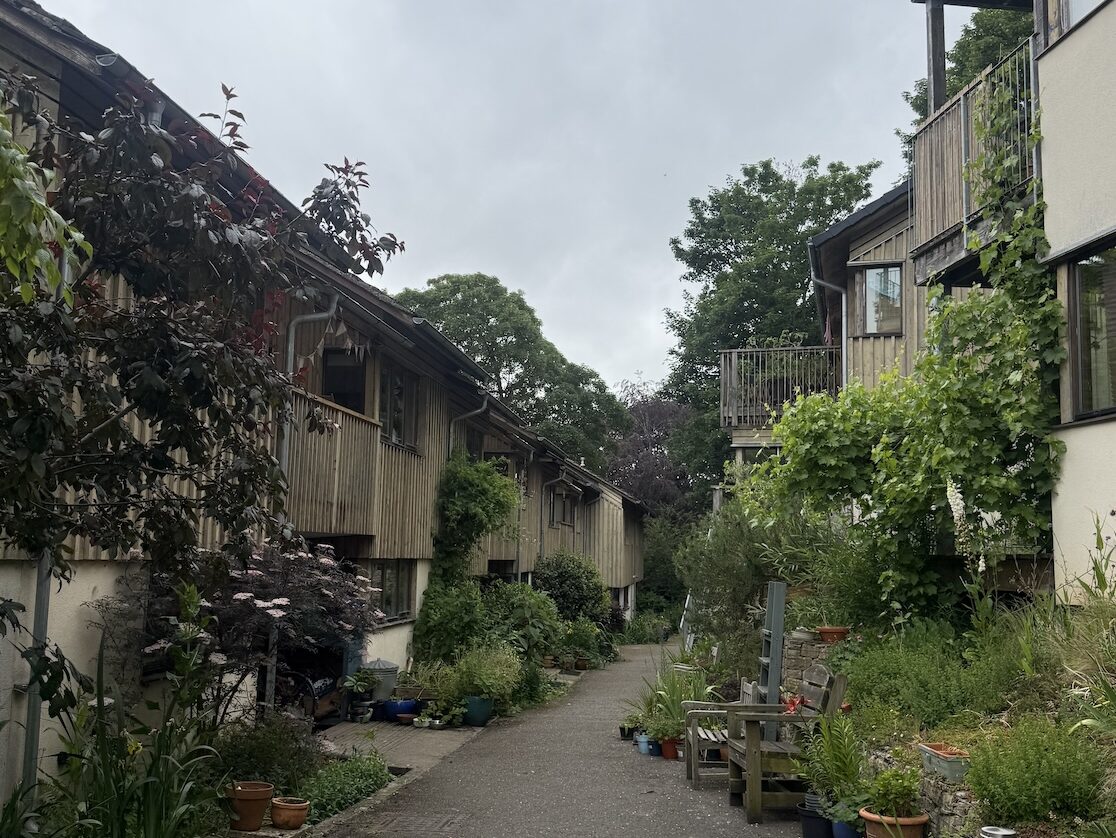
It is June at Springhill in Stroud, Gloucestershire and there is a wildness to the space that feels deliberate, though it could be that someone has just forgotten their turn on the lawn mowing rota. Within the shared communal space is an allotment growing produce to be shared, a wood workshop and a wildlife pond, “We have less things that are our own, in a way, we have one lawnmower, and most of us are on the lawn mowing rota, but do it about once every two years,” says Linny Gray, 49.
Linny has been living at Springhill, the UK’s first purpose built cohousing community, with her 18-year-old daughter for 16 years. A community of environmentally friendly timber-clad houses, surrounding shared green spaces where children play outside into the late evening and neighbours cook and eat as friends. It sounds idyllic. This was Springhill’s founder David Michaels vision, having been inspired by models in Denmark where cohousing became popular in the 1970s. Completed in 2003, Springhill is currently home to over 70 people ranging in ages from 4 to 84.
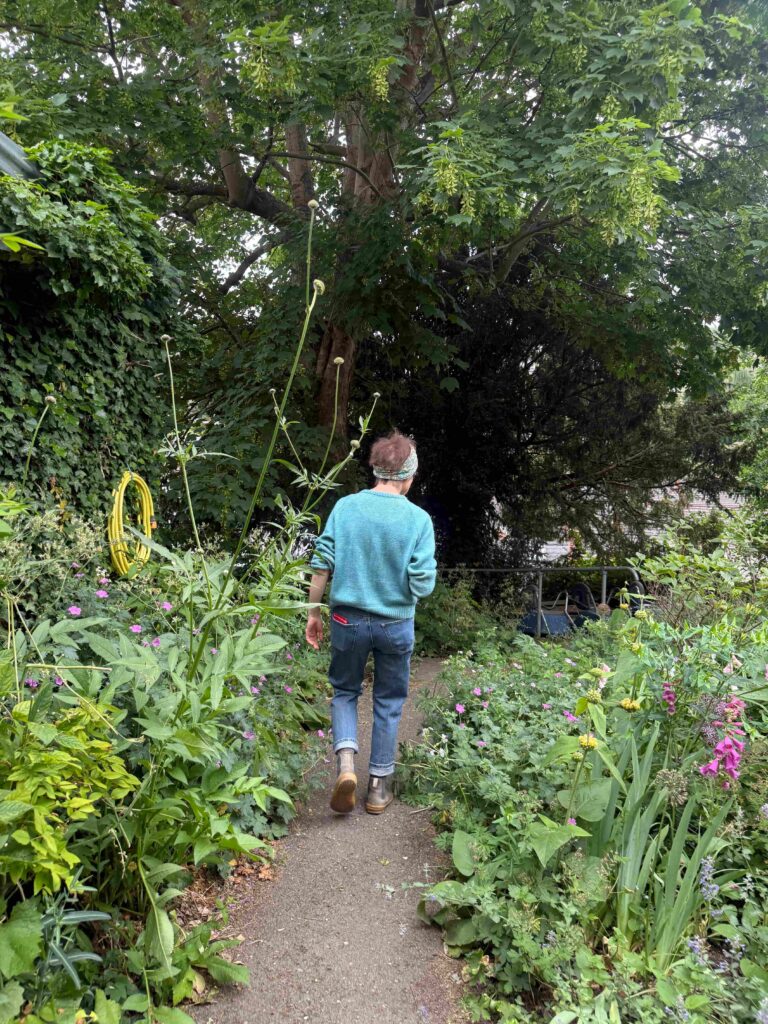
One of the pulls towards life in an intentional community for Linny, was raising a child. At Springhill everyone knows each other by name, children can play freely anywhere within the confines of the community, and residents don’t worry about traffic. “Growing up, my daughter had sibling-like relationships with a lot of the gang here,” says Linny, “they’re all young adults now, and there’s a new little gang of three- and five-year-olds. I just can’t really imagine living any other way.”
Cohousing as a concept first emerged in Denmark in the 1970s, built on the idea that housing should be designed deliberately around community. The model spread across Scandinavia and in 2026 one in five people in Denmark live in cohousing communities. Diggers & Dreamers, a not-for-profit collective whose aims are “to dispel the myth that communes came and went in the 1960s”, says that interest in intentional communities and cohousing has surged across the UK, driven by the rising cost of living, environmental concerns, and post-pandemic isolation, with more people than ever looking for affordable, community-oriented alternatives to conventional housing.
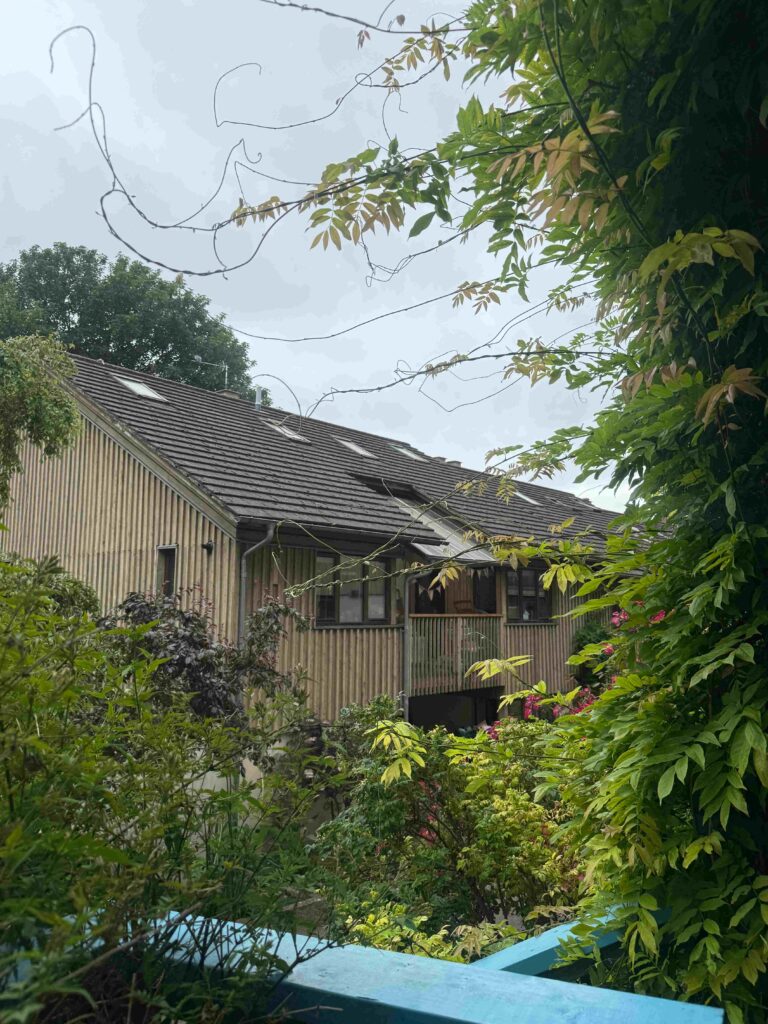
At Springhill, every family or individual owns or rents their own private property, though gardens remain largely unfenced, and most of the space within Springhill’s plot is shared between the community. Everybody who lives at Springhill also owns part of the community house, a large three-story building sitting at the centre of the development. Inside, is a shared kitchen and dining room where communal meals are eaten together three times a week, a large games room, and a cosy open plan living area where community members run music, arts and meditation groups. Residents also have access to two electric bikes, a laundry room as well as regular clothes and book swaps.
Inside the large communal kitchen, complete with a range cooker and an American-style fridge freezer Linny explains that everyone has to be on the cooking rota. “It’s pretty much the only thing you really have to do,” says Linny. “It’s once a month in a team of four, so it’s not a huge deal. And then there’s people organising the rota, people organising the shopping, people organising the recipes. It’s a well-oiled machine, and I think for that reason it works quite well.”
It does take quite a lot of work
Linny, Gray, Springhill
Though the rotas, organisation and routines might sound exhausting. At the end of the day, residents at Springhill can enjoy the privacy of their own homes. In 2004 Jane Serraillier, 76, and Neil Bunik, 76, became the first people to buy a property in Springhill, their five-bedroom home is one of the largest within the community. Retired planning officer Neil had lived in various other styles of intentional community before moving to Springhill, including in a farmhouse in Devon with three other families. “I knew if I ever did it again (cohousing), I want to be somewhere where I can be private and communal,” he says. “The thing about living here is, you go home, you shut the door.”
Meeting the wants and needs of 70 people requires work and compromise. Jane and Neil call the three points of pressure within the community, what he refers to as the “the three Ps: parking, parenting and pets”. Jane holds out three laminated cards in red, orange and green that are used for decision making at Springhill’s monthly meetings. Red is “over my dead body”, orange is “I have an objection or a question”, and green is “fine by me,” she explains. The idea is that eventually using this consensus method the group will come to a decision that everybody is happy with or can at least live with.
“It does take quite a lot of work, we are quite hot on procedure,” says Linny, “the order you have to do things in if you want to make a suggestion or make a change, otherwise it could just be complete chaos”.
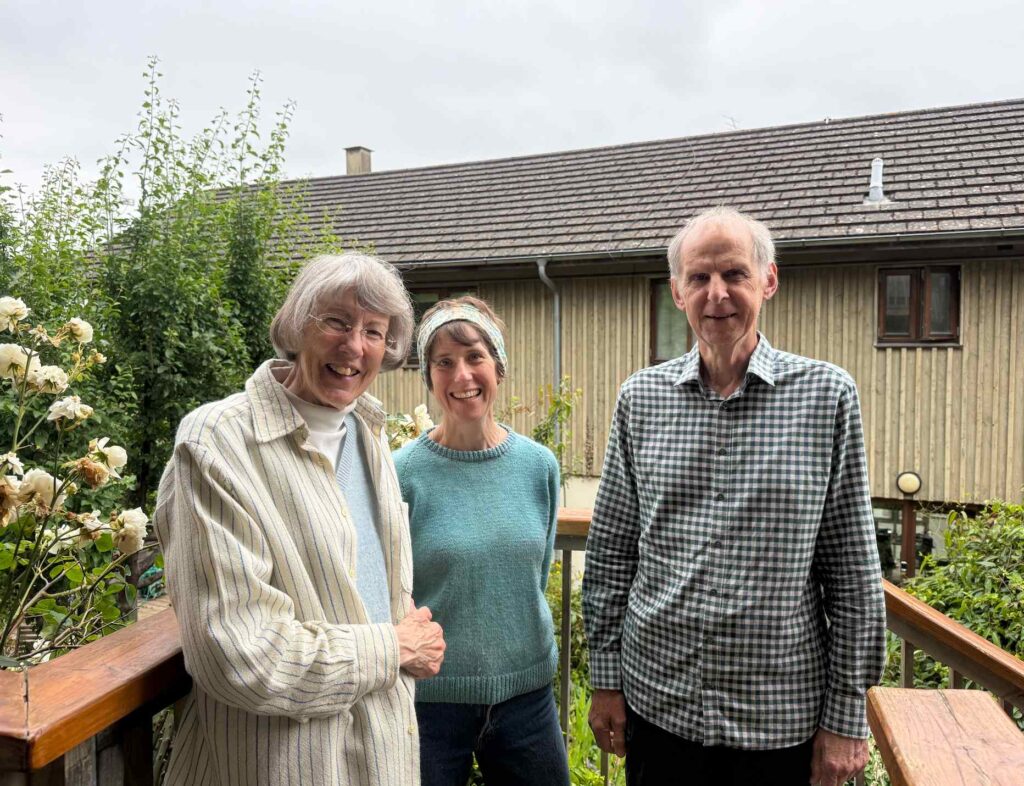
One of the key facets of intentional community is intergenerational living. More than 50% of the residents at Springhill are still the original cohort who moved in when it was first completed in the early 2000s, meaning that the median age has significantly increased. Dr Karen West, sociologist from the London School of Economics, says that there are several factors driving interest in communal living, with ageing being a key reason. Research suggests that the Baby Boomer generation want to age differently to the way they watched their parents age, perhaps having experienced the struggle of caring for ageing relatives themselves. “They see the bonds of community and mutual support among community members as an alternative way of meeting their needs,” says Dr West.
As the community at Springhill has gotten older, Jane explains that “one of the things that has really interested me is people dying here and how very different it is than outside.” The last lady to die at Springhill was cared for by fellow members of the community who took it in turns to bring her soup and sit with her during the last weeks of her life.
“Several of us were gathered outside, the hearse came,” says Jane, “and her brother went in to see her and said, ‘I’m sorry, I’m not going to bring her out, because she’s so peaceful here, she’s looks sohappy. Please can I leave her for another few days?’”
Just 40 minutes from Springhill, Laura Bowker, 38, and her family have taken a step further into living in an intentional community based in the centre of Bristol. In September 2025 Laura, her husband and three children aged 11, 7 and 4 moved into the large Edwardian house, where they live communally with over 20 others. LoveBristol is a not-for-profit church and charity, with many of its members choosing to live communally as a way to get closer to their faith, in one of the church’s four community homes.
We had a bit of a rough time as a family… we came out the other side remembering who we wanted to be and how we wanted to live our lives
Laura Bowker, Lovebristol
Laura, who works as a community house pastor at LoveBristol, had been part of the church for 11 years before she and her husband decided to move into the community. “We had a bit of a rough time as a family, and my husband’s mental health took a bit of a plunge,” says Laura. “He got a late ADHD diagnosis, and as these things do, it sort of makes you reassess your priorities a little bit… We came out the other side remembering who we wanted to be and how we wanted to live our lives. We wanted to really share our lives with people outside of our nuclear family.”
Moving into the community, learning to live alongside 20 others while raising three children has unsurprisingly been a huge adjustment for Laura and her family. “It took us a few months to feel like we found a new groove,” she says. “It has been great, though it was quite disorientating for me and my husband at first, but the children have loved it since [from] day one; they have this huge extended family and all this new space to play”.
Unlike at Springhill, where residents can mostly choose to be as involved as much or as little as they’d like, Laura explains that at LoveBristol “there’s an expectation that if people want to be in community, they will make space for the ‘rhythms’ of the week and be a part of those.” These include eating together every evening and praying together multiple times a week.
The beauty lies precisely in living alongside people who are not like you
Laura Bowker, Lovebristol
While for many, giving up private family life and the luxury of personal space would be unfathomable, Laura feels that the personal sacrifices her family have had to make to move into community at LoveBristol, are some of the most important elements. “It feels quite liberating to sort of have to constantly consider the needs of other people,” says Laura. “Living alongside people who are like, ‘Wow, you are not like me, and you don’t think the same as me,’ is actually part of the point.”
Most residents at the LoveBristol community choose to live in community for two to three years, like Jane, Neil and Linny at Springhill, Laura’s family feel that living in community will be their long-term plan.
Though Springhill and LoveBristol operate on vastly different models of cohousing, their members have made the same deliberate choice to reject the self-contained nuclear family that has defined Western culture in the 20th and 21st centuries.
There are obvious social, environmental and practical upsides to cohousing, but the true beauty lies not in the shared green spaces, the cooking rotas, Scandinavian architecture at Springhill, or shared worship at Lovebristol. In a world where genuine connection has never been easier to simulate and yet seems somehow harder to find, there is something special in the intentionality behind the choice to live in community, the decision to live alongside others in ways that may sometimes be personally inconvenient. But, in that compromise, residents gain children with extended families they never expected, neighbours who put time and effort into enriching the lives of those in their community, and tend to each other in death. As Laura puts it, the beauty lies “precisely in living alongside people who are not like you.”