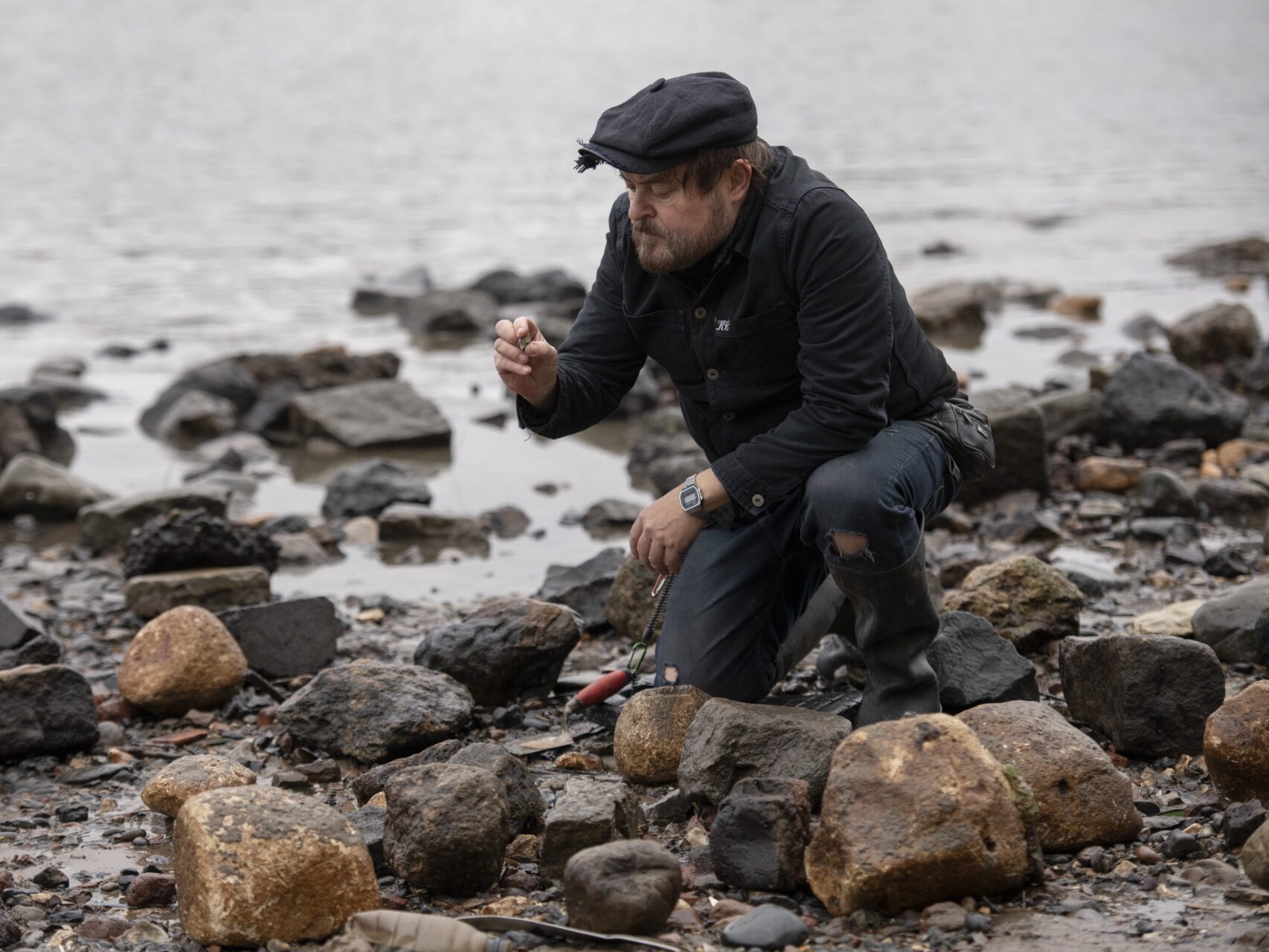
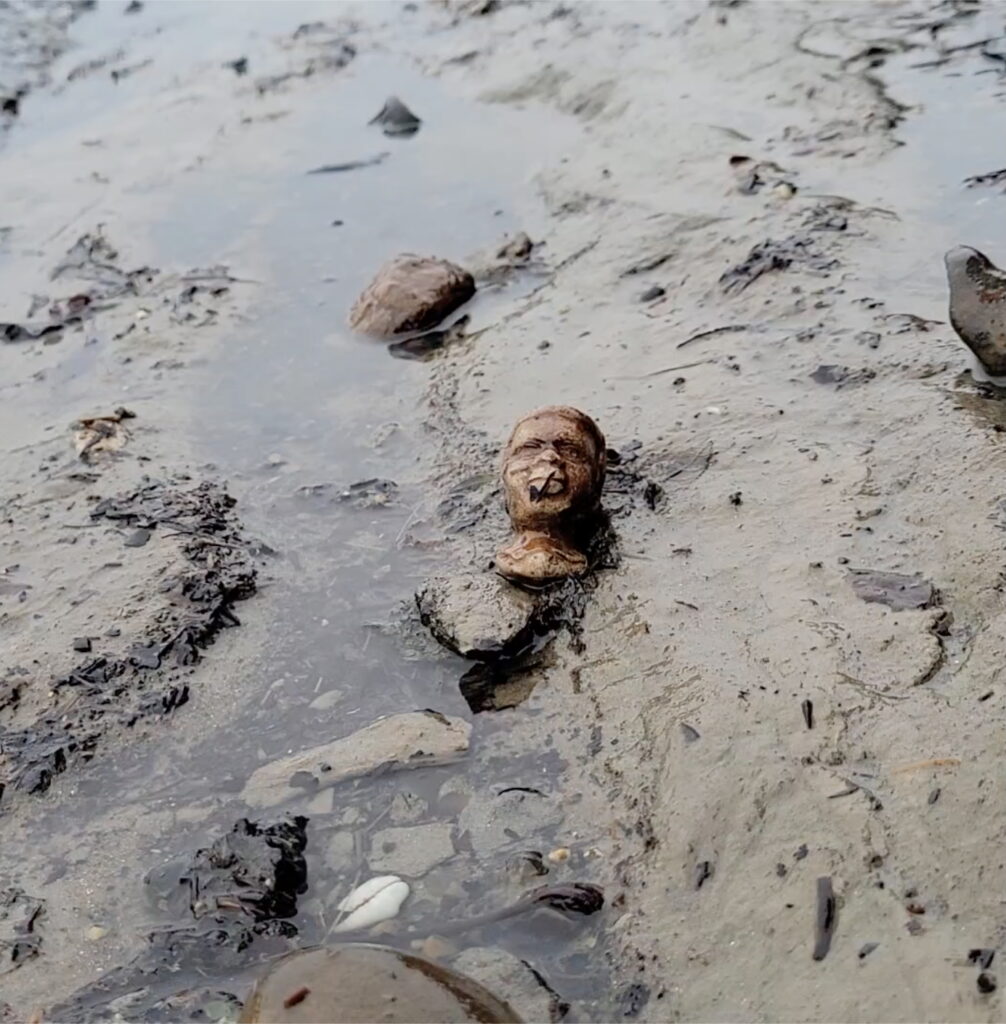
In amongst the pebbles and the waves of the river you’ll find Kenneth Collard searching the shore. Wearing wellies and a trowel in his hand, you’ll find him on his hands and knees searching for whatever history the river has washed up that day. Just below the tread of tourists, bustling commuters and noisy traffic queuing along the bridges, Kenneth is searching for anything that can take him away from the bustling metropolis of London and transport him to the past. He’s had some success in the six years he’s been mudlarking, boasting finds of a clay tobacco pipe in the shape of an enslaved person’s face and a cowrie shell.
“They were also used as currency in West Africa, cowrie shells, and they were sometimes used as currency for buying people,” he says. The Thames has a way of illustrating history in a way only mudlarkers can find, “the significance of this time, late 1700s-early 1800s, and the buying and selling of people across the world. The cowrie shell having washed up at the exact same time, another moment the tide would’ve gone. It was deeply significant. “Kenneth’s find was so astonishing that the London Museum Docklands featured it in its 2024 exhibition: Secrets of The Thames: Mudlarking London’s Lost Treasures.
Mudlarking is the name given to the act of searching the shores for anything of historical significance. It didn’t begin as a hobby for the historically curious but instead used to be a practice of London’s poor; scavenging anything they could find to sell and earn a living, but the 18th century practice has now become a hobby rather than a way to get by.
As well as history, mudlarking has led Kenneth to track modern societal issues, such as knife crime. Knife crime dropped in 2020 but, according to data from the Metropolitan Police, slowly rose again and this can clearly be seen in mudlarking finds.
“There are certain spots where you find so many knives and the majority are kitchen knives,” says Kenneth. “Then you ask the question, why are there so many kitchen knives in a river in this particular spot? That’s indicative of the river and its relationship to the environment. Also, the social history, what we’re going through, about knife crime. Children killing each other. All of it is kind of linked, nothing really exists in isolation.”
Kenneth, originally from Kent but moved to south-east London in 1992, took up mudlarking when he first discovered it on social media. He now runs successful accounts himself under the handle @talesfromtheforeshore across YouTube, TikTok and Instagram, amassing a total of 84.55k followers.
Despite the strong community surrounding the practice, Kenneth says there is some divide between mudlarkers and how they practice the hobby. In the 18th century there were no metal detectors or any other fancy kit you could use, people used their hands and sifted through The Thames’ shores looking for anything they could sell. “Some mudlarks will only use their eyes, they won’t scrape or dig,” Kenneth explains, while others point out that the Uber boats that go up and down The Thames disturb the foreshore, and so will use equipment to aid their search.
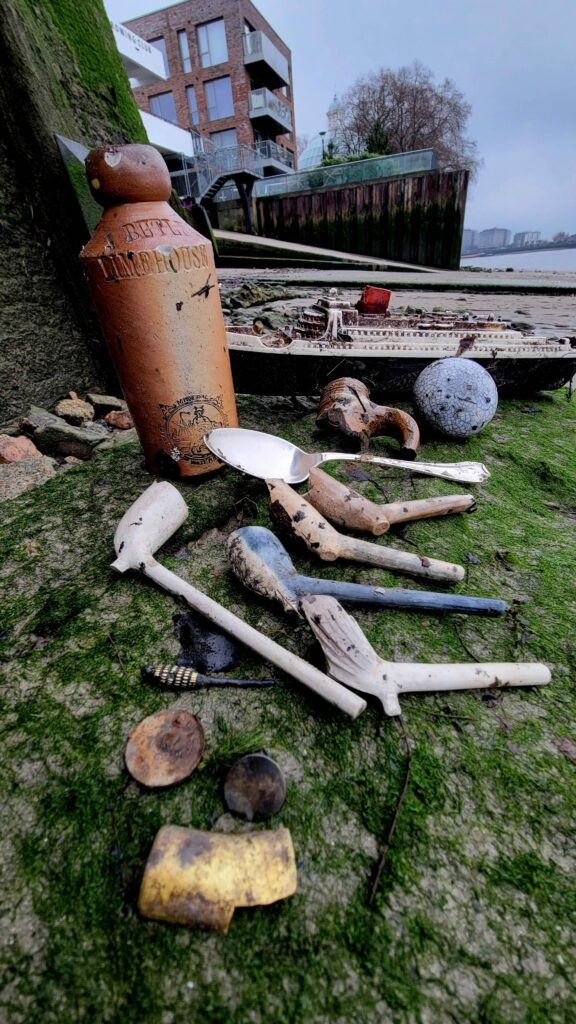
Mudlarking may be increasing in popularity, but it is regulated by the Port of London Authority (PLA) which issues permits for anyone wanting to treasure hunt on the banks of the Thames. The PLA offers 4000 permits annually which cost £35, however aspiring mudlarkers will need patience as well as a keen eye, as there is a waiting list of 10,000; without a permit it is illegal to dig or search the foreshore of the Thames.
The limitations on waiting lists and permits are operated with preservation in mind. The PLA says the Thames foreshore is a sensitive environment dating back to 10,000 BCE and so it must be protected by not allowing an overwhelming amount of people onto it. If a mudlark finds something of significant interest this must be reported to the Portable Antiquities Scheme Finds Liaison Officer, and sometimes mudlark finds are exhibited in the London Museum Docklands. Some recent finds by amateur mudlarkers finds include a 15th centenary gold ring, the skull of a Neolithic man and a Roman miniature carved chalk head. In 1857 an Iron Age shield was found in the Thames at Battersea, but only the decorative metal and not the wooden backing. Historians believe the lack of battle damage suggests it was sent into the Thames as either an offering to the river, or to mark an important death. Since its surfacing it has inspired the Royal Mail stamps and a replica is housed at London Museum Docklands whilst the British Museum has the original find.
Although mudlarking isn’t exclusive to London, Kenneth explains how the benefit of mudlarking in the UK’s capital is the “thousands of years of history that keeps coming out of the river.”
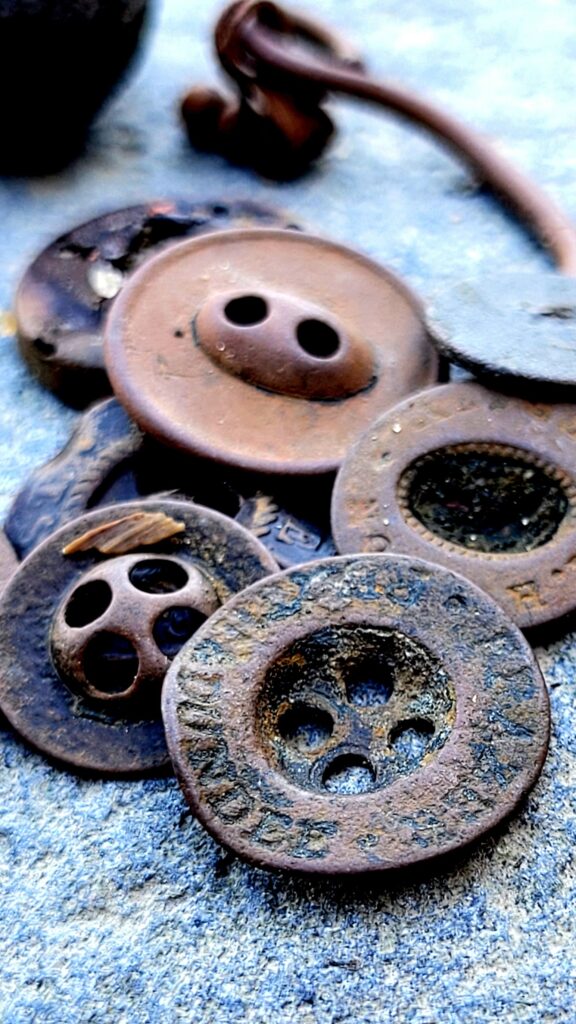
Depending on the tides and work commitments, Kenneth likes to mudlark every 10 days or so, and he’s usually on the lookout for coins, as he loves how coins show a part of everyday history.
One coin he found in May 2026 was inscribed with the year 1690 and a comment by a follower on YouTube made him consider how different things were now compared to when the coin was inscribed. “It was from 1690, so that’s 30 years after the Civil War and there was civil unrest across the UK,” says Kenneth. “Post pandemic, 1665 [ was the year of] the great plague of London and then the 1666 Great Fire of London: countless wars going on, a currency crisis. I thought, how different is that to 2026? It’s not. We repeat ourselves because human beings fundamentally don’t change.”
Another coin of interest that Kenneth has found and eagerly talks about is a French coin. It’s in a batch of things that he is preparing to take to the London Museum.
“[It’s a] King Louis the 14th Ancien Régime French coin,” Kenneth explains. “He was a child when his head was put on the coin. This was when France owned Barcelona, it was minted in Barcelona and a few years later lost in Barcelona. For a brief moment of history there’s this child king and it washes up in south London.”
Kenneth contemplates the journey this coin, carrying the likeness of a young king has been on: “You think, wow, the journey, how did that travel? Who had it? How did they lose it?”
However, mudlarkers of the future may not be able to find history through coins, Kenneth warns there’s a chance “we won’t find any more [coins] from this current period of time because we’re a cashless society.” He says, also noting how today’s coins are so poorly made that they will just rust away. “There will be a period where there’ll be no coinage of this period at all.”
Although mudlarkers today can claim finds of Neolithic jade axes made in Italy or 18th century shoes, Kenneth muses that the mudlarkers of the future will be finding cigarette butts or vapes. While it may seem like trash to us, Kenneth compares the clay pipe he found to vape that might be found hundreds of years from now: “[They’re]no different to cigarette butts or vapes but suddenly they’re special because they’re 200, 300 or 400 years old,” he says. “Imagine finding a 200-year-old vape, that’d be amazing. They’ll be reported to the museum.”
As well as history, the river holds secrets too. “What hasn’t changed in 1000, 2000 years is that people dump stuff in the river just to get rid of it. All those things you don’t want people to ever find,” says Kenneth. “The Thames is mostly tidal, so you may dump something in the river thinking nobody will ever see it but of course the river retreats and sometimes stuff is revealed.”
While mudlarking might seem like an innocent hobby, it’s not without its risks. Kenneth notes that mudlarking used to be a lot more dangerous, and sometimes fatal as people would get stuck in the mud and drowned by the incoming tide. Thankfully today the community is much safer and looks out for one another.
“There have been mudlarks that have fallen down steps and been found and been concussed, but very rare,” says Kenneth, who keeps himself safe by noting down on a calendar where he’s going, along with the tide times should something happen to him but thankfully he’s stayed safe and has thrived in the new community he’s found.
“It was only through some of the more experienced mudlarks who shared their understanding that I then started to understand how the foreshore works and how you search it,” says Kenneth, praising his newfound mudlarking community.
Kenneth says that everyone “must make time in life” to mudlark. “It isn’t just about searching for history… it’s about escaping the digital world, about a moment of quiet, peace, isolation and being at one with something.”
Featured Photo Credit: John Chase Courtesy of London Museum