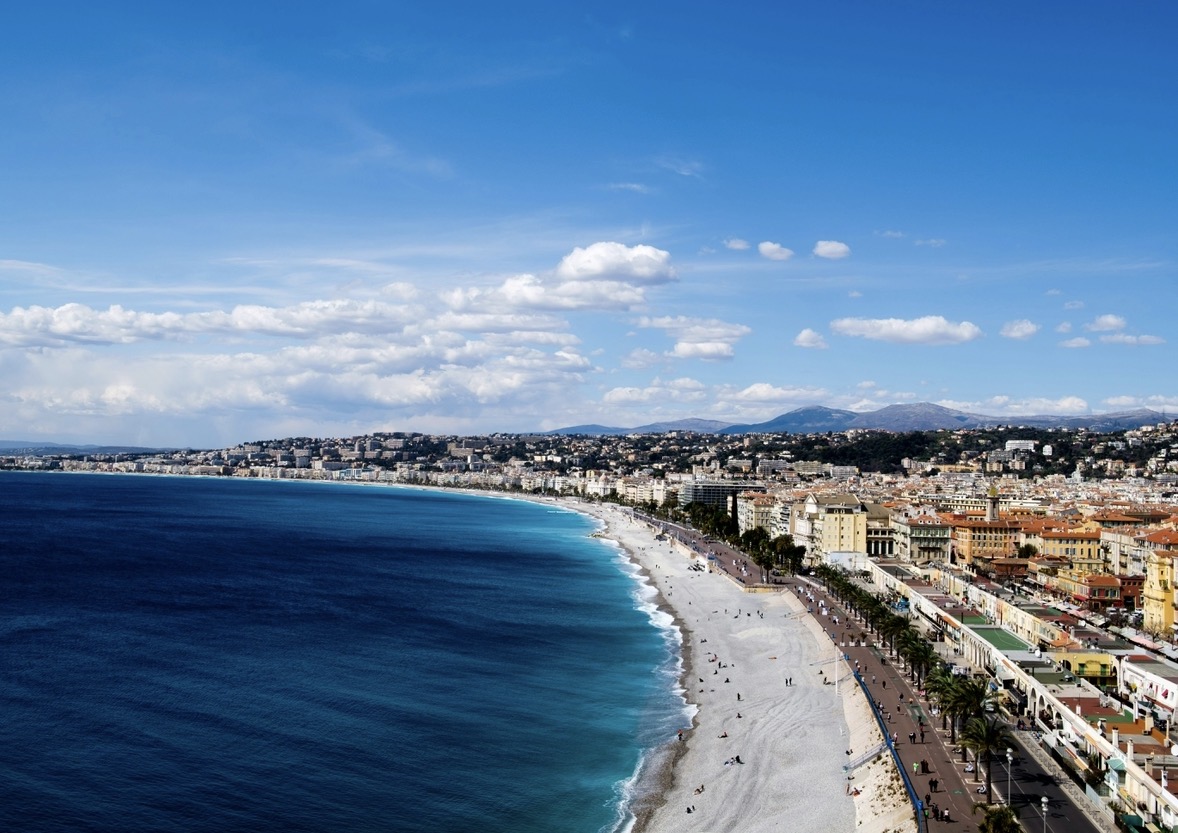
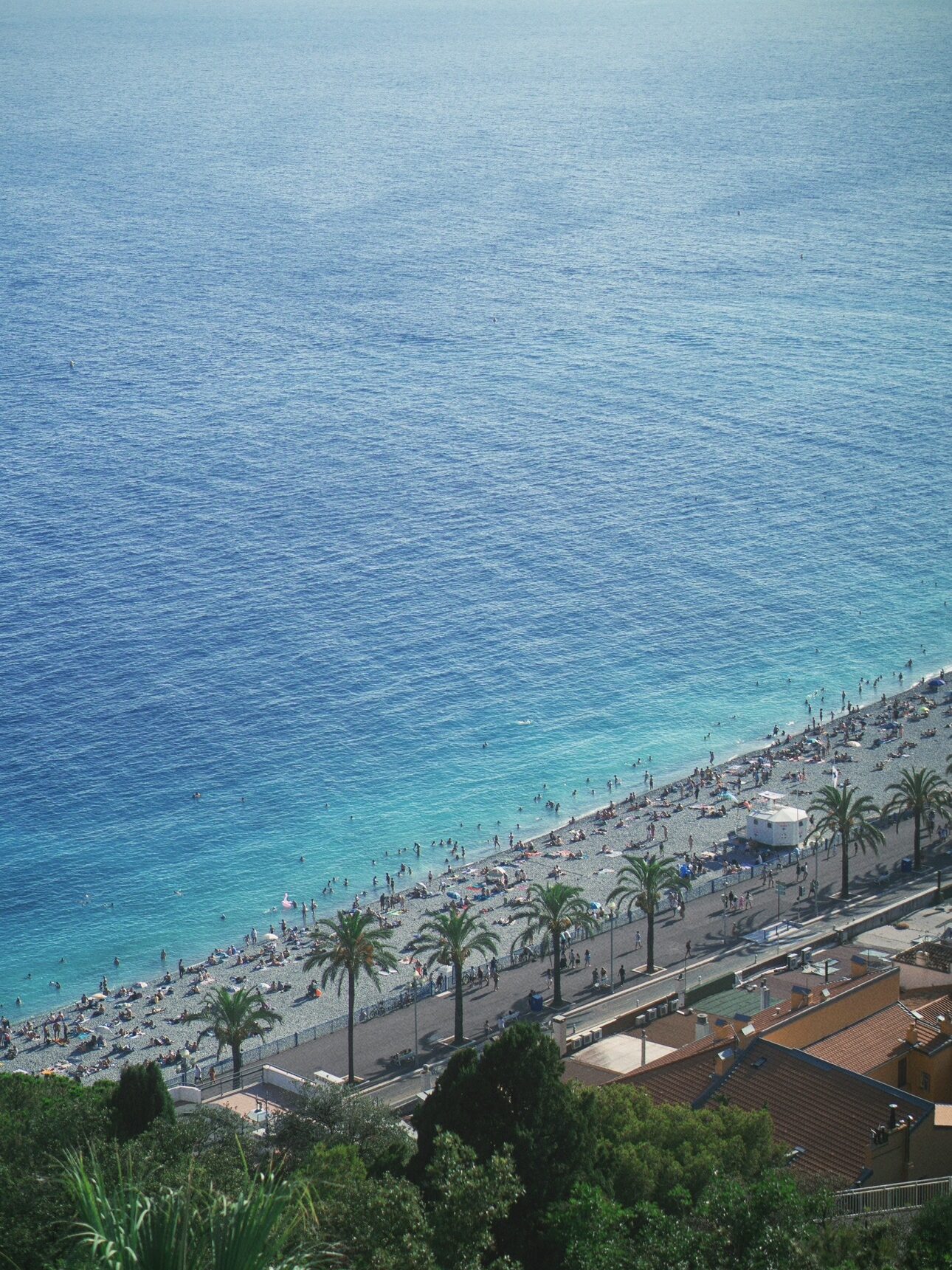
By late afternoon in Nice, the sunlight stretches across the Promenade des Anglais, warms the limestone façades into shades of honey and cream, and flattens the Mediterranean into a sheet of saturated blue. There is no skyline cutting the horizon into fragments. No vertical wall of glass interrupts your peripheral vision. The eye travels forward and keeps going.
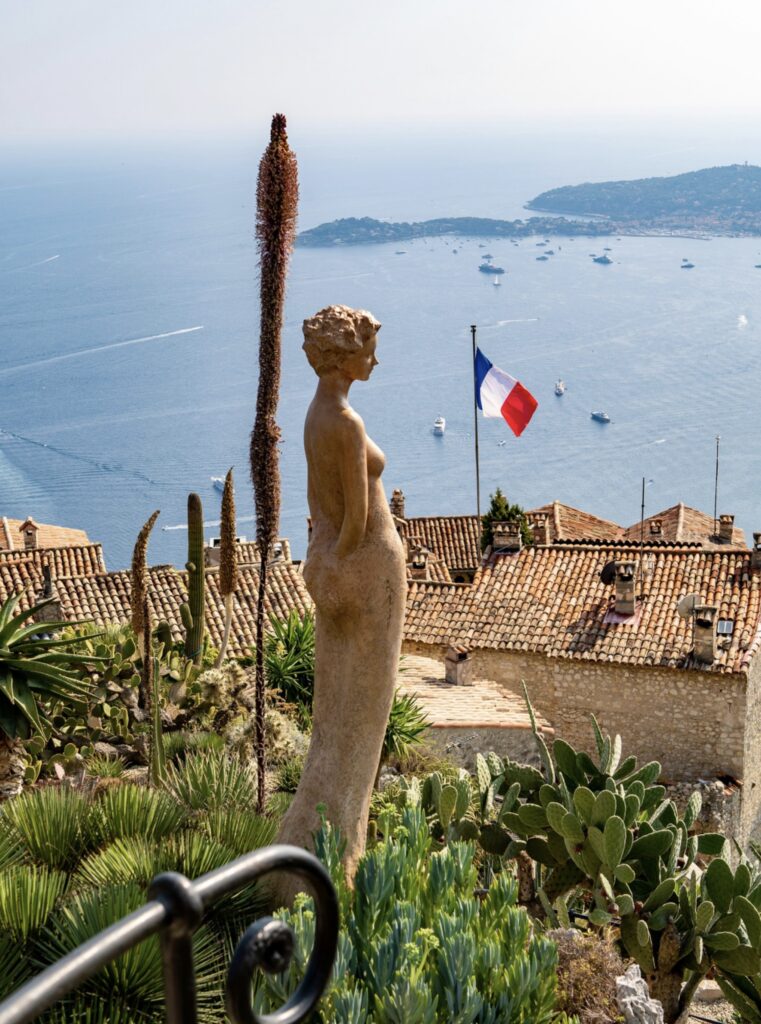
In most major business capitals, your gaze is constantly interrupted. Glass towers reflect competing images. Digital screens demand your attention. Traffic and density compress the horizon into blocks. Even when you are still, your eyes are working. In Nice, they are allowed to rest on the horizon. For a growing number of professionals relocating here, that uninterrupted visual field is not simply beautiful; it changes how they feel at work.
Claire Atkinson, 55, understands this shift intimately. After nearly three decades in the United States building a career as a journalist covering media, telecommunications, and technology policy, she could have permanently anchored herself in New York or Washington. Instead, she bought an apartment in Nice and now works remotely between France and the US.
“There’s real infrastructure here,” she says, referring to Cannes’ expanding calendar of media and technology conferences and the steady growth of AI-related events along the coast. “It’s connected.”
But when she compares the Riviera to larger cities, the difference she highlights is psychological rather than logistical.
“In other big cities it can feel very transactional,” Claire explains. “Here, it’s community first. Friendship, then work.”
That softer professional culture mirrors something measurable. In an interview with The New York Times, environmental psychologist Marc Berman discussed research showing that time spent in natural environments improves performance on tasks requiring memory and sustained attention. His studies found that participants performed better cognitively after exposure to natural settings compared to dense urban ones. The explanation lies in what psychologists call directed attention, the mental resource used for strategic thinking and decision-making. Urban environments tax it, while natural environments help restore it.
The Mediterranean’s intense blue is not only beautiful but also has some positive psychological effects. According to NASA’s Ocean Color research, seawater absorbs longer red wavelengths of light while shorter blue wavelengths are scattered back toward the observer, giving deep water its vivid colour. The relative clarity of the Mediterranean enhances that effect, creating a horizon that feels almost hyperreal. Some small-scale research has linked exposure to blue environments with perceptions of calm, but you do not need a journal citation to feel the difference between staring at glass and staring at open water.
Jean-Claude Goldenstein, 66, a Cannes native who spent 25 years building his career in the United States before returning to the Riviera, structures his routine around that difference. As a founder, advisor, and investor working across markets, his schedule remains international and under high pressure. What has changed is his recovery.
“I like to see the ocean,” he says. “It’s more informal here. I like serenity.”
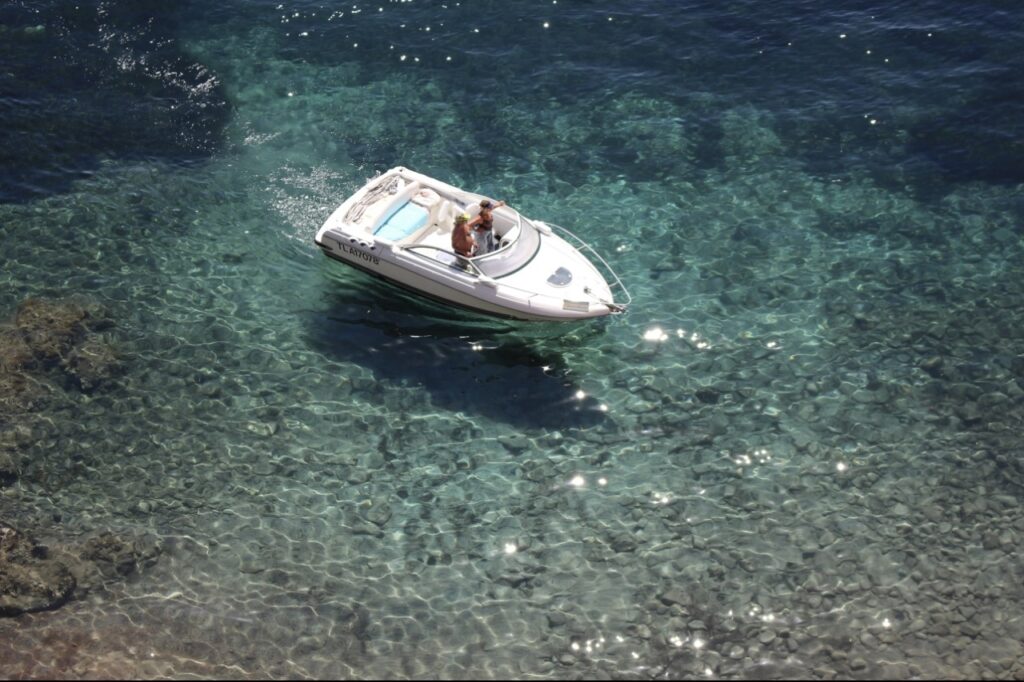
In the summer months, he sails for an hour or two before swimming. The physical fatigue is immediate, while the cognitive reset arrives the next morning. “I’m super regenerated,” he says.
One explanation lies in stress physiology. As Stanford neuroscientist Robert Sapolsky explains in his book Why Zebras Don’t Get Ulcers, cortisol, the body’s primary stress hormone, is useful in short bursts but harmful when chronically elevated. Persistent stress caused by living in cities can impair focus, working memory, and complex reasoning, while living in natural environments lowers stress levels, supporting clearer decision-making and more stable attention. He adds that living in natural environments does not eliminate all pressure, but they can reduce the constant low-level stimulation that keeps cortisol artificially elevated in dense cities.
Katrina Horning, 44, who relocated from New Orleans to establish an architectural tour company in Nice, describes the impact in sensory terms. “The limestone is everywhere,” she says. “The textures, the Mediterranean colours. And the blue here is specific. It makes me really happy.”
Her work depends on observation and narrative. She spends her days analysing façades, proportions, and urban layers. Collaborations often take place outdoors, and meetings stretch along café terraces facing the sea. The visual environment feeds directly into creative output.
The appeal of the Riviera is not detached from ambition. Twenty minutes inland sits Sophia Antipolis, one of Europe’s most established technology parks. Founded in the late 1960s, it was designed as a research and innovation campus integrated into pine-covered hills between Nice and Cannes. Today, it hosts thousands of companies across artificial intelligence, cybersecurity, biotech, and telecommunications, alongside research institutions and engineering schools. Global firms maintain operations there, and AI has become a particular growth area in recent years.
What distinguishes Sophia Antipolis is not just its industry concentration, but its setting. Offices are embedded in greenery rather than packed into financial towers. The ecosystem provides credibility and opportunity without demanding the sensory overload of a traditional tech capital.
For professionals considering relocation, this combination is persuasive. The Riviera offers infrastructure, international connectivity, and a growing technology network. It also offers an intact horizon.
Late in the evening, as the sun lowers behind the curve of the coast, the blue deepens toward silver. Conversations continue along the Promenade. Emails wait until morning. The Mediterranean remains steady, absorbing the last light of the day.
For the people building companies, advising boards, and negotiating deals from this coastline, that steady line between sea and sky is a daily recalibration point. Attention holds longer here, and decisions are made from a slightly calmer baseline.
The work is still serious, and the ambitions are still global. The difference is that in Nice, your eyes are not constantly fighting the environment. And over time, that changes how clearly you think.