Jemima Roques
Behind the world’s most popular treat lies a system of inequality allowing corporations to thrive on neocolonialism

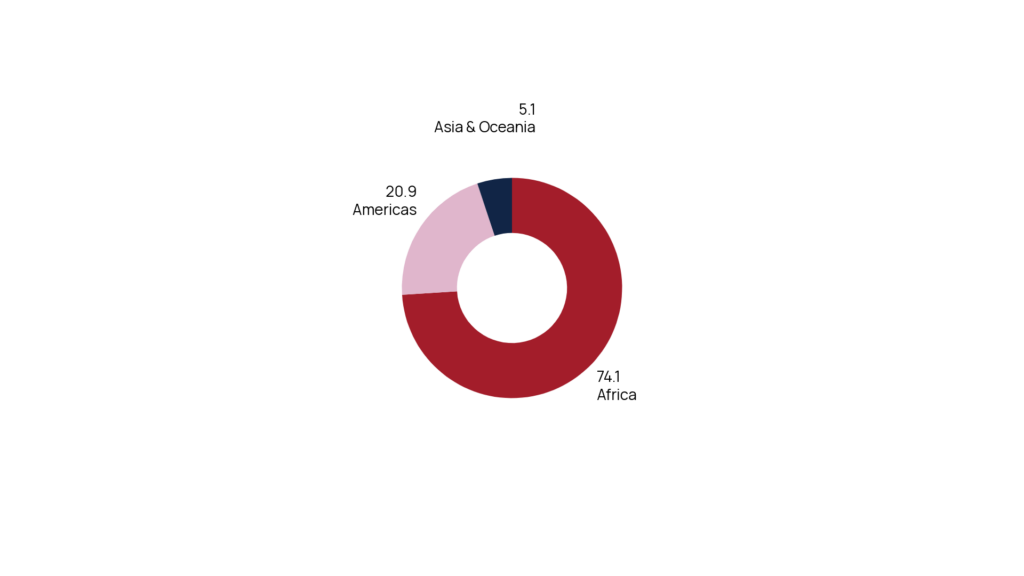
The world’s cocoa is grown almost entirely in Africa, Latin America, and Southeast Asia & Oceania – mostly formerly colonised nations — but it is exported mainly to Europe and North America who make the most profit. This familiar neocolonial system, characterised by Euro-America’s resource extraction and control of producing nations’ economies, is evident in production, exportation, and marketing. This goes far beyond the publicised discussions of fair trade and sustainability issues, encouraging us to reconsider the systems our consumption is upholding.
How does the chocolate industry exemplify neocolonialism?
Colonialism and exploitation have shaped the supply chains of the industry for centuries. Euro-American companies buy raw or minimally processed cacao and make the profit through processing, manufacturing, and branding. This leaves farmers with little control over pricing. This can even lead to Euro-American chocolate companies being able to influence policy and trade agreements. With Euro-America controlling the value chain, the economic and financial systems of cocoa-growing nations are tied to dominant global powers — the definition of neocolonialism. Whilst some companies such as Tony’s Chocolonely source their cocoa cautiously and transparently, most of the industry remains cruelly focused on profit through concealed processes, making statistics tough to find.
Production of cocoa beans by continent 2022/2023 (thousand tonnes)
Beyond being unethical, what impact does this have on the lives of cocoa farmers?
In many cocoa-producing countries, farmers earn very low incomes, particularly when compared to the profits of cocoa processors, global brands, and supermarket retailers. According to an Oxfam report, for every milk chocolate bar sold in Germany, 42% profit on average goes to the supermarket and less than 9% to cocoa farmers, many of whom live below the poverty line. Wealth is extracted from producing countries instead of supporting local development. Low profit for farmers means less money to invest in their industry or, for example, developing local chocolate manufacturing. Additionally, when emphasis is placed on profitable crops like cacao, labour is redirected away from growing food crops, requiring importation.
How does neocolonialism contribute to the human rights crisis in the cocoa industry?
The power structure created by neocolonialism results in everyday violations of basic human rights on cocoa farms due to underpayment. A study by Oxfam found that up to 90% of Ghanaian cocoa farmers do not earn a living income and that chocolate corporations sustainability programmes are “failing to deliver on promises to raise farmers’ incomes”. Poverty is a widespread consequence of low cocoa prices, often leading to child labour and forced labour being used. Because harvesting must be done by hand and pods are split open with knives or clubs, farmers endure long hours of physically tough work exposed to dangerous tools, creating unsafe and unfair working conditions. Neocolonialism keeps cocoa farmers economically dependent on low prices set by global markets controlled by Euro-American companies, trapping them in low pay and unsafe work.
How does marketing ascribe cultural value through soft imperialism?
Many companies brand their chocolate proudly as Swiss, Belgian, or ‘locally produced’, coordinated with a high price for being so, even though the fundamental ingredient and long-term labour were carried out elsewhere. Whilst different countries do have specific production techniques — such as the Swiss technique of conching which involves intense mixing leading to creamier chocolate — much of the industry is priced by cultural value. The label ‘Ghanaian cocoa’ doesn’t provoke the same appreciation for most Euro-Americans as ‘Belgian chocolate’ does due to imperialist ideas about the worth of colonised nations.
A growing trend for artisan goods has, however, seen the rise of chocolate prided as ‘single origin’ and labelled with the country in which the cocoa was grown. Whilst this does credit cacao producers, it does so to please Euro-American ideas about craftmanship. Some packaging and company websites include stories of the farms where the cocoa was grown. ‘Fair and sustainable’ brand Bantu Chocolate writes in an article that single-origin chocolate is “not just a sweet treat, but a story”. Although the brand aims to be ethical, their branding turns origin into a consumable narrative, curating a brand-controlled, romanticised story customers want to hear. The story of cocoa growers, as well as the brand’s claims to be ethical, add value to the product in a demonstration of soft imperialist power.
How does the neocolonial structure of the industry drive ecological damage?
Because farmers are paid very little, they are forced to produce a high volume of cocoa to earn enough money. One way to increase exports is by expanding farms and deforestation is often a consequence. The Stockholm Environment Institutecalculated that from 2003 to 2017, 1.65 million hectares of tropical moist forest were converted into cocoa plantations in Côte d’Ivoire — that’s equivalent to an area almost the size of New York City every year. The climate crisis also contributes to deforestation as it leaves farmers vulnerable to drought, diseases, and pests, which can destroy harvests. Land degradation increases the need for new cocoa farms. Global markets reward high cocoa output, discouraging farmers from diversifying their crops. This results in monoculture — growing a single genetically identical crop over a large area — which creates a loss of biodiversity, as well as increased vulnerability to pests and disease.