Fatma Fedai
Once weaponised as a racist trope and now circulating as a symbol of solidarity, a single fruit has carried radically different political meanings across time and place
On a summer afternoon, a slice of watermelon feels almost cliché: juice running down your wrist, black seeds flicked into the grass. It tastes like heat and childhood. But for others, that same fruit carries a different weight — one shaped by caricature, censorship and resistance. Why did the fruit become a racist stereotype, a flag — and how did this all happen?
“The stereotype has been around for so long…many people think the stereotype simply appeared out of thin air” writes historian William R. Black in “How Watermelons Became Black.” The anti-Black stereotypes of the watermelon have long lingered in American culture, emerging for a “specific historical reason,” explained by W. R. Black. The stereotype emerged following emancipation, with many African Americans growing and selling watermelons, offering them a measure of economic independence which soon became a representation of their freedom. However, the reality was quickly distorted with many Southern white people reacting to this freedom negatively, changing the meaning, and reinventing the fruit as a symbol of poverty. Through postcards, advertisements, and popular imagery, it was recast as ridicule — a way of undermining Black freedom. As a result, the racist stereotype of the watermelon was born.
The stereotype even persists in a more modern world. In 2002, Boris Johnson used a racist phrase to describe Black people — referring to them as “watermelon smiles.” The former prime minister faced criticism, but continues to defend his choice of words.
Despite the long racist past of the stereotype, many have made it their mission to confront and change the imagery. In recent years, instead of ignoring the stereotype, many artists and illustrators have chosen to redraw and rework it — reclaiming the fruit from its racist framing. One artist on TikTok, Tyree Soleil, has attracted millions of views for dismantling racist imagery through digital reinterpretation. “Unfortunately, we can still find memes and content that holds the same [racist] messages,” the artist added on a post. Another artist on Instagram, Cafed Hier, has a video with over 100,000 views — reinterpreting harmful historical imagery. “This type of imagery was really the norm for centuries,” she adds.
However, the fruit’s political journey did not end there. It would re-emerge thousands of miles away, recast as resistance. Once used to undermine freedom, the watermelon would later come to signal it.
Red flesh, black seeds, white and green rind — now a recognisable symbol for the Palestinian flag. In 1967, the Israeli government made the public display of the Palestinian flag a criminal offence. To resist the ban, Palestinians began using the watermelon as a substitute symbol — as they share the same colours — resulting in the watermelon, once again, holding significant symbolism and meaning.


But is the fruit merely a substitute or has it taken on a life of its own? Researchers Ilhaam Khan and Deirdre Pretorius, who wrote Seeds of Freedom: The Watermelon in Palestine Posters, analysed 408 Palestine posters produced between 2023 and 2025. “Although the watermelon symbol could stand alone, it is strengthened when combined with other Palestinian symbols,” says Khan, showcasing how the symbol has expanded far beyond replacement. She also explains how the familiarity of the watermelon results in a person quickly being able to make the link between the fruit and Palestine.
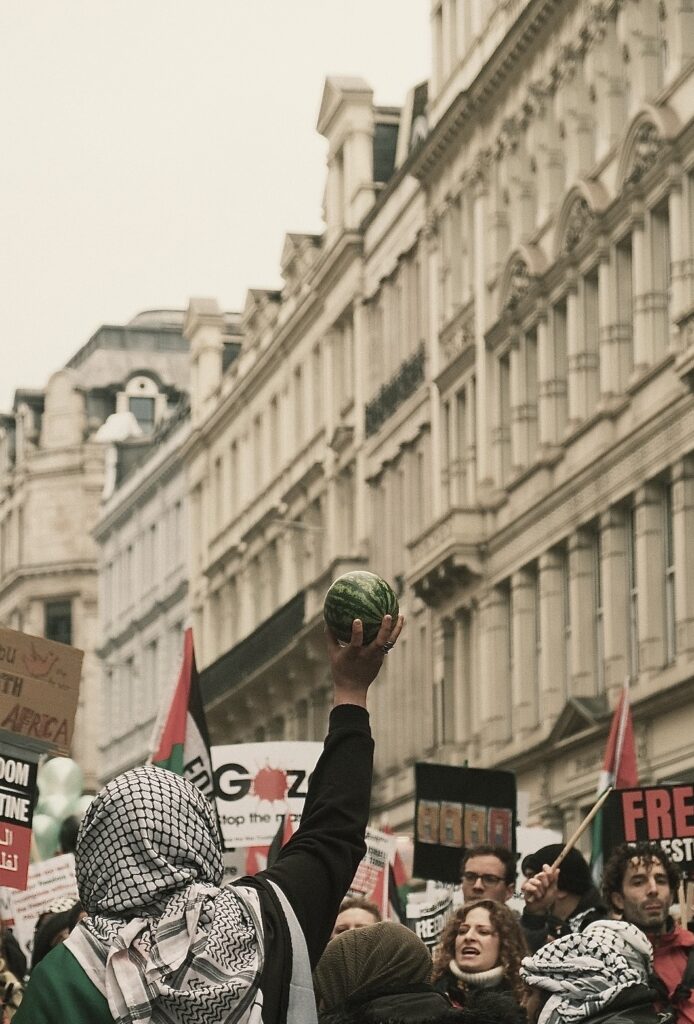
The watermelon’s significance is held beyond the Palestinian land, emerging on social media. Historically the fruit was used as a form of resistance but today, it is used on social media as a way to avoid censorship and shadow banning. Users post images of the fruit or use the emoji instead of the flag, reducing the chances of the algorithm identifying the video. Detection of Palestine related content often leads to videos being put out less onto users’ feeds. Far from weakening its meaning, censorship has strengthened the watermelon’s symbolic force. “The more a symbol is banned, the more people want to defy the rules and make it work,” Khan notes. She adds that it only adds to the allure of the symbol which simply results in further curiosity.
“The watermelon acquires expanded symbolic significance beyond acting as a substitute for the Palestinian flag,” co-author Deirdre Pretorius says, adding that the watermelon serves to symbolise land, body, weapons, and words. Across the hundreds of posters the authors examined, the watermelon consistently shifts from sliced, styled, and embedded into maps — reappearing in their own way. “Our examination of the symbols shows that it acquires various meanings,” Pretorius explains, going on to add that the poster designers in different countries incorporate and interpret the watermelon to communicate a variety of messages.
The story of the watermelon — from racist stereotype to a form of defiance — shows how objects can carry memory, identity, and resistance. As Khan puts it: “people are incorporating the watermelon symbol in their own way, thus creating new meaning.”