Ailin Khassen
The art world has always claimed to be open, but right now its barriers feel harder to ignore. Beneath the surface, outdated structures still dictate who gets seen and supported, even as a new wave of artists and collectives push back to reshape the landscape
While talent may be universal, access is not. For many young creatives in Britain, the art world still reads as glossy and gated — a place where wealth and proximity to power too often matter more than the work itself. And yet it insists on the opposite: a cultural sector that prides itself on being meritocratic.
In reality, scratch the surface and it starts to look like one of the country’s most quietly exclusive industries. Who can move to the capital without a safety net? Who can survive months of precarity while building a portfolio? Who already speaks the coded language of private views, funding applications, and panel discussions — and who is left translating as they go?
“Ideas about good design and taste were largely shaped by middle- and upper-class European standards, which made my lived experience feel undervalued”
That exclusivity isn’t accidental; it’s structural. Larry Botchway, a 32-year-old architect, encountered a Eurocentric curriculum that often overlooked or misunderstood his interest in traditional African art and architectural practices when he was just starting out. “These perspectives were rarely explored with depth or legitimacy. Ideas about good design and taste were largely shaped by middle- and upper-class European standards, which made my lived experience feel undervalued,” he says. Built over centuries on economic and social hierarchy — and sharpened by the pressures of late-stage capitalism — the art world continues to reproduce this exclusivity through institutions, markets, and networks that determine whose work is made visible and whose is kept at the margins. If the sector is serious about openness and experimentation, it can’t keep mistaking inherited advantage for merit. It’s time not just to acknowledge this exclusivity, but to demolish it.
Inside the art sector and its structural barriers
The arts still carry an unmistakable sheen of establishment power in Britain — and it’s hard to ignore when its most visible symbols sit so close to it. Several members of the Royal Family have studied art-related subjects — Prince William, Catherine, Princess of Wales, and Princess Beatrice among them — reinforcing the impression that the arts are something you enter through the right schools and the right background. At the same time, in an increasingly barren graduate jobs market, creative degrees are routinely dismissed as indulgence rather than a credible path into work.
The data points in the same direction. Research published in 2024 shows that younger adults from working-class backgrounds are around four times less likely to work in creative industries compared to their middle-class peers. Across leading creative programmes at Oxford, Cambridge, King’s College London, and Bath, upper-middle-class students make up more than half of the cohort. It’s no wonder, then, that many people spend their lives keeping the art world at arm’s length — deterred by its opaque pathways and its reliance on unpaid labour.
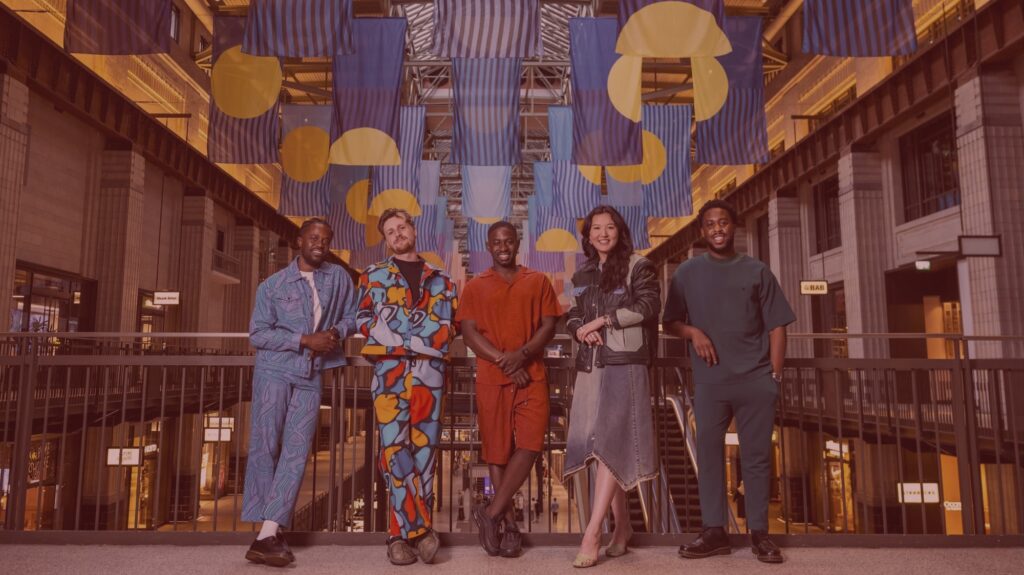
For Botchway that early distance felt less like indifference than self-preservation. Now co-founder of POoR Collective, a socially minded design practice focused on community development and youth empowerment, he traces the first barriers back to home. “In many African British households, creative careers are often seen as unstable or unviable, which meant I initially lacked encouragement and clear guidance toward architecture,” he explains. “As a result, access to internships, mentors, and professional networks was largely non-existent for me.”
“I rarely saw people who looked like me in senior or aspirational roles, and it’s hard not to take that as a message about who the industry is really built for”
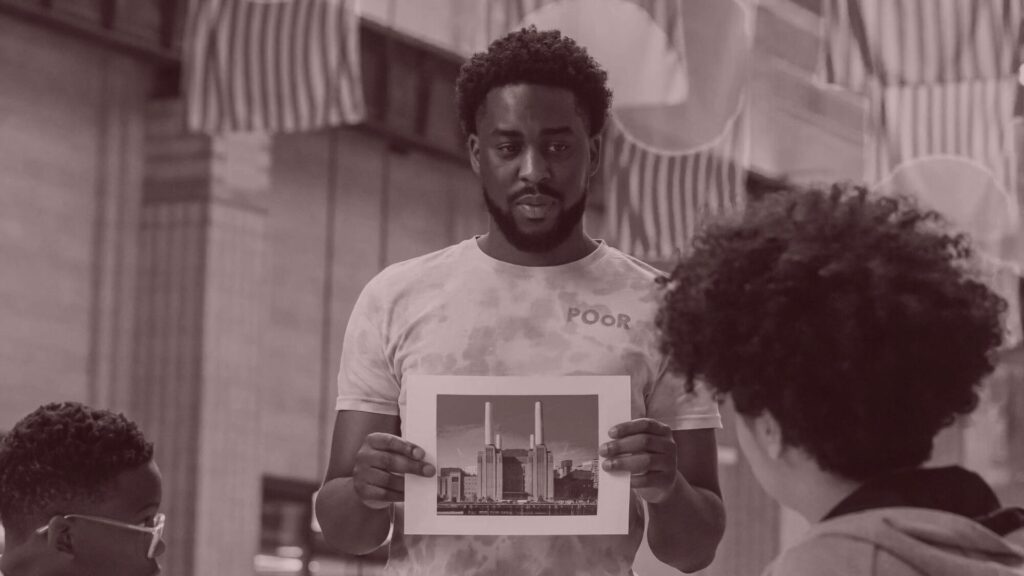
It is part of what drove him to establish POoR Collective with Shawn Adams in 2019. The organisation — which won the Emerging Design Medal at the London Design Festival in 2023 — works with young people to help them recognise their agency in shaping local environments, while making architecture feel like a viable path rather than a closed profession. For Botchway, that mission is inseparable from his own experience of the industry. “In practice, I was frequently the only Black practitioner in the room,” he explains. “I rarely saw people who looked like me in senior or aspirational roles, and it’s hard not to take that as a message about who the industry is really built for.”
The market as gatekeeper
Botchway’s observation is as much about power as it is about representation. When you rarely see people who look like you in senior roles, you start to notice where decisions are actually made and who gets to make them. In the arts, visibility is not simply a reward for talent; it is shaped by commissioners, funders, collectors, and institutions. And historically, those gatekeeping roles have sat within a narrow set of networks.
That arrangement is hardly new. Fine art in Europe was long organised around elite access and money, with commodification accelerating during the Renaissance. The patronage system bound artistic production to the wealth and tastes of the powerful: influential families — including the Medici banking dynasty — commissioned work to support culture, while also projecting authority and consolidating status. Writing for theArt Institute UK, Stephen Farthing notes that Medici patronage helped bring artists such as Michelangelo, Botticelli, and Leonardo da Vinci to prominence — while the works they commissioned became enduring symbols of the family’s wealth and power.
What it also makes clear is that this was never an equal exchange. Patronage came with conditions: patrons steered subject matter and style, shaping what could be made and how it would look. Artistic freedom, in other words, has long been negotiated — mediated by those with the money and status to commission it. That dynamic hasn’t disappeared; it has simply modernised, reappearing today in the softer pressures of funding criteria and market tastes.
Lauren-Löis, a Ghanaian cross-disciplinary artist and designer, points to the instability tied to independence. “Artists lack stability because we essentially work as self-employed individuals and our funding is project to project,” she says. That structure pushes many artists into precarity, with income that arrives unevenly — if it arrives at all. And while there may be funding streams for a wide range of practices, she argues that the application process itself often assumes a narrower idea of what art looks like and how it should operate. “As an interdisciplinary artist it’s hard to apply for certain funding because the way you make work, who you engage with when you make work, and where and how you want that work to be experienced is not conventional,” she explains.
“We, as artists, need to adjust and change the work that we want to create in order to get funding and representation”
Those assumptions carry through to visibility and career progression. “Usually the types of people that get gallery and agency representation are fine artists who have a well-established career of five to ten years,” she explains. Funding, she adds, doesn’t only influence what gets made; it shapes what gets shown, and where. In her experience, certain artists learn how to make work that’s legible to particular audiences — especially within fine art and the upper end of the market. “It’s not necessarily an aesthetic, but a subject matter that is really interesting to the art world right now,” she says. The result is a subtle shift: artists make work that suits the moment rather than work that is niche or deeply personal. “We, as artists, need to adjust and change the work that we want to create in order to get funding and representation.”
The Art Basel and UBS Survey of Global Collecting 2025 offers a telling snapshot of how firmly art now sits inside the logic of wealth management. It draws on research conducted in mid-2025 with high-net-worth individuals active in the market and finds that collectors allocated an average of 20% of their wealth to art in 2025. Paintings remained the market’s anchor — the most-purchased medium and the largest by value — accounting for 27% of total fine art spending.
Read alongside the sector’s access problem, the implication is uncomfortable: creativity is being treated less as a public good than as a private asset class. In this context, the value of art can drift away from its cultural force or social function and towards its performance as investment. And when art is financialised in this way, resources concentrate among a narrow circle of collectors, institutions, and artists whose work the market already knows how to price.
Counter publics and new cultural infrastructures
Yet there is a growing counter current. Across Britain, artists and organisations are actively challenging the exclusivity that has long defined the sector. By dismantling practical and social barriers, they are working to democratise opportunity and widen participation — both for emerging practitioners and for new audiences.
Often, this shift is driven by established organisations choosing to deploy their influence and resources differently. The Institute of Contemporary Arts (ICA), one of London’s most prominent spaces for contemporary culture, positions diversity and inclusion as central to its mission. Rather than treating access as an afterthought, institutions like the ICA frame it as integral to how exhibitions are curated, how artists are commissioned, and how audiences are invited into the space. As the ICA acknowledges, it has “maintained racial inequalities which have marginalised some individuals and communities” in the past. Its current direction reflects a conscious effort to address that history, with a stated commitment to equality and diversity — striving to improve their daily operations to be a truly inclusive organisation.
Parallel to these institutional efforts is the rise of self-built platforms and peer-led communities designed to operate beyond traditional gatekeeping structures. Working Arts Club,V22 London, and South Asian Salon are among a small but growing cohort of initiatives working towards structural change — offering mentorship schemes and practical workshops, creating access to affordable studio spaces, and building global networks that connect artists with like-minded individuals.
“If you want visibility, you have to create your own network”
In January 2024, Ravista Mehra launched South Asian Salon to connect South Asian creatives with industry figures globally. “In a lot of industries, the old networks are still in charge and they’re not exactly welcoming to those just starting out,” she says. “It can feel gated. You always need an invite to get in.” For Mehra, the way forward is in building collective infrastructure: “If you want visibility, you have to create your own network. That’s what I’m doing with South Asian Salon — connecting the industry with global talent to ensure there is real visibility and opportunity for us.”
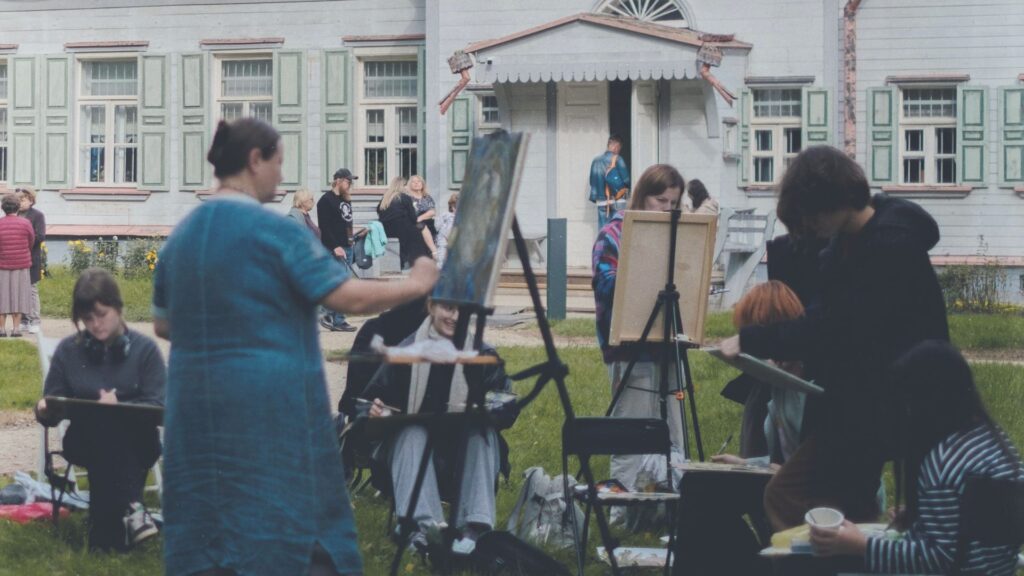
Through these infrastructures and communities, the art world starts to feel less daunting and demonstrates the strength of collective power. With mentors to turn to and peers moving with the same intent, artists can begin building an ecosystem on their own terms — shaping what comes next instead of fighting for space in the old one.
The point, then, isn’t just that new doors are appearing. It’s that people are learning how to build them and how to keep them open for a new generation of artists. If talent is universal, access has to be treated that way too: properly funded, supported, and shared more widely. Because a sector that calls itself meritocratic can’t keep mistaking proximity to power for merit.