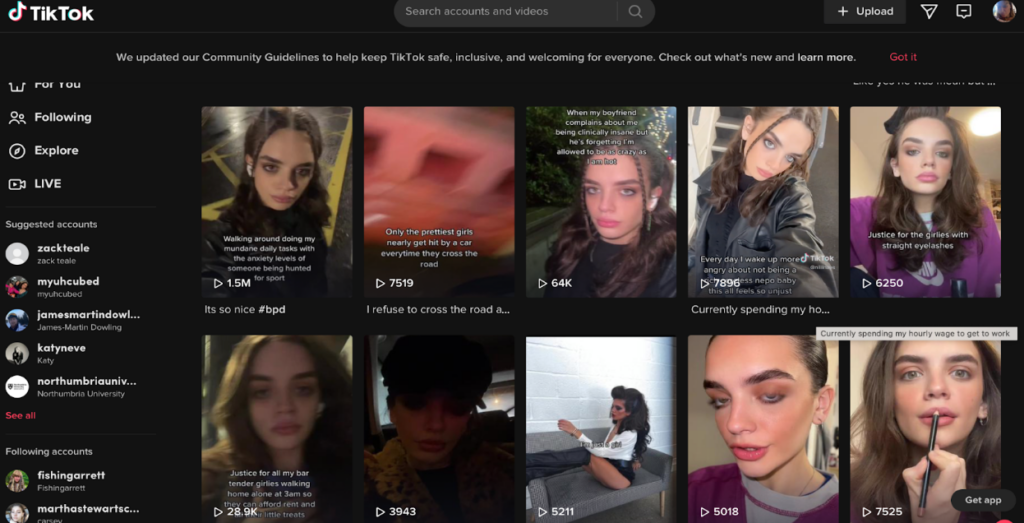

Gen Z have a reputation for being hyper aware of current affairs, global politics, inequality etc and have a name for being the ‘woke’ generation. The generation born between 1997 and 2012 is known for its unique sense of humour. This humour is often characterised by its irreverence, absurdity, and self-awareness, reflecting the digital age in which they have grown up. To gain some insights into this generation’s humour, I spoke with Nina, a 20-year-old university student, model and TikTok content creator who has provided her insight on Gen Z humour and her own experiences of her videos going viral and gaining a following on TikTok.
Tell me a bit about yourself and your account on TikTok.
My name is Nina Stoddart, I’m 20 and from Newcastle. My Tiktok account (@niinaes) has 70,000 followers and quite a few of my videos have gone viral and my most popular TikTok reached 1.7 million people and 339,000 people liked my TikTok. This video was on the topic of mental health and i used the hashtag #BDP in relation to Bipolar disorder.
What inspired you to start creating content on TikTok?
Now I think about it. I initially started making content and posting videos for attention seeking reasons to put it simply. I wanted to relate to other people and create a community for myself with people I relate to and find like-minded people. The TikTok algorithm is designed to bring very similar people towards you. The more content you make that’s more reflective of your ideologies the more people with similar ideologies are going to respond to the content created.
How do you come up with ideas for your TikTok videos and is there a theme with the videos that have proven to be the most successful in going viral?
Other trending videos inspire the content I have created and I like to interpret these with my own niche. My content on TikTok often has themes of mental health issues and my videos are realistic, raw and personal. Some of my popular videos are almost confessional which creates a sense of community within the app. The more raw and personal the more likely they are to do well.
What have you learned from the platform with the videos that have blown up and how has going viral impacted you?
The most popular ones are often aesthetically pleasing. Relatable content also does well. For me when my videos first went viral it gave me a confidence boost and I felt good about myself. There is a lot of hate on TikTok. I would be called ugly and a lot of people were questioning my integrity and how truthful I was being in my confessional/storytelling videos. I do think there is more love than hate and I get a lot of support but the hate stands out.
How would you describe Gen Z humour ?
It’s all about memes. It’s about taking a funny image, adding some text, and sharing it online. It’s quick, it’s easy, and it’s always changing. Memes are like a language of their own, and if you don’t understand them, you’re not really part of the culture. Gen Z humour in itself I find confusing, nonsensical and at times morbid and dark. We’re definitely into self-deprecating humour. We like to make fun of ourselves and our generation. We’re also into absurdist humour, which is when things are just so ridiculous and nonsensical that they’re funny. And we like to make jokes about social and political issues too.
What advice would you give to TikTok users from your own experience of TikTok?
Every child should stay away from every form of social media. It’s very easy to get on the wrong side of the algorithm where the content is very harmful and in my opinion this is how children get radicalised. Whilst TikTok can be educational I think the risk of getting on the wrong side of the algorithm should be taken seriously. It is very hard to monitor and is very dangerous for impressionable children.
What values do you see in the content on TikTok that you feel reflect our generation?
I think our humour reflects our values of diversity and inclusivity. We’re more likely to make jokes that include different races, genders, and sexual orientations. We also use humour to comment on social and political issues that we care about. One example of this is the TikTok account of Sarah Cooper, a comedian and writer who gained popularity during the 2020 US presidential election for her lip-sync videos of Donald Trump’s speeches. Her videos often use humour to criticise political figures and policies.