In September 2023, around 1,000 people gathered at Berlin’s Potsdamer Platz railway station. Some wore canine masks. Others barked, howled, and moved on all fours. Organised as a show of solidarity for those who identify as dogs, the event blurred the line between protest, performance, and identity.
For critics, it was spectacle. For participants, it was self-recognition.
The Berlin gathering sits within a wider cultural shift. Across TikTok, Reddit, and YouTube, individuals describe themselves as “canine,” “puppy,” or “dog-identified,” often linking this to spiritual alignment or species dysphoria. Mainstream media has amplified the phenomenon. On The official This Morning show ITV channel, a YouTube segment titled: My Daughter Identifies As A Pomeranian Puppy, introduced audiences to a family navigating a child’s identification as a dog. Another widely shared segment which aired on CTV your morning programme, An English language television program produced in Canada, featured the Horse Girl from Alberta, a young woman capable of galloping and jumping with striking equine precision.
https://www.instagram.com/reel/DNK596WMGe0
The framing often hovers between curiosity and disbelief. But the deeper question remains where identity ends and metaphor begins.
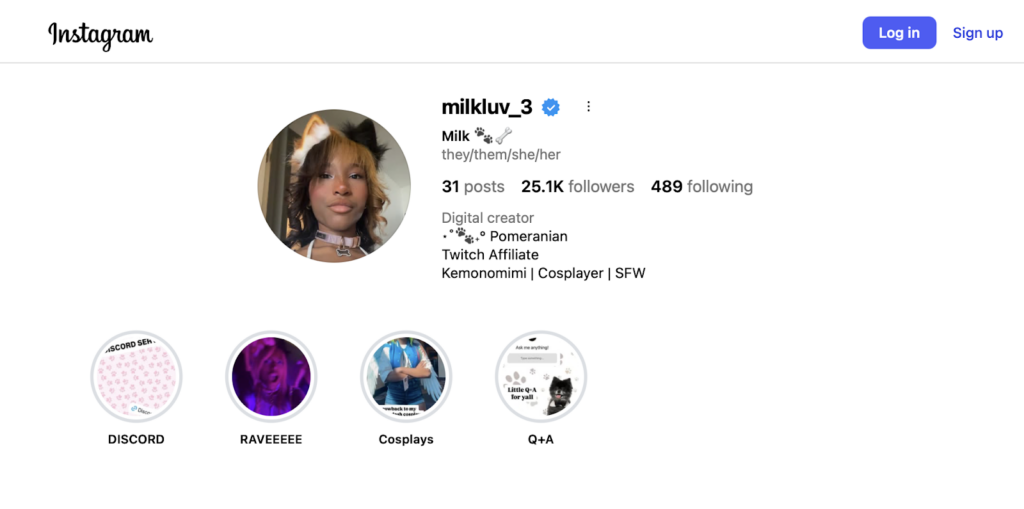
I spoke to Milk, the young woman who identifies as a Pomeranian dog over a Zoom call.
Soft-spoken but direct, she rejects the idea that her identity is performance.
“People think it’s a joke or attention-seeking. It’s not,” she told me. “This is how I experience myself. It feels more natural than being human ever did.”
Milk describes her identity as something she came into, rather than chose.
During our conversation, I told her about the Yoruba account of Obatala, the idea that some humans first ancestors were animals, transformed into human beings through divine intervention.
She paused.
Then smiled.
“That actually makes a lot of sense to me,” she said. “I’ve never heard that before, but it kind of explains things in a way I’ve struggled to.”
Rather than dismissing the story as myth, Milk leaned into it, not as proof, but as recognition.
“It doesn’t feel random anymore,” she continued. “It feels like there’s something deeper behind it. Like maybe this isn’t as strange as people think.”
Online, reactions to Milk range from support to outright hostility. But she remains unmoved.
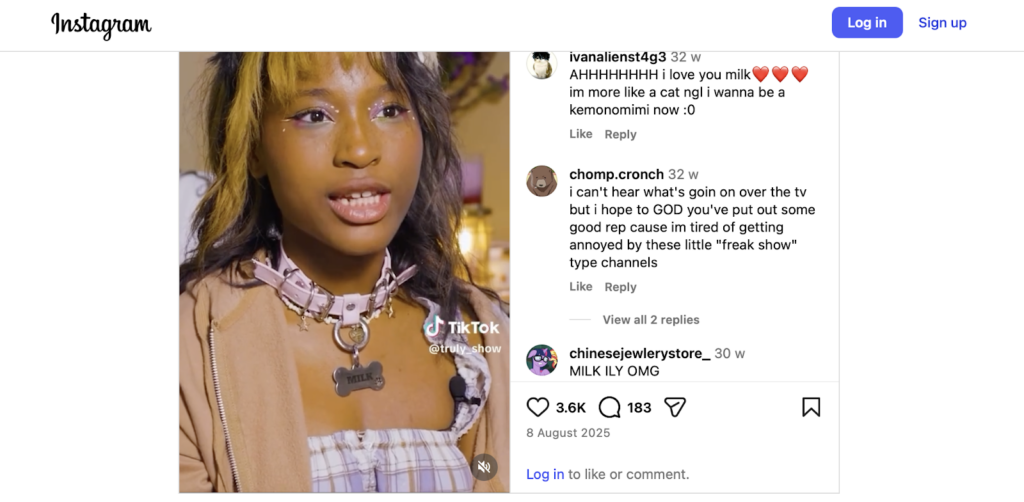
“People laughed at everything new at first, but that doesn’t make it unreal.”
It appears Her framing is not symbolic. It is lived. And, in moments like this, it begins to intersect with something much older than the internet, a framework where identity is not fixed, but inherited, remembered, and, perhaps rediscovered.
Leave a Reply