Image: Adhitya Sibikumar, Unsplash
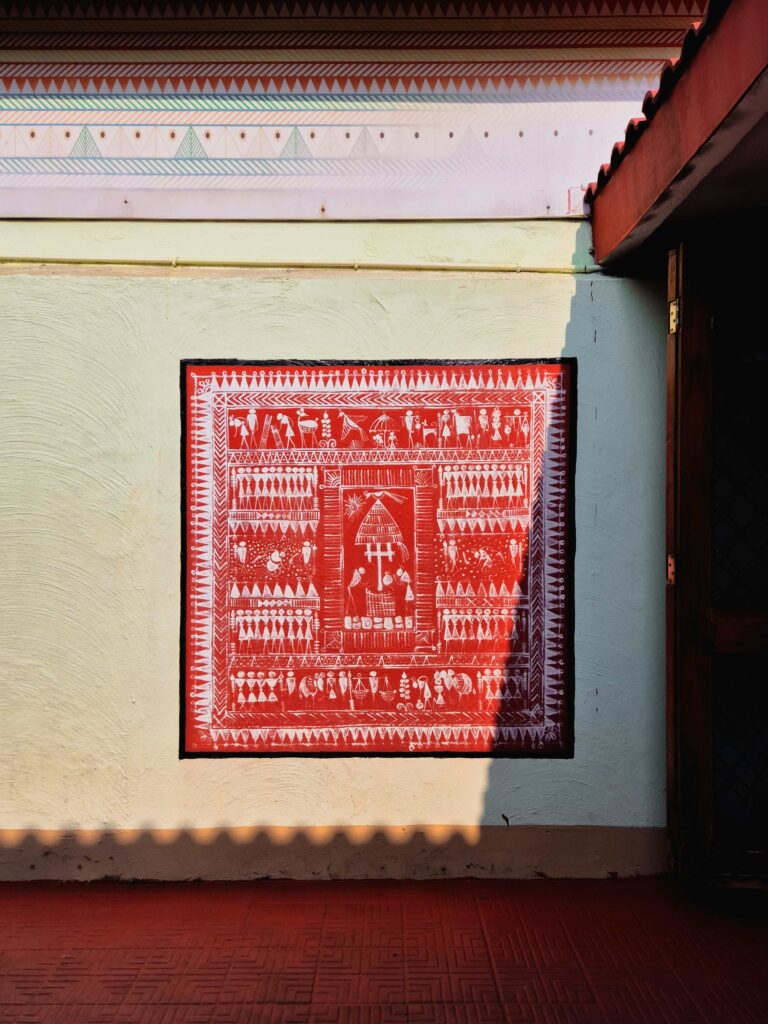
Nestled in the mountains of Maharashtra, India, reside the Adivasi tribes, also called the Warli tribes. Like most cultural groups, both ancient and modern, Warli communities found their own unique ways to decorate their homes. The women of the Warli tribes would create white, geometric illustrations which spanned across rust-coloured walls, often depicting scenes of daily life. As secluded as the Warli tribes were, their art was discovered in the late 1970s and was sensationalised across India due to their unique, intricate styles. Now, Warli paintings are not just restricted to the walls of Warli tribespeople’s homes, but have also found a place in the homes of many across the world.
While traditionally only found on the mud walls of houses, Warli artists now paint on paper as well. These paintings are then displayed and sold in various traditional exhibitions and markets across India. While walking through the Dilli Haat market in New Delhi- a collection of traditional handicrafts stalls in the heart of the city, I came across the stall of Warli artists. Dilip Vighne, one such artist, spoke to me about his craft.
His paintings are intricate, with white patterns standing out against rust coloured, blue and earthy green backgrounds. Traditionally, Warli paintings were passed down from generation to generation in the tribe. Today, some artisans spend years training to learn how to paint these. “We have been learning how to make these since we were young,” Vighne says. Warli paintings have now evolved into highly detailed scenes of nature and everyday life. “It takes days to make just one painting, but they dry quickly,” he remarks.
The earthy-toned backgrounds of modern Warli paintings bear resemblances to the muddy walls of traditional tribal huts. “The backgrounds of my paintings are made with geru colours,” explains Vighne. Geru refers to an ochre powder (also called Red Earth) widely used in both art and traditional medicine across India. Sometimes, the backgrounds utilise kumkum- a vibrant red powder made with turmeric and slaked lime, to depict scenes of prosperity. Red colours may also be extracted from palash flowers, whose trees are colloquially referred to as the ‘Flame of the Forest’. In some instances, yellow dyes are extracted from pineapples.
The primary characteristic of the Warli paintings is the shapes used to paint humans and daily scenes of life, often using triangles, circles, and sharp lines. Some paintings also contain detailed illustrations of wildlife done in a similarly geometric fashion. Vighne says, “The designs have been painted using poster paints. But, in the past, Warli painters would usually use rice flour to make the paintings. They would grind it, add water to make a paste, and then use it to paint.”
Warli art is now widely acclaimed, even being part of the art curriculum in schools across the country.
While many tribal arts may be lost to the ages, the pride and dedication with which artisans like Dilip Vighne preserve their traditions keep Warli art alive and relevant in today’s fast-advancing world.
Leave a Reply