
Yilin Li immerses her senses of smell for a baking session at the London-based bakery, Bread Ahead
Near the Bread Ahead stand on a weekend afternoon, a faint aroma of butter hangs in the market air. It draws passers-by towards the stall, where trays of baked goods and pastries quickly gather a crowd. As the crowd thins and you reach Bread Ahead, it becomes clear the smell rises from the open kitchen behind the counter, where bakers and students work side-by-side. The scent acts as a quiet invitation, encouraging people to step closer and peer into the baking room beyond.

In contrast to the noisy and lively atmosphere of the outside stalls, Bread Ahead’s baking class offers a slower, warmer, and more intimate experience of the bakery. Inside the large open baking room, the focus is not only on learning how to handle dough and master pastry techniques, but also on experiencing baking as a sensory journey where smell becomes the most direct link, connecting space, process and perception.
The Pastry Workshop fills the baking classroom with various flavours, different types of bread courses such as the Sourdough Bread Beginner’s Guide, the Doughnut, Croissant Workshop, Brioche & Buns Workshop. Walking into the baking room, five students, including myself, sit around a stainless-steel table. The teacher, Sophia, grabs a handful of flour and scatters it across the surface.
The flour lingers in the warm air for a moment, releasing a dry wheat aroma, before quietly settling onto the metal table. Sophia begins to knead the already fermented dough. As she works, the dough gives off a faint yeast aroma – a subtle, slightly sweet scent that blends into the warmth of the room. Her movements are steady and rhythmic, and the repeated motion of her hands seems to draw everyone into a meditative state. She kneads and smiles at the same time. Only when the dough reaches a shape she is satisfied with does she look up and say, “Welcome, everyone, to our baking class. Are you ready to make fragrant small breads?”
As Sophia guides the class through the first steps of kneading, a pleasant aroma begins to spread through the room, even before any technique is fully applied. It rises quietly from the dough in the mixing bowl and from the table lined with various seasonings, blending with the warmth of the oven and creating an atmosphere that feels comforting and almost therapeutic.
Among the ingredients is a small bowl of lemon juice, added in modest amounts to the egg mixture. When Sophia squeezes the lemon by hand, its skin splits open, and a strong, fresh fragrance immediately wafts into the air, carrying a brightness that feels like a summer morning. As I brush the egg mixture onto the pastry, the citrus scent rises at once sharper and brighter than anything that has filled the room before. People pause, breathing a little deeper, their shoulders easing almost instinctively, as if the fragrance itself gently settles the space.
Sophia notices it too. Later, she explains: ‘‘Not only lemon but also mint has a similar effect. If used in the baking process, their scents all have a soothing effect.’’ If someone breaks a mint leaf and gently rubs it, that refreshing grassy aroma will spread throughout the entire baking kitchen, making the atmosphere clear and gentle without people even realising it. Sophia explains that some students even seem to wake up suddenly when the scent appears. ‘‘Not because they’ve suddenly mastered the technique,’’ she says, ‘‘but because the freshness of mint makes them feel more alert.’’
For Sophia, aroma is often misunderstood as something that appears only once a pastry is baked. It is a part of the baking process, an intangible companion. Different scents emerge in the early stages of baking, when dough and fillings are still being prepared. These smells, she believes, influence a baker’s mood, focus, and even confidence in subtle ways. As aromas move through the space, they can ease tension and encourage students to settle into the rhythm of the work, making it easier for beginners to find their footing.
Sophia believes that the relationship between smell and emotion is so close that it has become part of teaching. ‘‘It’s therapeutic,’’ she says, ‘‘the smell helps people settle in.’’
Aroma is not simply a result of baking, but an active part of the process. It does not appear only when a finished pastry or bread emerges from the oven. Instead, it unfolds at every stage, during kneading, fermentation, and the quiet waiting that follows. From the natural scent of fresh ingredients to the warm steam released by freshly baked bread, smell runs through the class like an invisible thread. It gently guides students from the initial nervousness of stepping into the kitchen towards a deeper state of focus and ease, allowing both body and mind to settle into the rhythm of making. As Sophia says, the aroma of the bread is calming, a reason to stop, take a deep breath and regain one’s rhythm.

Natural perfumer and aromachologist – Nicky Jones offers a scientific explanation for this effect. She explains that the olfactory system has a direct pathway to the brain’s emotional centre. “When we inhale an aroma, the molecules travel through the olfactory system and directly enter the frontal lobes, where emotions and memories are processed,” she says.
Certain chemical compounds, such as linalool, commonly found in natural essential oils, have been shown to reduce anxiety and stress. But beyond chemistry, Jones highlights the importance of memory.
“Our brain creates scent associations,” she explains. “If a scent is linked to a particular emotion, time, place or person, when that aroma appears again, it immediately recalls the memory and emotion associated with it.”
In the baking classroom, this neurological shortcut helps explain why the scent of warm dough can instantly shift the mood of the room. Aroma does not merely decorate the space; it shapes how the body settles into it. Changes in temperature can also affect the release of aroma, which is closely related to baking. Sophia explains that temperature not only affects the activity of the yeast but also determines when and how the aroma will spread. As the oven gradually heats up, the lemon juice in the egg-washed pastry crust and the sugar added to the dough begin to evaporate more quickly. The air takes on a fragrance that is fresh but never cloying, warm without becoming heavy. When the oven door is gently pulled open, a warm and sweet steam instantly gushes out, making the entire classroom seem to be filled with light in an instant. At that moment, no one speaks: the attention of the entire group is held by the smell alone.
However, this calming effect does not stay confined to the classroom. Just outside Bread Ahead, in the crowded lanes of Borough Market, the same sensory influence continues.
Among all the visitors in that afternoon, Robbie, who has travelled down from London with his partner shares “We have seen videos of the bakery online and plan to stop for lunch”. Yet it is not the online popularity that make them stay. “We know we are in the right place because you can smell the fresh bread,” Robbie adds.
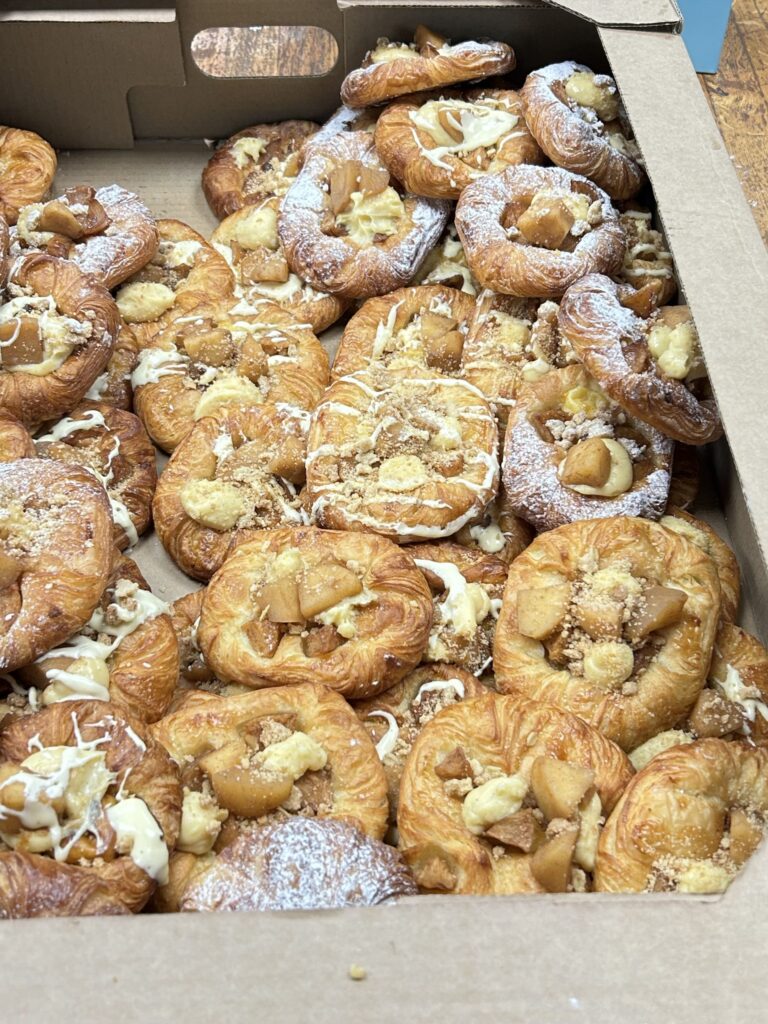
For locals, the relationship with the bakery feels different. Haley, who lives nearby, has brought her partner Kane, visiting her for the day to try it. While Robbie describes smell as a way of confirming they have arrived at the right place, Haley and Kane experience it as something more immediate. “Everything,” Haley says when asked what she can smell, before narrowing it down: “the garlic and the bread is very, very strong over here.”
Finally, what lingers is not just the taste of the bread, but the quiet way aroma shapes how people feel, remember and connect to a place.
Leave a Reply