
We spoke to three people about their experiences in education during the Covid-19 pandemic to reflect on how it may have changed our relationship with our homes
It felt like a dream, or should I say a nightmare when covid struck our world. Our normal lives suddenly shifted. Living rooms became classrooms, bedrooms doubles up as offices, and our homes don’t seem to have been the same since. Who, now, doesn’t have at least some remote working? Data from Employment and Law suggests that remote and hybrid working remains widespread in the UK, with nearly half of the workforce (44%) spending time working from home. So we asked three people how their homes have been adapted.
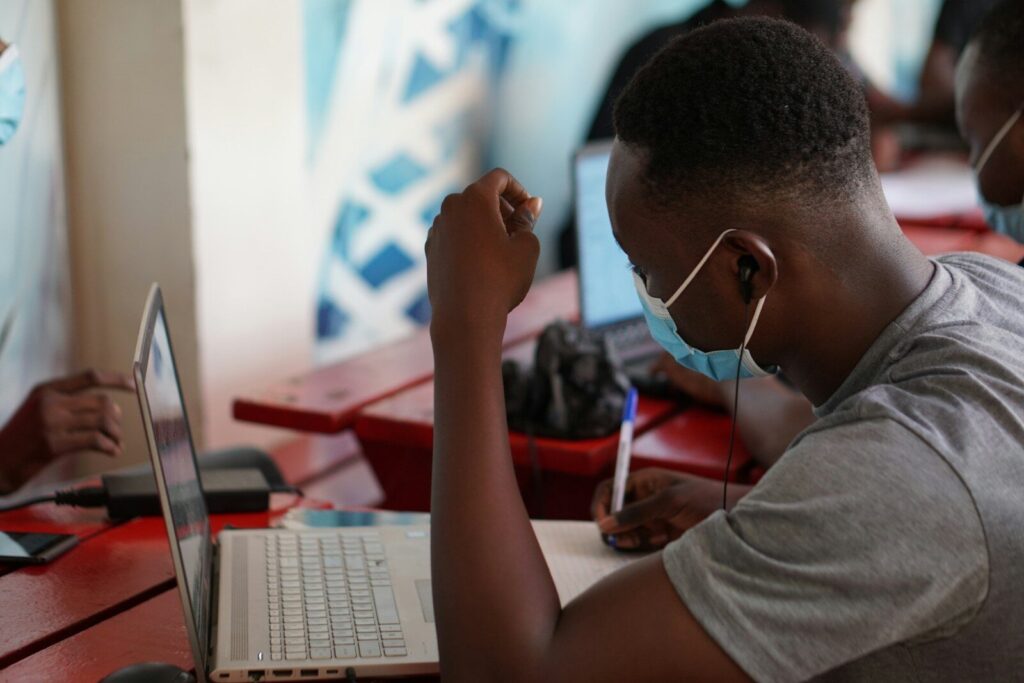
Image Kojo Kwarteng, Unsplash
Richard Smith is a lecturer at Goldsmiths University.
‘Moving online during COVID impacted me greatly. I have caring responsibilities at home, my daughter has profound learning disabilities and behavioural problems, and wasn’t going to school for extended periods of time.
Like most people, my living space became my office. Because of the caring duties, I had to create a new space that had least disruption so that I can carry out my work.
I am working a lot from home these days. I am now used to it, and I find it beneficial, as I am now living far from Goldsmiths and have to commute three and a half hours a day to work. I am really happy as I have more space and have a dedicated office.
Vana Goblot, is a Media & Communication lecturer at Goldsmiths.
At the start of the pandemic I was already working from home preparing classes and undertaking research two days a week so had many of the facilities required for online learning in place.
However, the additional time spent at home became hard to manage in terms of having a clear boundary between work and domestic responsibilities. When you are working at home you are often distracted by domestic tasks that need doing, especially if you are struggling to focus on work.
Other people living in the house also tend to interrupt your work to discuss family matters and other issues or to ask you for help with something. At the time of the pandemic my son was completing his university degree and had to return home to study which put extra pressure on space resources. My partner was working in a job where she was still required to go into work so this also created some tension. People who were able to work from home were actually in a relatively privileged position as long as they had sufficient space to do their work. Working from home became far more difficult for students and workers living in shared houses, for example. I know many people who had to work sitting on their bed because they didn’t have a proper office space or even a kitchen table to work from.
I am very fortunate to have a dedicated office space at home which makes working from home reasonably straightforward. Aside from the issues I mentioned above, working from
home is straightforward for me.
I would say that the general culture at Goldsmiths is that people work from home far more than previously, even though pre-pandemic most academics would work from home or in other locations for at least two days per week. Many meetings are still held online, for example. However, I actually prefer a balance and enjoy coming into Goldsmiths regularly to meet with staff and students in person. I do not really like the isolation of working from home for lengthy periods of time and appreciate the sociability of the workplace.
The issue I found hardest to manage was pre-recording lectures. My office set-up at home is not ideal for recording and I had to order quite a bit of additional equipment to ensure the recording quality was sufficiently good for Teams. Recording lectures is not a natural process and is very different to delivering the lecture in person. There is additional pressure to deliver a perfect lecture which becomes far more time-consuming with frequent re-recording and editing required for the online lecture video. Over time I became very proficient at putting the online lectures together and eventually the process was far less time-consuming. Online seminars were more straightforward as I quickly got used to speaking with large groups of students online. It felt more of a natural process than pre-recording the lectures.
Vivian (24) was attending Goldsmiths as a student during the pandemic.
How has online learning impacted your home life?
At the start of the pandemic I adapted well. I didn’t need to wake up that early, or necessarily dress myself up, so being confined to home made me feel quite relaxed. I’m also not one to socialise, so being alone wasn’t a problem. I think online learning offered me more space and time to reflect on myself, and make me feel free from the hustle. I tried to decorate the table and made it as cozy as possible, such as putting many photos of my friends and family on the desk, and handed a lovely wall tapestry.
However, I think it is harder to set out a boundary. Since I was living alone with just a room and an en-suite like many other young people who can’t afford a house or a flat, I would usually wake and go to the desk next to my bed and start working. And when I turn off the computer, the day ends. Sometimes I think it is quite good as I don’t need to leave the room, but sometimes it was a bit suffocating when I’m staying in the room for days and not going anywhere to get some fresh air.
I still work from home quite a bit, but I don’t think it is about Covid. I work in the communications industry, and the nature of my job allows me to work from basically anywhere with internet and laptop. I never experienced
Leave a Reply