
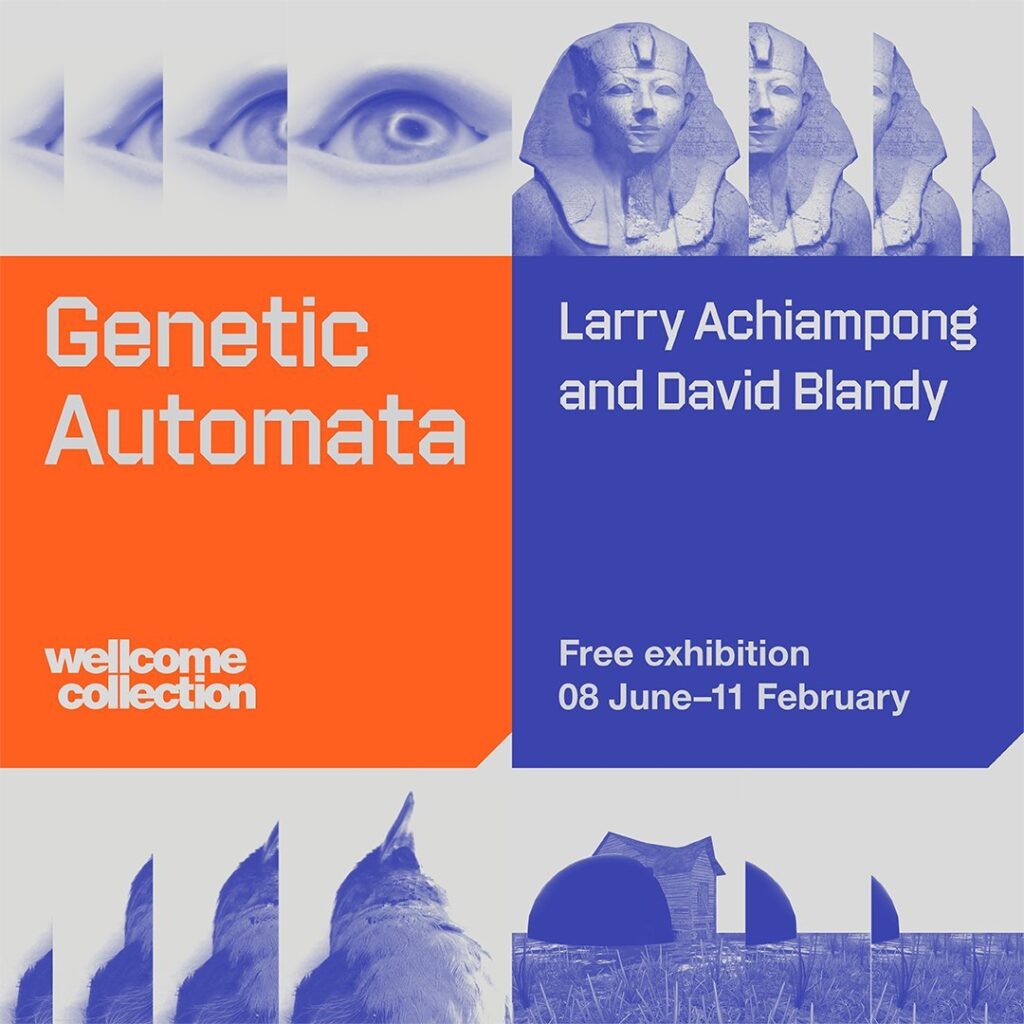
The Wellcome Collection hosts a pioneering exploration of scientific racism that combines audio-visual and digital art.
Genetic Automata, created by London-based artists Larry Achiampong and David Blandy and curated by Shamita Sharmacharja, interrogates scientific racism in four short video installations. Scientific racism was used to justify colonial oppression and discrimination and Achiampong and Blandy shed light on the ways it still pervades our understanding of identity in “the age of avatars, videogames, and DNA ancestry.”
Achiampong and Blandy have been working as friends and artistic collaborators for over a decade, their shared projects often question their differing life experiences as a black Ghanaian man and a British white man respectively.
The exhibition space is easy to navigate, but a solid hour should be put aside to appreciate the films. Visitors enter into a room titled “Legacies of Eugenics,” which accompanies the first, and the latest, film on display: _GOD_MODE_ (2023). Both spaces exhibit a range of artifacts, positioning Achiampong and Blandy’s works in a wider cultural and historical narrative of race and identity.

Visitors can then tour the screening rooms. The first of the films, commissioned by Arts Catalyst, is A Terrible Fiction (2019), exploring categorisation and classification. Visuals of Darwin’s bird collection are layered with shots of the artists’ skin and digitally rendered avatars based on the artists’ DNA ancestry results. The popularity of ancestry testing kits is questioned: most scientists agree that race cannot be defined by a biological basis yet we often subscribe to their fictitious definition of our racial differences.
The artists ‘ next thought-provoking moving image work is commissioned by Art Exchange and the University of Essex, A Lament for Power (2020). It addresses the historical injustice to Henrietta Lacks, an African American woman whose cancer cells were collected without her or her family’s knowledge or consent in 1951. Lack’s cells were harvested to generate the first immortalised cell line, HeLa, used in developing vaccines and decoding the human genome. This piece urges us to question the ethics behind biomedical advances and Lack’s brutal dehumanisation. This is exemplified through the zombie-like black video game characters, referencing Resident Evil 5, a controversial video game about bioterrorism in West Africa.

Dust to Data (2021), commissioned by FACT Liverpool, delves into the relationships between archaeology, colonialism, and eugenics, and their eerie resemblance to modern-day data-mining. This was my personal favourite for its aesthetic quality and bright graphic landscapes. The film displays ancient Egyptian ruins, and its narration is based on exchanges between Flinders Petrie, a British Egyptologist and founder of modern archaeology, and W E B Du Bois, an American sociologist and civil rights activist.
Achiampong and Blandy’s shortest most recent film is titled _GOD_MODE_ (2023), commissioned by Wellcome Collection, Black Cultural Archives, and Wellcome Connecting Science. The title refers to a gaming mode in which a player is all-powerful. Blandy voices the first half, and the second half is narrated by Achiampong. We follow a supernatural spider navigating a videogame world, based on the West African folk tale of Anansi, a shape-shifting demi-god. Here we are told the artists are interrogating whether empathy is enough to create long-lasting change in a medical system suffering from a eugenic hangover, but this meaning is frankly difficult to extract from the simulation shown.
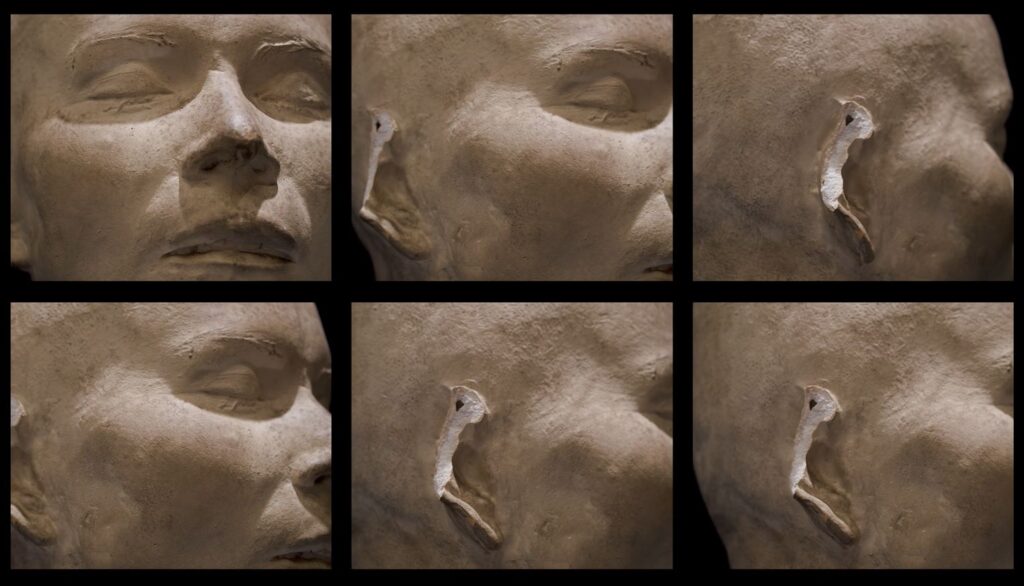
Ultimately, this exhibition combines visually striking videos and dreamlike scenes with urgent and overdue messages about injustice and systemic racism. While the messages are sometimes ambiguous or rely on prior knowledge, not only of the videogame industry but also of specific scientific theories and disciplines, I believe Genetic Automata has something to teach all of us as human beings and inheritors of racist legacies.
The exhibitors have done as best they can to make these works accessible to the wider public though, providing much-needed captions and in-depth text displays at the entrance to every screening room, which provides context to the works.
Genetic Automata runs from June 8th, 2023 to February 11th, 2024 on the first floor of the Wellcome Collection. It is open from Tuesday to Sunday, from 10.00 to 18.00 (closing at 20.00 on Thursdays). In case you missed it, be sure to check out the extensive program of exhibitions and events on the Wellcome Collection’s site
.