
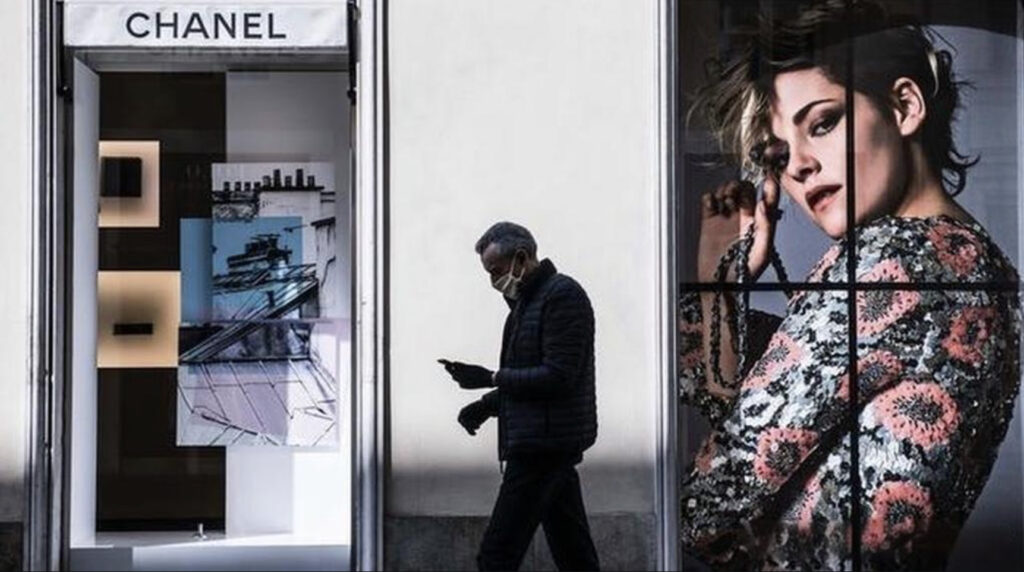
The Covid-19 pandemic plunged the world’s economy into crisis and had an irreversible impact on the fashion industry.
Since the pandemic, the global economy has declined and retail stores have closed, leaving the fashion industry in trouble. According to Vogue, ‘Business of Fashion estimates that revenues for the global fashion industry will contract up to 30 per cent in 2020 year-on-year.’ As happens in times of crisis, much of the hardship caused by the pandemic fell on supply chain workers, with brands experiencing significant revenue reductions and declines.
Ding Gu, 32, who owns a fashion buyers shop in Nanjing, explains: “During the pandemic, I lost almost £50,000.” After the outbreak of Covid-19, consumers chose to self-isolate at home and reduce the number of trips to prevent the spread of the virus. For offline retail stores, the loss came from the expense of rent and the retention of goods due to fewer customers. Most of the supply chain of the shop lay overseas. When buyers bought goods and sent them back to their home countries, the lack of personnel in delivery companies led to delay in delivery time.
After the pandemic, these goods were already out of season. Compared with seasonal styles and new products, these out-of-season goods could only be sold at low prices and stored in warehouses. Shops updated frequently on social media to increase the exposure of products, and some stores even provided video-call model-fitting services to improve the user experience of online shopping. Although online sales became the main way people shopped, Ding noted that “inappropriate sizes, fabrics and colours that are different from the photos (were) reasons customers often returned products.”
On the other hand, many companies went out of business, so people have no stable source of income and their spending power is reduced. The panic and uncertainty caused by the pandemic have caused many consumers to re-evaluate their purchasing behaviour. They pay more attention to practicality and functionality, and have less demand for luxury and fashion items. People spent a lot of time at home, and clothing needs changed. Furniture and casual wear became hot items, and fashion brands increased their development and promotion of these items. Stores reviewed the needs of customers and altered the goods they sold accordingly.
Ye Dai, 38, worked at a fashion jewellery company for three years. She was in charge of the jewellery sanding and cleaning department. In the production sector, dozens or even hundreds of workers worked together in a closed environment. Although they disinfected the site every day and wore masks to work, many workers were still infected with the virus and forced to suspend work. As offline retail stores lost revenue, layoffs and wage cuts became regular occurrences.
“Under the high-intensity work, my salary was not even enough to maintain my life, so I chose to quit” Ye adds. “My colleague was an asymptomatic infected patient. At that time, the infection was transmitted to the surrounding workers. After the factory knew about it, it forced the infected person to stop work and did not guarantee the original position and salary after returning to work.” There was no social security including vaccination and provision of COVID-19 drugs for workers in the production sector. In the later stage of production, due to the severe shortage of raw materials combined with pressure from government policy, most of the factories had to close.
Mae, 29, is an Italian retail assistant who has worked in London for over five years. After she graduated from UAL, she worked in a fashion studio. A lot of studios closed down because of the pandemic. “Because I am a foreigner, I need a visa from the place where I work, so the probability of being recruited to work is even less,” she says. Mae was unable to find a suitable job for three months during the pandemic. The studio cut the employee’s salary, citing fewer customers and rising rent, so she returned to Italy to cut expenses. During her tenure in Italy, the employment rate in the fashion industry also decreased. Mae tried a career in other directions, such as gallery publicity and social media operations, but that’s not what she wants to do. After the pandemic, she returned to London to work for new fashion companies.
Allen, who is Chinese and lives in the United States, is a niche brand designer. “I am glad that at least the brand I work for is not a fast fashion company, and the design volume of fast fashion brands is at least five times less work.” Although the pandemic gave designers more leisure time, design and inspiration from the outside world was harder to get. This led to a decrease in innovation and efficiency after several seasons of design. However, this stage of the pandemic was also an opportunity to hone in, change original design drafts and clothing styles according to public taste, and gave more designers more opportunities to breathe and understand the clothes that customers wanted.
In fact, some designers are so optimistic that they think the pandemic was a good period of time to cut contact and socialize with the outside world. Allen’s brand had plenty of time to prepare their work and design manuscripts. They gradually focused their design inspiration on the ‘homemade’ series. For their media, the most immediate impact was on the logistics and printing of paper media. Because of the characteristics of digital media itself, content and inspiration was not affected. “I bought photography equipment through the Internet and built a small studio at home to complete the sample clothes shooting,” Allen says.
The pandemic was a warning to the fashion industry, and the usefulness of digital media and the Internet was fully demonstrated when the pandemic hit. Most shopping depended on the Internet, although online engagement was not as high as previous offline engagement. The London 2021 Fashion Week also made emergency plans to ensure the health and safety of those who participated in the fashion week and to deal with the impact of the pandemic on logistics, staffing and planning. Everyone entering the show was required to provide proof of vaccination, wear a mask during the entire viewing and the number of guests participating was reduced.
The coronavirus pandemic has had a huge impact on the fashion industry as a whole. The production, trade and retail sectors have all undergone significant changes. Despite the passing of the pandemic, the fashion industry has been unusually slow to recover. This slow recovery may be due to the combined influence of internal factors in the fashion industry and external economic environment factors.