
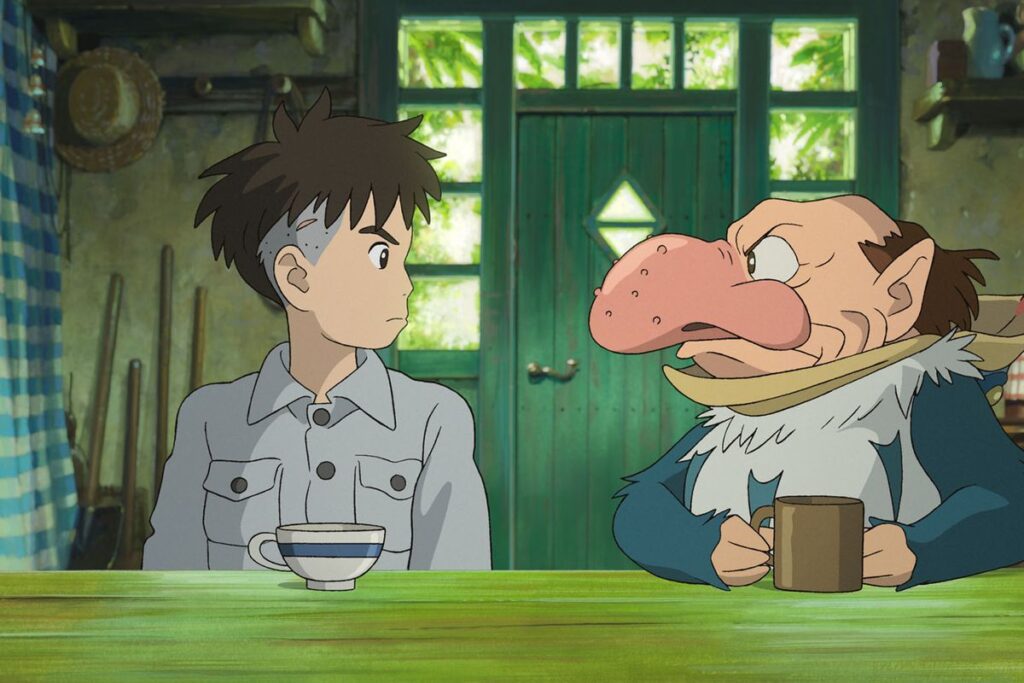
Hayao Miyazaki, the co-founder of Studio Ghibli and iconic filmmaker behind My Neighbour Totoro and Spirited Away, returns from his hiatus with a film that is nothing short of an ambiguous fever dream, exploring very personal themes. Miyazaki’s movies never fail to transport you into a fantasy world and with The Boy and the Heron, you will be left appreciating the beautifully vibrant scenes as well as the likeable, and often comedic, characters. However, its dreamlike sequences and constant shift from scene to scene can also count as the film’s weakness. At times, the plot seems too incomprehensible and – especially at the end – rushed.
The Boy and the Heron has a truly intense beginning. Young boy Mahito (Soma Santoki) is awakened by a hospital fire caused by an air raid. His mother dies in the fire and he is forced to move from Tokyo to the countryside. He finds it difficult to adjust to his life and accept his new mother, Natsuko (Yoshino Kimura), who is the younger sister. At his new home, Mahito finds himself in conflict with a mysterious grey heron (Masaki Suda), who leads him into an alternate reality where his surreal adventure unfolds.
The bird is arguably the film’s most intriguing character. But it is the tension between him and Mahito created at the beginning of the film that is most notable. In a particular scene, the 12-year-old stands on a rock awaiting the heron’s arrival: sun beaming on his face while he is absorbed in a strange silence. The heron suddenly descends from the sky as Mahito tries to hurt him and at the same time, the wind intensifies and the music (composed by Joe Hisaishi) becomes dramatic and utterly thrilling. Moreover, the animation is just as recognisable as the previous Ghibli films.
The Boy and the Heron not only leaves audiences in awe of its incredible visuals, but also how the characters are reflective of Miyazaki himself. As a young boy, he lived through the Pacific War of the early 1940s, and just like Mahito, had a semi-absent father who helped manufacture fighter plane components. Mahito later meets the keeper and architect of the alternate reality, Great Uncle (Shohei Hino), who is worried about its future – he too represents how Miyazaki is looking for someone in his bloodline to continue the legacy that is Studio Ghibli. These characters and their lives/goals provide a bittersweet metaphor that undoubtedly gives the film depth, complexity and leaves audiences feeling contemplative. Despite the film focusing predominantly on its fantastical elements, it does a great job at grounding Mahito’s story to reality. The theme of healing and closure is inspiring as Mahito doesn’t dwell on staying in the fantasy world.
Equally, the film focuses too much on the exploration of the fantasy world – Mahito experiences many events that happen too quickly (to comprehend) or are hardly explained later on. It’s not expected for anything in a magical realm to run chronologically. However, the plot can be overwhelming and there is never really a moment of stillness where audiences can register everything that has happened. Also, the ending is abrupt and revealed in a matter of minutes. Regardless, The Boy and the Heron is a delight to watch for all ages and another Miyazaki masterpiece.