
London has more than 3,000 green spaces, accounting for 47% of the city’s total area. There are eight royal parks which are eight largest parks that cover approximately 5,000 acres in London. Let’s embark on a journey through these six largest parks, each testament to history and culture, offering respite from London’s urban bustle.
1. Richmond Park (2360 acres)
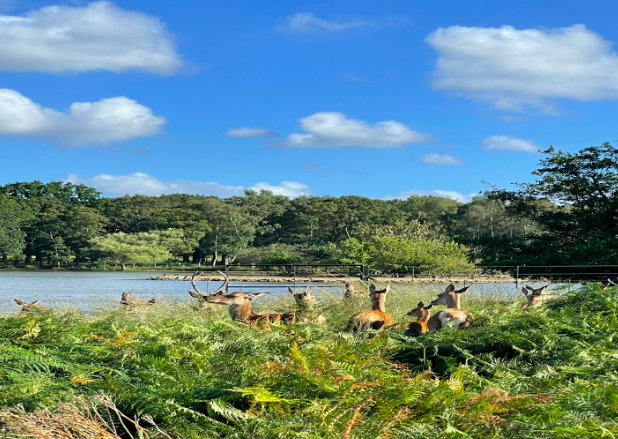
Richmond Park stands as London’s largest Park which is 955 hectares located in Kingston upon Thames. It used to be a royal hunting spot, but now Richmond Park is famous for herds of red deer. I had a chat with Emily Rodriguez, 35 years old who visits Richmond Park regularly. I ask what draws her to Richmond Park on a regular basis? She calls Richmond Park her chill spot. “I love spotting deer and feeling like I am out of the city, even though it’s right there,” she explains. So, if you’re into wild adventures without leaving the city that far, Richmond Park is your first choice
2. Bushy Park (1100 acres)
Bushy Park is renowned for its historic significance and natural richness, covering 1,100 acres in Kingston. Its similarities with Richmond Park, Bushy Park as a royal hunting ground before and habitat for deer right now. Located in Kingston upon Thames, Bushy Park dates to the 16th century. The park designated as a Site of Special Scientific Interest, is not just a haven for deer but also for a diverse range of flora and fauna. With the presence of water features like the Longford River and the picturesque Chestnut Avenue, Bushy Park offers more than just greenery. It stands as a testament to Kingston’s commitment to preserving natural landscapes while allowing visitors to immerse themselves in the history. I ask Sarah Thompson, 36, who is a Kingston resident, if there are any specific features in Bushy Park that she likes. She says: “Definitely the Diana Fountain. It’s like this hidden gem within the park. The surroundings are so calm, and you can just sit there.”
3. Regent’s Park (410 acres)
Regent’s Park is celebrated for its design and cultural significance. Originally conceived by architect John Nash, it showcases an arrangement of pathways, gardens, and water features in the heart of London. Located in the City of Westminster, Regent’s Park dates to the early 19th century and stands as a prime example of English garden-style landscaping. The Inner Circle’s rose gardens add to the park’s allure, providing visitors with diverse areas to explore. In addition, Regent’s Park is home to the world-famous London Zoo, making it a unique blend of landscapes and culture. Alex Mitchell, a 30-year-old visitor, describes the most captivating attraction. He says: “London Zoo. The diversity of animals and the conservation efforts are fascinating”.
4. Hyde Park (350 acres)
Hyde Park, sprawling across 350 acres, was established in the 16th century as a hunting ground, evolution to a public space now. Serpentine is a meandering lake that not only adds a nice landscape but also hosts boating activities. Ducks and geese are regular inhabitants of the Serpentine, who contribute to the park’s ecological diversity. They create a harmonious coexistence between urban life and wildlife. You can engage in activities or simply observe the resident waterfowl in Hyde Park. Liam Nguyen, a 24-year-old visitor, explains how he feels about the wildlife, which includes ducks and geese. “They add this natural charm. You can sit by the Serpentine, observe them going about their day, it’s a grounding experience,” he says.
5. Kensington Gardens (260 acres)
Encompassing 260 acres, Kensington Gardens is a distinguished green expanse linked to Hyde Park. It was originally conceived as the private gardens of Kensington Palace. The Sunken Garden, bursting with floral displays. The Italian Gardens features classical sculptures and fountains. They serve as a retreat within the park. Cultural landmarks like the Albert Memorial showcase the park’s diverse offerings. The Long Water, a winding lake, enriches the landscape. We asked Charlotte Turner, a 35-year-old visitor, which specific feature within Kensington Gardens stood out to her. “The Sunken Garden is enchanting. It’s this quiet corner with vibrant blooms,” she replied.
6. Greenwich Park (180 acres)
Greenwich Park is a massive 74-hectare green paradise in London. There are winding paths and many old trees. Basically, it is like having your own backyard in the heart of London city. The Royal Observatory is a landmark building. You are the timekeeper for the whole world when you stand at the Prime Meridian of the Royal Observatory. How cool is that? I chatted with James Anderson, 40, from Greenwich, about the scale of the park. “I love it, but it’s not just about the size; it is about all the things you can do here, like going for a jog by myself or visiting the Royal Observatory with my kids,” he says.