Gen Z are in the midst of a religious renaissance. They’re searching for friendship and love with the man above, but also with the person in the pew beside them
On a sunny Sunday morning, Shoreditch’s busy High Street is populated by the local milieu of young Londoners donning the newest streetwear and TikTok fashion. But rather than mooching around vintage shops on Brick Lane, a cluster of them are in the area for the midday service at Shoreditch Church.
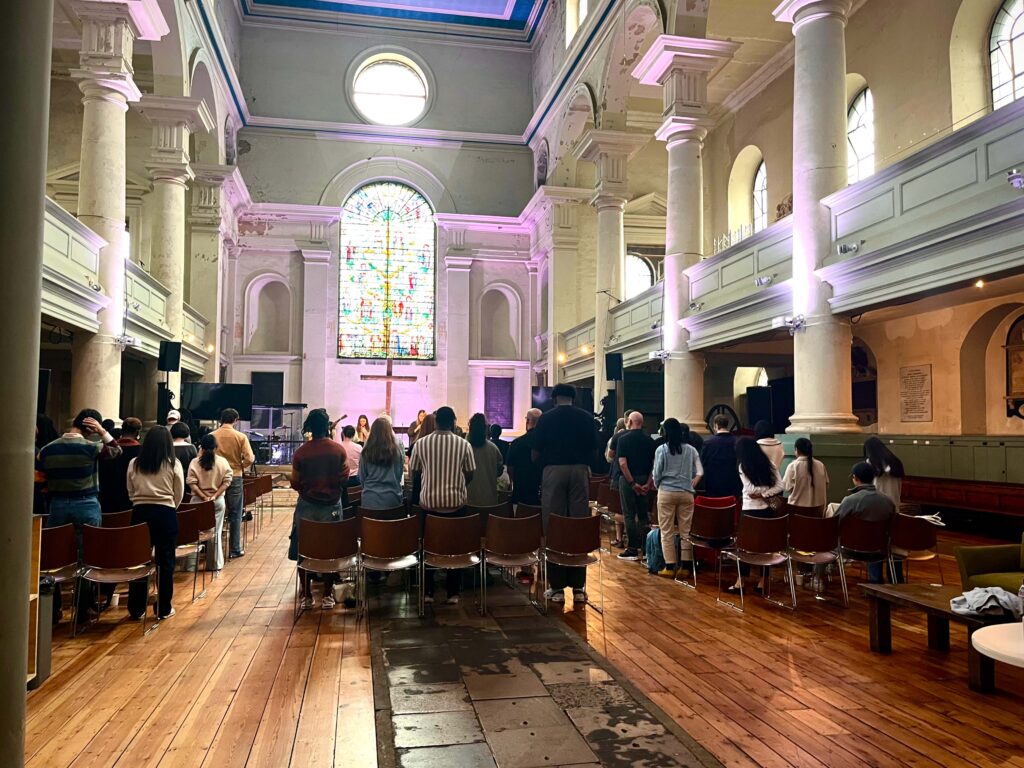
Inside, a band playing Christian pop songs fills the Grade I listed parish. At a guess, the average age of the congregation is 25-years-old, an empty cup from Blank Street coffee has been left on the chair next to me, and a girl standing in the front row is scrolling through her Instagram feed while raising her hands in the air to praise the lord.
The pastor is a young woman dressed in an oversized shirt and black leather Mary Janes, like a model for the contemporary fashion brand TOAST. She leads the sermon with an analogy relating her attendance at a Hackney running club to the joys and perils of ‘running the race with Christ.’
Sat in the back row of the congregation is Rose Johnson, a 25-year-old who was invited by a friend two months ago. “I’m quite new to faith,” she tells me. “I was at a low point in my life, feeling very empty and trying to fill that space with a lot of materialistic things and relationships that left me feeling burnt out and alone.” Then one day, Rose had the sudden urge to order a Bible. After reading it and listening to an audiobook version, it was as if “someone had finally turned the light on.”
Religion is not necessarily what one would first guess to be the latest craze amongst a generation of young people whose sacred space is their Instagram For You page. But research suggests that the Church, of all things, is now en vogue.
According to a study conducted by the Bible Society, gen Z are leading the rise in church attendance in the UK, which has increased by 50 per cent over the past six years. Last year, there was a 16 per cent increase in church going amongst those aged 18-24, and a 13 per cent increase amongst those aged 25-34. This is significantly more than the millennial generation, whose rates of church-going increased by 8 per cent for those aged 35-44.
Rose highlights the mental health crisis as a main reason why she believes religion has become such a grounding force for a generation of lonely young people. “In today’s society, everyone’s struggling with mental health and feeling very burnt out. People aren’t connecting and talking to each other, and it’s left a lot of people, myself included, lacking a sense of purpose and meaning to life,” she says.
Evidently, young people are looking for a deeper meaning in a fast-paced, technology-driven world. But what exactly is leading gen Z to flock to Christianity at rates notably higher than generations that preceded them? Is it just a passing viral fad, or are we truly experiencing a religious renaissance?
Rob Barward-Symmons, Senior Research and Impact Manager at the Bible Society, attributes this shift to the changing social conditions such as the cost-of-living crisis and the impact of the pandemic. “We are all aware of the struggles that young people are facing at the moment, particularly with mental health but also loneliness and purpose, and we know they are searching for meaning, healing, and belonging,” he says.
“Young people are finding deep meaning in their engagement with church, as well as a connection to a community which can be rare for young people in contemporary society but brings with it a deeper sense of belonging and relationship.”
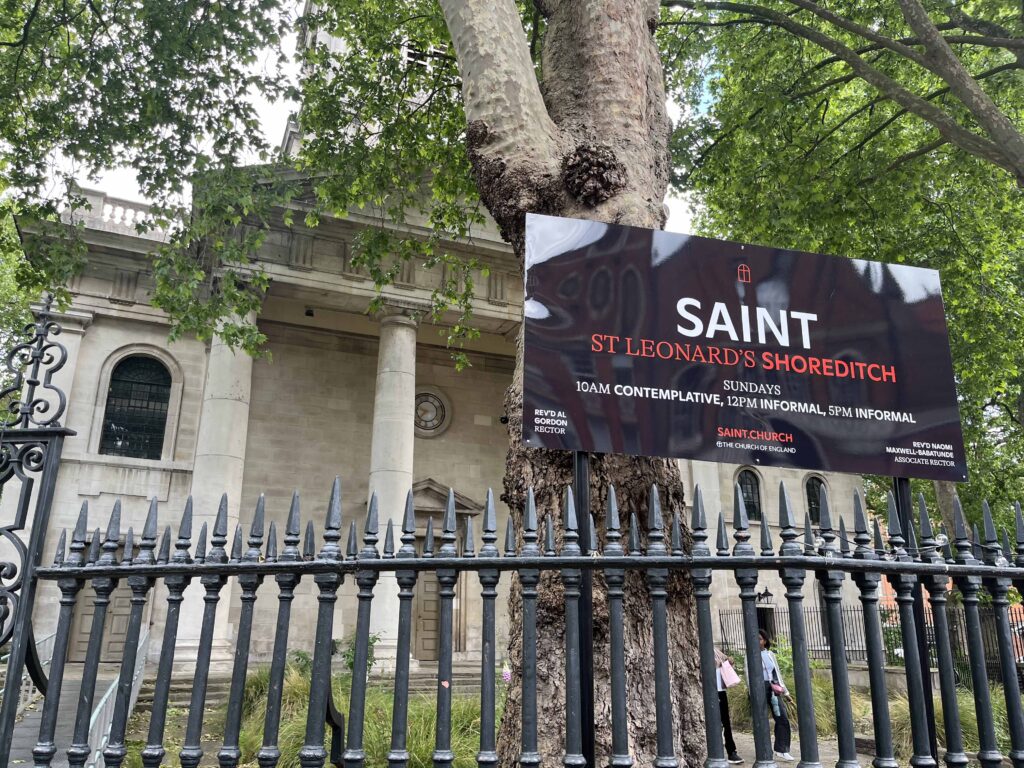
The church Rose currently attends has garnered the reputation of East London’s ‘hipster church’. Saint Church is a fast-growing, registered charity, which has taken over multiple parishes across East London. I’m told by one attendee that it’s “not quite a chain”, however, their glossy Instagram page and aesthetic branding make the company look more like a trendy coworking startup than a religious institution. Perhaps it is precisely this commercial acumen that has garnered the enthusiasm of young, hipster Christians across London.
“I know someone recently who became interested in Christianity because someone brought it up in a podcast”
Daniella Ross, a model-esque 26-year-old with vibrant dyed red-hair, works in fashion and has been attending Saint church regularly for about two-and-a-half-years. “Young people are losing purpose in life and not really sure where they belong, what their identity is,” she says. “We’ve been through the Covid-19 pandemic and all that kind of stuff, and I think people are searching for something meaningful.
“I know someone recently who became interested in Christianity because someone brought it up in a podcast,” she says. “There’s this accessibility to Christianity that other generations haven’t had, a YouTube video comes up or their favourite influencer posts about it.”
It may be no coincidence that Christianity is finding traction with a population of young people who have been coined the lonely generation. For a certain few, the church has opened a space for them to find love with the man above and the singleton sitting in the pew beside them.
Nia Lucia, 24 and Elijah Horne, 25 are recently engaged. The couple first met at church camp when they were 14-years-old. “I tried to chat Nia up at the time, and it didn’t go very well,” Elijah jokes.
“We started a relationship, and then we were kind of long-distance for a while when we were at uni. Then we moved to London three years ago and now we’re engaged,” says Nia, smiling as she twirls a gold engagement ring around her finger. The pair are set to get married in July.
For a generation of people for whom dating apps and ‘sliding into the dms’ has been the dominant mode of courtship, the religious notion of belonging has rebranded the church as a potential dating hotspot. “I am a big proponent of dating in church,” says Martin Bechmann-Hansen, a 27-year-old living in East London, aptly dressed for the hipster service in suede Birkenstock clogs and cuffed, baggy jeans.
“Where else can you find somebody who has the same values as you and the same desires in life? Church is definitely a great venue where you can find those things.” The trick to finding love in church, he says, is the same as anywhere else, “you just have to put yourself out there.”
Much of the appeal of church life in London is related to its alternative messaging that counteracts the shallowness of modern life for young people, explains Elijah. “There’s so little meaning to dating life in London, because it’s just go, go, go and do do, do,” he says. “When you go to the pub, the first thing everyone asks is what’s your job? It’s a very demanding and identity-based place. I think people end up feeling disillusioned by that,” says Elijah.
“The church, the community of it and also the message of the gospel, is about giving and generosity. That is countercultural to how London is now. The church says you can have a purpose that isn’t just about outdoing everyone else. It can be more selfless.”
However, Daniella’s search for romance through religion hasn’t been quite so easy. “I find dating within church tricky,” she says. “A lot of times, Christian men have an idea in their head of what they want their wife to be. It’s kind of like this mother, nurturing sort of person. Even though I have those qualities I don’t think men specifically see me as that. I’m quite career driven, I’m quite outgoing, I like to party and there’s nothing wrong with that.”
“Ultimately, I plan on being with someone who has the same beliefs as me, just because I think the more you have in common when it comes to your lifestyles and morals, the easier the relationship is. But I think sometimes, maybe this isn’t my dating pool.”
For Nia and Elijah, the lessons of Christianity have been the fundamental underpinning of their relationship. “I think it helped us to have the same values,” says Nia. “Being part of a community and caring about people, church is about giving, not just taking, so it’s informed our relationship in that way.”
As the couple move into the next stage in their lives, Elijah tells me that they’re looking to move on from Saint Church and find another parish which is more ‘family-oriented’. Certainly, there will be plenty more religiously curious young people coming through the door behind them, with an iPhone, Stanley Cup and copy of the Holy Bible in hand.